
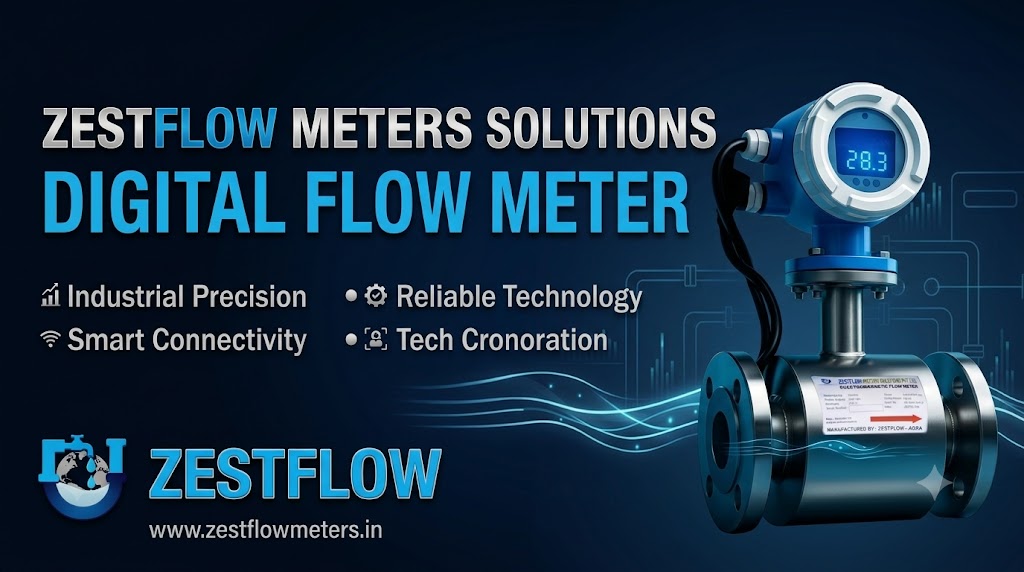
What Is a Digital Flow Meter?
A Digital Flow Meter is an advanced measuring instrument used to determine the flow rate or quantity of a liquid, gas, or other process fluid passing through a pipeline. Unlike traditional mechanical meters that depend on moving components, many modern digital flow meters use electronic sensors, transmitters, and digital displays to measure and communicate flow information.
Digital flow meters are increasingly used in water treatment plants, industrial manufacturing, irrigation systems, chemical industries, pharmaceuticals, food processing, utilities, and many other applications where accurate flow measurement is important.
For industries handling water and other conductive liquids, electromagnetic digital flow meters are particularly useful. An electromagnetic flow meter works according to Faraday’s Law of Electromagnetic Induction. When a conductive liquid moves through a magnetic field, it generates a voltage that is proportional to the velocity of the liquid. Electrodes detect this voltage, and the transmitter processes the signal to calculate flow.
Zestflow Meters Solutions provides digital and electromagnetic flow measurement solutions designed for applications such as water management, wastewater treatment, industrial processing, irrigation, and infrastructure projects. Its product range includes electromagnetic flow meters, digital water flow meters, IoT-based flow meters, and other flow measurement instruments.
How Does a Digital Flow Meter Work?
The working principle of a Digital Flow Meter depends on the technology used inside the instrument. Different flow meters may use electromagnetic, ultrasonic, vortex, turbine, variable-area, or other measurement technologies.
For conductive-liquid applications, an electromagnetic digital flow meter is one of the most widely used solutions.
The basic working process is:
- The liquid enters the measuring pipe.
- A magnetic field is generated inside the flow tube.
- The moving conductive liquid passes through the magnetic field.
- An electrical voltage is generated.
- Electrodes detect the induced voltage.
- The transmitter processes the signal.
- The calculated flow rate is shown on the digital display.
Depending on the model, the flow data can also be transferred to PLC, SCADA, telemetry, or other monitoring systems.
The induced voltage is related to liquid velocity, while the known pipe cross-sectional area allows the instrument to calculate volumetric flow.
This electronic method makes digital flow measurement highly useful for modern process automation because the measured information can be displayed, recorded, transmitted, and integrated into control systems.
What Is an Electromagnetic Digital Flow Meter?
An electromagnetic digital flow meter, commonly called a magnetic flow meter or mag meter, measures the flow of electrically conductive liquids using electromagnetic induction.
It generally consists of a measuring tube, liner, electrodes, magnetic coils, and an electronic transmitter. The coils create a magnetic field across the measuring tube, while the electrodes sense the voltage generated by the flowing conductive liquid.
One important characteristic is that electromagnetic flow meters have no rotating mechanical parts inside the flow path. This can reduce mechanical wear and make them suitable for applications involving water, wastewater, slurries, and certain aggressive or corrosive liquids.
Zestflow describes its electromagnetic flow meter solutions as suitable for conductive liquids and applications, including water treatment, chemical processing, food and beverage, and pharmaceutical manufacturing.
Main Components of a Digital Flow Meter
A digital flow meter contains several important components that work together to produce a reliable flow reading.
1. Flow Sensor
The sensor is the part installed in the pipeline where the fluid passes through. Its design depends on the measurement technology.
In an electromagnetic flow meter, the sensor includes the measuring tube, electrodes, lining, and magnetic field components.
2. Electrodes
In electromagnetic flow meters, electrodes detect the electrical voltage generated when conductive liquid moves through the magnetic field.
Correct electrode construction and positioning are important for obtaining stable measurements.
3. Magnetic Coils
Electromagnetic flow meters use coils to create the magnetic field required for measurement. The moving conductive liquid interacts with this field and generates a measurable electrical signal.
4. Digital Transmitter
The transmitter is responsible for processing the sensor signal and converting it into useful flow information.
A transmitter can provide values such as instantaneous flow rate and accumulated flow depending on the meter configuration.
5. Digital Display
The digital display allows operators to view measurements directly from the instrument.
Depending on the model, the display may provide flow rate, totalized flow, units, diagnostic information, and other parameters.
6. Communication Interface
Advanced digital flow meters can support communication with industrial automation systems. Depending on the model and configuration, communication may include pulse, analog, RS485, telemetry, or other digital interfaces.
Zestflow also promotes solutions that can connect flow measurement with PLC, SCADA, IoT, and remote monitoring systems.
Key Benefits of a Digital Flow Meter
Digital flow meters offer several advantages over conventional mechanical flow measurement methods.
- Accurate Flow Measurement
One of the biggest reasons industries choose digital flow meters is their ability to provide precise and repeatable measurement when correctly selected, installed, and calibrated.
Accurate flow measurement can help organizations monitor consumption, improve process control, identify abnormal flow conditions, and reduce unnecessary losses.
- Real-Time Digital Display
Operators can see the measured flow directly on the instrument’s display. This makes routine monitoring easier and can reduce the need for manual calculation or interpretation of mechanical scales.
- No Mechanical Moving Parts in Electromagnetic Models
Electromagnetic flow meters do not require a rotating impeller or turbine inside the pipe. This can reduce mechanical wear and make the meter suitable for liquids containing suspended particles, provided the application meets the meter’s specifications.
- Suitable for Water and Wastewater
Water and wastewater are among the common applications for electromagnetic flow measurement. Zestflow highlights water treatment, wastewater, municipal water distribution, irrigation, and industrial water management among relevant applications for its flow measurement solutions.
- Easy Integration with Automation
Modern digital flow meters can be integrated with automation and monitoring systems. This allows organizations to use flow data for process control, data logging, alarms, reporting, and remote monitoring.
- Remote Monitoring
Some digital flow measurement solutions can transmit information through telemetry or web-based systems. Zestflow offers electromagnetic flow meter solutions with GPRS/web-based data transmission for applications requiring remote monitoring.
- Reduced Maintenance
Because electromagnetic meters have no moving components in the measuring section, they require less mechanical maintenance than meters that rely on rotating parts.
However, proper installation, electrical connections, grounding, cleaning where necessary, and periodic verification remain important.
Where Are Digital Flow Meters Used?
Digital flow meters have applications across many industries.
- Water Treatment Plants
Water treatment facilities need reliable flow measurement to monitor raw water, treated water, process water, and distribution lines.
Digital flow meters can provide continuous measurement and can be connected to plant monitoring systems.
- Wastewater Treatment
Wastewater can contain suspended solids and other contaminants. Electromagnetic flow meters are often considered for wastewater applications because they have no rotating measurement element in the flow path.
- Industrial Water Management
Factories use water for cooling, processing, cleaning, and other operations. Measuring water flow helps companies understand consumption and manage processes more effectively.
- Irrigation
Agricultural and irrigation systems can use digital flow meters to monitor water delivery through pipelines.
Accurate flow data can help operators understand how much water is being supplied to different sections of an irrigation network.
- Chemical Industries
Chemical plants often require flow measurement for process liquids. Meter materials, lining, electrodes, pressure rating, temperature rating, and chemical compatibility must be selected according to the actual fluid and operating conditions.
- Food and Beverage
Flow measurement can be used for water, process liquids, cleaning systems, and other fluid-handling applications. Hygienic requirements and material compatibility should be considered when selecting a meter.
- Pharmaceutical Industry
Pharmaceutical processes often require carefully controlled fluid measurement. The meter selection should be based on process requirements, hygiene requirements, fluid characteristics, and applicable standards.
- Municipal Water Distribution
Municipal water systems need flow measurement for distribution monitoring, consumption management, network analysis, and infrastructure control.
Digital Flow Meter vs. Traditional Mechanical Flow Meter
The major difference between digital and mechanical flow measurement is the method used to detect and process flow.
A mechanical meter may use components such as turbines, gears, impellers, or floats. A digital meter uses electronic sensing and signal processing.
For example, an electromagnetic flow meter measures the voltage generated by conductive fluid moving through a magnetic field rather than relying on a rotating mechanical component.
- Digital Flow Meter Advantages
- Digital display
- Electronic signal processing
- Real-time measurement
- Easy data integration
- Potential remote monitoring
- No moving parts in electromagnetic designs
- Suitable for automation systems
- Useful for continuous industrial monitoring
The best choice depends on the application. A digital electromagnetic flow meter is not automatically suitable for every fluid because the liquid must meet the conductivity requirements of electromagnetic measurement.
Why Choose Zestflow Meters Solutions for Digital Flow Measurement?
Zestflow Meters Solutions focuses on industrial instrumentation and flow measurement solutions for different sectors. Its portfolio includes electromagnetic flow meters, digital water flow meters, IoT-based flow meters, ultrasonic flow meters, turbine flow meters, and other measurement instruments.
The company highlights several features across its flow measurement solutions, including digital monitoring, customization, industrial-grade construction, remote data access, and integration with automation systems.
For customers looking for a Digital Flow Meter Manufacturer in India, choosing a supplier that understands the application is important. The correct flow meter should be selected according to fluid characteristics, pipe size, flow range, pressure, temperature, installation conditions, and communication requirements.
Zestflow can provide flow measurement solutions for water management, industrial processing, wastewater, irrigation, and other applications.
How Digital Flow Meters Support Smart Water Management
Water management is becoming increasingly data-driven. Organizations need to know how much water enters a facility, how much is consumed, where losses may occur, and how distribution systems are performing.
A digital flow meter can act as an important data source in this process.
When connected to a suitable monitoring or telemetry platform, flow information can be collected at regular intervals and used for analysis. Remote monitoring can reduce the need for frequent manual meter readings and provide operators with better visibility into water usage.
Zestflow’s product information describes digital and web-based flow measurement solutions that can transmit data for remote monitoring applications.
Digital Flow Meter for Industrial Automation
Modern factories increasingly use PLC, SCADA, IoT, and other automation technologies.
A digital flow meter can provide a continuous measurement signal to these systems. The data can then be used to:
- Monitor production processes
Control pumps and valves
Track water consumption - Detect unusual flow conditions
- Generate alarms
- Record historical flow data
- Support preventive maintenance
- Improve process efficiency
This makes digital flow measurement more than simply displaying a number. It can become part of an integrated industrial control and monitoring system.
Maintenance Tips for Digital Flow Meters
Although many digital flow meters are designed for reliable industrial operation, proper maintenance is still important.
- Check Electrical Connections
Inspect connections periodically and ensure that cables and terminals are properly secured.
- Verify Grounding
Electromagnetic flow meters require appropriate grounding and installation practices to maintain signal quality.
- Inspect the Pipeline
Make sure the installation remains mechanically secure and that the meter is not exposed to conditions beyond its rated specifications.
- Monitor Readings
Unexpected changes in flow can sometimes indicate process problems, leakage, blockage, pump issues, or instrumentation problems.
- Follow Manufacturer Guidelines
Always follow the manufacturer’s installation, commissioning, calibration, and maintenance instructions for the specific meter model.
Conclusion
So, what is a digital flow meter?
It is an electronic flow measurement instrument designed to provide accurate and convenient monitoring of fluid movement through pipelines. Depending on its technology, a digital flow meter can measure flow using electromagnetic, ultrasonic, turbine, vortex, or other principles.
For conductive liquids such as water and wastewater, electromagnetic digital flow meters are an important option. They use Faraday’s Law of Electromagnetic Induction to determine fluid velocity and calculate volumetric flow. Their digital displays, electronic signal processing, automation connectivity, and potential remote-monitoring capabilities make them valuable for modern industrial and water management applications.
Zestflow Meters Solutions offers digital and electromagnetic flow measurement solutions for a wide range of industrial and water-related applications. With options for digital monitoring, automation integration, and remote data transmission, Zestflow aims to provide practical flow measurement solutions for customers across India.
If you are searching for a Digital Flow Meter Manufacturer in India, selecting the right meter according to your fluid, pipeline, flow range, installation conditions, and monitoring requirements is essential for dependable long-term performance.