
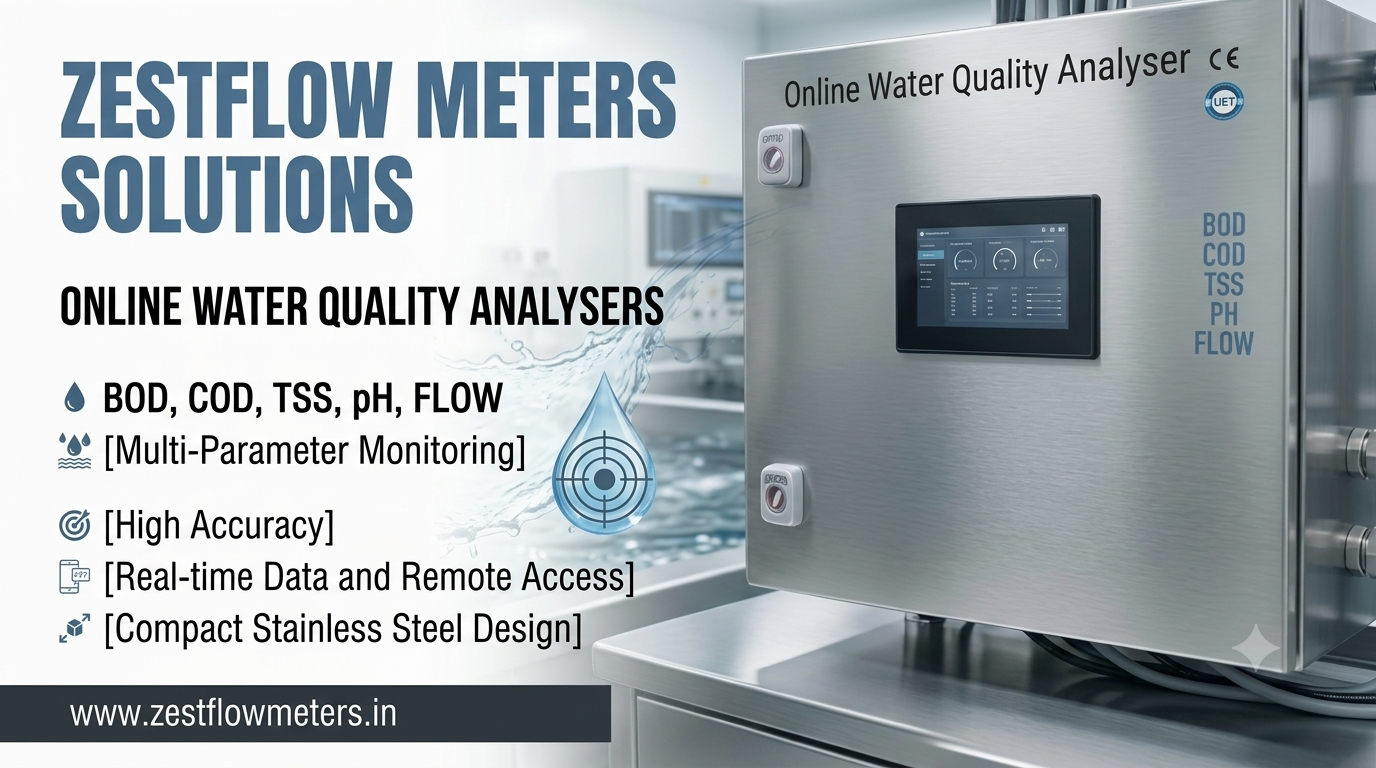
How Online Water Quality Analysers Improve Water Quality Monitoring
Introduction
Water quality monitoring is an essential part of modern industrial, municipal, environmental, and wastewater management systems. As industries become more dependent on efficient water treatment and resource management, continuous monitoring has become increasingly important. Traditional laboratory testing can provide valuable information, but it may not offer the immediate data required to identify sudden changes in water quality.
This is where Online Water Quality Analysers play an important role. These advanced monitoring systems are designed to measure important water quality parameters continuously and provide real-time information to operators. Depending on the configuration, an online water analyser can monitor parameters such as pH, dissolved oxygen, turbidity, conductivity, total suspended solids, COD, BOD, temperature, and other water-quality indicators.
Zestflow Meters Solutions provides advanced measurement and monitoring solutions for water and industrial applications. Its product portfolio includes flow meters, water meters, IoT-based flow meters, water level recorders, analytical instruments, and online water analysers.
In this blog, we will understand what online water quality analysers are, how they work, their major benefits, applications, important parameters, and why businesses should consider real-time water quality monitoring.
What Are Online Water Quality Analysers?
Online Water Quality Analysers are instruments or integrated monitoring systems designed to continuously measure selected physical, chemical, or biological characteristics of water.
Unlike periodic manual sampling, an online analyser can remain connected to a water stream, process line, treatment system, or sampling arrangement and continuously collect measurements. The resulting information can help operators understand changes in water quality and take timely corrective action.
Modern online water monitoring systems may combine sensors, analysers, controllers, data logging, communication interfaces, alarms, and software platforms. Depending on the application, the system can be configured for individual parameters or multiple parameters.
For example, online monitoring can be used in:
- Effluent Treatment Plants (ETPs)
- Sewage Treatment Plants (STPs)
- Drinking water treatment systems
- Industrial process water systems
- Wastewater treatment facilities
- Environmental monitoring
- Water distribution systems
- Manufacturing plants
- Research and laboratory facilities
- Agricultural and irrigation applications
Online water analysis technologies can support continuous monitoring across municipal, wastewater, and industrial applications.
Why Real-Time Water Quality Monitoring Is Important
Water quality can change because of variations in raw water, industrial processes, chemical dosing, biological activity, temperature, contamination, or treatment performance.
If water is tested only occasionally, an important change may remain undetected between sampling periods. Continuous monitoring provides a more immediate view of process conditions.
For example, if the pH of wastewater suddenly changes, an online analyser can identify the variation much sooner than a periodic laboratory test. Operators can then investigate the cause and make appropriate process adjustments.
Real-time monitoring can therefore help organizations:
- Detect abnormal water conditions
- Improve treatment control
- Reduce process variability
- Monitor treatment performance
- Identify potential contamination
- Improve operational efficiency
- Support compliance requirements
- Maintain better records of water quality
Online analysers are specifically designed to provide continuous measurements and can monitor multiple parameters depending on the system configuration.
Important Parameters Measured by Online Water Analysers
The parameters measured by an online system depend on the analyser model, sensor technology, application, and monitoring requirements.
1. pH
pH is one of the most common water quality parameters. It indicates whether water is acidic, neutral, or alkaline.
Continuous pH monitoring can be particularly useful in wastewater treatment and industrial processes where chemical dosing and treatment performance depend on maintaining an appropriate pH range.
2. Dissolved Oxygen
Dissolved oxygen (DO) measurement is important in biological wastewater treatment and other applications where oxygen availability affects the process.
Monitoring DO continuously can help operators understand aeration conditions and optimize treatment processes.
3. Turbidity
Turbidity indicates the presence of suspended particles that affect the clarity of water.
Continuous turbidity monitoring can be useful in drinking water treatment, wastewater treatment, surface-water monitoring, and industrial applications.
4. Total Suspended Solids
Total Suspended Solids (TSS) measurement helps determine the concentration of suspended material in water.
TSS monitoring can support wastewater treatment operations and help operators evaluate treatment efficiency.
5. Conductivity and TDS
Electrical conductivity can provide information about the ionic content of water. TDS, or Total Dissolved Solids, is another important indicator used in many water treatment and industrial applications.
Monitoring these parameters can help identify changes in water composition and process conditions.
6. COD and BOD
Chemical Oxygen Demand (COD) and Biochemical Oxygen Demand (BOD) are important parameters for wastewater applications.
Depending on the analyser technology, online systems can be configured to monitor organic pollution indicators and provide continuous or frequent process information.
7. Temperature
Temperature affects many physical, chemical, and biological processes in water.
Combining temperature data with other parameters can provide a better understanding of changing water conditions.
8. Other Parameters
Depending on the analyser configuration, online systems may also monitor parameters such as:
- Ammonia
- Chlorine
- Phosphate
- Silica
- Total Organic Carbon (TOC)
- ORP
- Nitrate
- Salinity
- Colour
- Other application-specific parameters
Different online analyser technologies support different measurement ranges and parameters, so users should select a system according to their actual monitoring requirements.
How Do Online Water Quality Analysers Work?
The working principle depends on the parameter being measured and the sensor or analytical technology used.
A typical online monitoring setup may include the following stages:
Step 1: Water Sampling
Water is brought to the sensor or analyser through a direct installation or a sampling arrangement.
Step 2: Parameter Detection
The sensor or analyser detects the selected water quality parameter. Different parameters may require different technologies, including electrochemical, optical, colorimetric, electrode-based, or other analytical methods.
Step 3: Signal Processing
The instrument processes the sensor signal and converts it into a readable measurement.
Step 4: Display and Data Logging
The measurement can be displayed locally and, depending on the system, stored for historical analysis.
Step 5: Communication
Advanced systems may provide communication interfaces for integration with PLC, SCADA, cloud platforms, or other monitoring systems.
Step 6: Alerts and Process Control
Where supported, alarm functions can notify operators when measurements move outside configured limits. This can help teams respond quickly to process changes.
Benefits of Online Water Quality Analysers
- Continuous Monitoring
The biggest advantage is continuous monitoring. Instead of depending entirely on periodic sampling, operators can receive frequent or real-time information about water conditions.
- Faster Detection of Problems
Sudden changes in pH, turbidity, dissolved oxygen, conductivity, or other parameters can potentially be detected much earlier.
- Better Treatment Control
Real-time information allows operators to make more informed process adjustments and monitor whether treatment changes are producing the desired results.
- Reduced Dependence on Manual Sampling
Laboratory testing remains important for many applications, but online monitoring can complement manual testing by providing continuous process information.
- Improved Operational Efficiency
Consistent monitoring can help organizations identify process variations, optimize treatment operations, and reduce unnecessary resource consumption.
- Data Logging and Analysis
Digital monitoring systems can record historical measurements. This information can help teams identify trends, investigate process changes, and prepare operational reports.
- Remote Monitoring
Depending on the system architecture, online analysers can be integrated with digital communication and remote monitoring platforms. Zestflow also focuses on IoT-based measurement solutions that support real-time data tracking and remote monitoring.
Applications of Online Water Quality Analysers
- Water Treatment Plants
Online analysers can help monitor treated and raw water parameters throughout a treatment process.
Continuous monitoring can support better process control and help operators identify changes in water quality.
- Effluent Treatment Plants
ETPs need consistent monitoring to evaluate the quality of industrial wastewater before and after treatment.
Online analysis can provide information about parameters such as pH, COD, BOD, TSS, turbidity, and other application-specific measurements.
- Sewage Treatment Plants
STPs can use online monitoring to track treatment performance and observe changes in wastewater characteristics.
- Industrial Manufacturing
Industries such as pharmaceuticals, chemicals, food processing, textiles, and other manufacturing sectors may need water quality monitoring at different points in their processes.
- Environmental Monitoring
Online monitoring systems can be used for environmental water quality applications where continuous information is valuable.
- Drinking Water Systems
Water treatment and distribution operations can use online analysers to monitor selected quality indicators and support consistent water management.
Factors to Consider When Selecting an Online Water Analyser
Choosing the right analyser requires understanding the actual application.
- Measurement Parameters
First, identify which parameters need to be monitored. A system designed for pH monitoring will be different from a multi-parameter analyser measuring pH, COD, TSS, turbidity, and other indicators.
- Installation Environment
Consider water temperature, pressure, suspended solids, chemical composition, flow conditions, and other environmental factors before selecting the system.
- Maintenance Requirements
Sensors require appropriate cleaning, calibration, inspection, and maintenance. Select an analyser that fits the available maintenance resources and operating conditions.
- Communication and Data Integration
For modern industrial plants, communication capabilities can be important. Consider whether the analyser can integrate with PLC, SCADA, data logging, IoT, or remote monitoring systems.
- Calibration
Reliable measurements depend on proper calibration and maintenance. Users should follow the manufacturer’s recommended calibration procedures.
- Technical Support
Choose a supplier that can provide application guidance, installation support, calibration assistance, maintenance information, and after-sales service.
Why Choose Zestflow Meters Solutions?
Zestflow Meters Solutions is a manufacturer and supplier of measurement and monitoring solutions for water management and industrial applications. Its portfolio includes electromagnetic flow meters, AMR water meters, IoT-based flow meters, water meters, water level recorders, analytical instruments, and online water analysers.
The company focuses on accuracy, reliability, and application-oriented instrumentation. Its solutions are intended for sectors including water management, wastewater treatment, agriculture, industrial processing, and infrastructure applications.
For organizations evaluating Online Water Quality Analysers, selecting equipment based on the required parameters, operating environment, accuracy, integration requirements, and maintenance needs is essential.
Zestflow’s online water analyser solution includes measurement capabilities for parameters such as COD, TSS, pH, and flow, with specifications depending on the selected configuration.
The Role of Smart Water Monitoring
Water monitoring is increasingly moving toward connected and data-driven systems.
An online analyser can become part of a larger digital monitoring ecosystem by connecting sensors, instruments, communication systems, data platforms, and control systems.
When combined with IoT technology, real-time water data can potentially be viewed remotely, stored for historical analysis, and used to identify trends.
This approach can help organizations move from reactive water management toward proactive process management.
Maintenance Tips for Online Water Quality Analysers
Regular maintenance is essential for maintaining reliable measurements.
Important practices include:
1. Clean sensors according to the manufacturer’s instructions.
2. Calibrate sensors at recommended intervals.
3. Inspect sampling lines and connections.
4. Check for fouling, scaling, or suspended material.
5. Verify sensor readings against appropriate reference measurements.
6. Inspect cables, connectors, and communication interfaces.
7. Maintain proper data logging and backup procedures.
8. Replace consumable components when required.
9. Keep maintenance records.
10. Follow the manufacturer’s operating instructions.
Proper maintenance can help extend equipment life and maintain measurement reliability.
Future of Online Water Quality Monitoring
The future of water quality monitoring is increasingly connected with automation, IoT, remote data access, advanced sensors, and intelligent analytics.
Instead of simply collecting measurements, modern monitoring systems can help organizations understand trends and respond to changing process conditions.
As industries continue to focus on water conservation, environmental responsibility, operational efficiency, and data-driven decision-making, demand for continuous monitoring technologies is expected to remain important.
Conclusion
Online Water Quality Analysers are becoming an important part of modern water and wastewater monitoring. By providing continuous information about important parameters, these systems can help organizations improve process visibility, identify changes quickly, optimize treatment operations, and support better water management.
From water treatment plants and ETPs to STPs and industrial processes, real-time analysis can provide valuable operational information that periodic testing alone may not deliver.
Zestflow Meters Solutions offers measurement and monitoring solutions for water and industrial applications, including online water analyser systems, flow meters, water meters, IoT-based monitoring solutions, and water level recorders.
If your organization needs a reliable solution for continuous water quality monitoring, evaluate your required parameters, operating conditions, accuracy requirements, communication needs, and maintenance expectations before selecting an analyser. The right monitoring system can become an important component of efficient, reliable, and data-driven water management.