
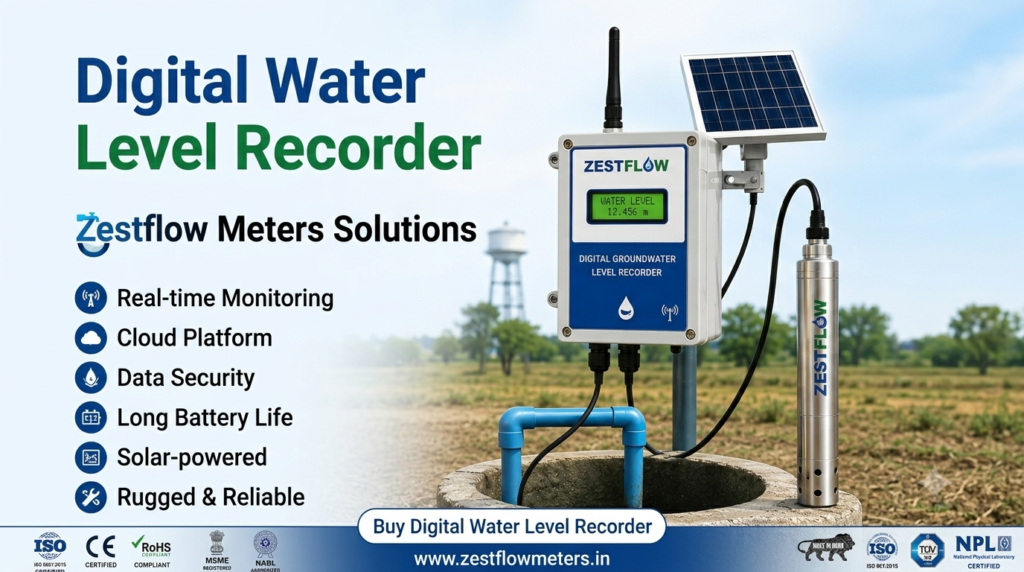
Digital Water Level Recorder for Accurate Groundwater Monitoring
Digital Water Level Recorder for Accurate Groundwater Monitoring
Water is one of the most valuable natural resources, and effective monitoring is essential for sustainable water management. Groundwater supports agriculture, industries, infrastructure projects, municipalities, and domestic water requirements. However, groundwater levels can change because of seasonal rainfall, excessive extraction, industrial consumption, irrigation, and changing environmental conditions. For this reason, accurate and continuous water-level monitoring has become increasingly important.
A Digital Water Level Recorder is an advanced instrument designed to measure and record changes in water levels over time. Instead of depending entirely on manual measurements, digital recording technology allows users to collect consistent data at predefined intervals. This information can help engineers, researchers, environmental professionals, industries, and water-resource managers understand groundwater behavior and make better decisions.
Zestflow Meters Solutions provides advanced measurement and monitoring solutions for water-management applications. Its published product range includes water-level recorders and groundwater monitoring equipment designed for applications where reliable level measurement and data recording are important.
What Is a Digital Water Level Recorder?
A Digital Water Level Recorder is an electronic monitoring device used to measure, store, and analyze changes in water level. It is commonly installed in borewells, observation wells, groundwater monitoring stations, reservoirs, and other water bodies where regular level measurements are required.
Modern systems can use pressure-based sensing technology. In a typical arrangement, a submersible pressure sensor is placed inside the well below the water surface. The sensor detects changes in water pressure, and the system converts these measurements into corresponding water-level information.
Zestflow’s published Digital Groundwater Level Recorder combines a data logger with a submersible pressure transducer. The sensor is installed inside the well, where pressure variations are monitored and converted into changes in water level. The system also includes features such as continuous data storage, programmable recording intervals, USB communication, and an LCD display.
This makes digital recording particularly useful for applications where water levels need to be monitored repeatedly over days, months, or longer periods.
Why Is Groundwater Level Monitoring Important?
Groundwater levels provide important information about the condition of underground water resources. A single manual measurement may show the water level at one particular moment, but long-term monitoring can reveal patterns and trends.
For example, regular measurements can help identify:
- Seasonal changes in groundwater levels
- Effects of rainfall and recharge
- Increased groundwater extraction
- Changes caused by irrigation
- Long-term groundwater depletion
- Recovery of groundwater after rainfall
- Impact of industrial water consumption
- Changes in groundwater conditions around construction projects
Continuous monitoring therefore provides a much more useful picture than occasional manual measurements.
A digital recorder can collect readings according to a selected time interval. This creates a historical database that can be reviewed later for analysis, reporting, planning, and resource management.
How Does a Digital Water Level Recorder Work?
The working principle of a Digital Water Level Recorder depends on the sensor technology used by the instrument. Pressure-based groundwater level recorders are commonly designed around a submersible pressure transducer and data logger.
The basic process can be explained in several steps:
1. Sensor Installation
The sensor is lowered into a borewell, observation well, or other monitoring location. It is positioned at an appropriate depth so that it remains submerged while measurements are being taken.
2. Pressure Measurement
The submerged sensor detects water pressure. As the water level changes, the pressure acting on the sensor also changes.
3. Data Conversion
The instrument processes the sensor signal and converts it into useful water-level information.
4. Data Recording
The built-in data logger stores readings according to the programmed measurement interval. Some systems allow users to configure the recording frequency according to the monitoring requirements.
5. Data Transfer
Depending on the model, recorded information can be transferred through available communication methods for further analysis. Zestflow’s published model, for example, specifies USB communication and data output in an Excel-compatible format.
6. Analysis and Reporting
The collected data can be used to create groundwater-level charts, identify trends, compare seasonal variations, and support water-management decisions.
Key Features of a Digital Water Level Recorder
The right features depend on the project and application, but several capabilities are particularly valuable in modern groundwater monitoring equipment.
- High Measurement Accuracy
Accurate measurement is essential when small changes in groundwater level can influence engineering or environmental decisions. Zestflow’s published Digital Groundwater Level Recorder lists an accuracy of 0.25% full scale.
- Built-In Data Logger
A built-in logger allows measurements to be stored automatically instead of requiring an operator to record every reading manually.
- Programmable Recording Intervals
Different projects have different monitoring requirements. A programmable recording interval allows users to select an appropriate frequency for collecting water-level readings. Zestflow states that its recorder supports user-programmable storage intervals.
- Digital Display
An LCD display can make it easier for operators to check information directly from the instrument during inspection or maintenance.
- USB Communication
Digital communication simplifies the process of transferring stored measurements from the recorder to a computer for analysis and documentation.
- Low Power Consumption
Low power consumption is particularly important for remote monitoring locations where frequent battery replacement or maintenance can be inconvenient.
- Corrosion-Resistant Construction
Groundwater environments can expose instruments to moisture and potentially corrosive conditions. A corrosion-resistant sensor housing can help improve equipment durability. Zestflow’s published specifications mention stainless-steel wetted materials and corrosion-resistant sensor housing.
Applications of Digital Water Level Recorders
A Digital Water Level Recorder can be used across a variety of water-monitoring applications.
1. Groundwater Monitoring
Groundwater agencies, researchers, consultants, and environmental organizations can use digital recorders to monitor water-level fluctuations in observation wells.
2. Borewell Monitoring
Borewells used for agriculture, industry, infrastructure, and water supply can benefit from regular water-level monitoring. Automated recording reduces the need for repeated manual measurements.
3. Agriculture and Irrigation
Agricultural water consumption can have a significant effect on groundwater levels. Monitoring helps farmers, irrigation professionals, and water managers understand water availability and changes over time.
4. Construction Projects
Large construction projects may require groundwater monitoring, especially where excavation, foundations, basements, or underground structures can interact with the water table.
5. Environmental Research
Researchers can use historical water-level datasets to study groundwater behavior, seasonal patterns, recharge, and long-term changes.
6. Water Resource Management
Government agencies and water-management organizations can use recorded data to support groundwater assessment and resource-planning activities.
7. Industrial Applications
Industries that use groundwater as part of their operations can monitor water levels to better understand resource availability and support responsible water management.
Digital vs. Manual Water Level Monitoring
Traditional manual measurement methods can be useful for basic monitoring, but they require personnel to visit the monitoring location repeatedly.
Benefits of Using a Digital Water Level Recorder
There are several reasons organizations are moving toward digital groundwater monitoring solutions.
- Better Data Quality
Automated measurements reduce the possibility of errors associated with manually reading and recording water levels.
- Reduced Field Visits
When the recorder stores measurements automatically, personnel do not need to visit the monitoring location for every individual reading.
- Long-Term Data Availability
Stored historical data can be used to compare water levels across different periods.
- Improved Decision-Making
Reliable data allows engineers and water-resource professionals to make decisions based on actual measurements rather than assumptions.
- Efficient Monitoring
Automated recording improves monitoring efficiency, particularly when multiple wells or locations need to be observed.
- Easy Data Analysis
When recorded data can be transferred to a computer or spreadsheet, it becomes easier to create graphs, compare readings, and prepare reports.
How to Choose the Right Digital Water Level Recorder
Before purchasing a Digital Water Level Recorder, users should evaluate the requirements of their project.
- Measurement Range
Choose a suitable measurement range based on the expected water depth and monitoring conditions.
- Accuracy
Select an instrument with an accuracy level appropriate for the application.
- Data Storage
Consider how many readings the device can store and whether the memory is sufficient for the planned monitoring period.
- Recording Interval
Check whether the instrument allows programmable measurement intervals.
- Communication
USB, GSM, GPRS, or other communication options may be useful depending on whether data needs to be retrieved locally or remotely. Some Zestflow-related specifications available online also list GSM/GPRS communication for certain measurement instruments, demonstrating that communication options can vary by model.
- Environmental Protection
Consider enclosure protection, sensor materials, temperature range, moisture resistance, and corrosion resistance.
- Installation Requirements
The sensor diameter, cable arrangement, well dimensions, mounting method, and installation depth should all be checked before purchasing.
- Data Format
A recorder that provides data in a convenient format can simplify analysis and reporting. Zestflow’s published groundwater recorder information specifies Excel-format data output.
Why Choose Zestflow Meters Solutions?
Zestflow Meters Solutions focuses on measurement, monitoring, and instrumentation solutions for industrial and water-management applications. Its product portfolio includes flow meters, water meters, IoT-based flow meters, water-level recorders, and other instrumentation products.
The company also highlights accuracy, reliability, customized solutions, and advanced monitoring technologies as important parts of its product approach.
For organizations looking for groundwater monitoring equipment, Zestflow’s water-level recording solutions can be considered for applications involving borewells, groundwater monitoring, infrastructure projects, and water-resource management.
When selecting equipment, users should always discuss their exact application requirements with the supplier. Factors such as well depth, expected water-level range, required accuracy, recording frequency, environmental conditions, communication requirements, and data-management needs can influence the appropriate model.
Conclusion
Groundwater is a critical resource, and accurate monitoring is an important part of responsible water management. A Digital Water Level Recorder provides a practical way to automatically measure and record changes in groundwater levels, reducing dependence on frequent manual measurements and creating useful historical datasets.
From borewell monitoring and agriculture to construction, environmental research, industrial applications, and water-resource management, digital water-level monitoring can provide valuable information for planning and decision-making.
Zestflow Meters Solutions offers water-level recording and measurement solutions designed for modern monitoring requirements. Its published Digital Groundwater Level Recorder combines pressure-based sensing, data logging, programmable recording intervals, digital communication, and a display to support efficient groundwater monitoring.
If your organization needs reliable groundwater-level monitoring equipment, evaluate the required measurement range, accuracy, storage capacity, communication requirements, and installation conditions before selecting the right solution.