Top IoT Based Digital Water Metering System Supplier in India
Introduction
Water is one of the most important resources for residential communities, industries, commercial facilities, agriculture, and municipal infrastructure. As water demand continues to increase, organizations need better ways to measure consumption, identify losses, monitor distribution, and improve overall efficiency. Traditional water meters can provide basic consumption information, but modern water-management requirements increasingly demand connected and remotely accessible solutions.
This is where an IoT based digital water metering system can make a significant difference. By combining digital measurement technology with Internet of Things connectivity, organizations can collect water-consumption data, transmit information remotely, and use real-time or periodic data to make better operational decisions.
Zestflow Meters Solutions provides smart metering and instrumentation solutions designed for modern measurement and monitoring requirements. Its IoT-based water-metering solutions can connect with water meters and other sensors and communicate collected information to cloud-based systems. Zestflow’s IoT-based flow meter supports communication through technologies and interfaces such as GPRS, TCP, HTTP, MQTT, and RS-485/Modbus, depending on the configuration.
If you are searching for an IoT Based Digital Water Metering System Supplier in India, understanding the technology, benefits, applications, and selection criteria can help you choose the right solution for your project.
What Is an IoT Based Digital Water Metering System?
An IoT based digital water metering system is a smart water measurement solution that combines a water meter with digital communication and IoT connectivity. Instead of depending entirely on manual meter reading, the system can collect consumption data and transfer it to a remote monitoring platform.
The basic process is straightforward:
1. The water meter measures the flow or volume of water.
2. The digital interface collects the measurement data.
3. An IoT communication device transmits the information.
4. Data is sent to a server, cloud platform, or monitoring system.
5. Authorized users can analyze the information remotely.
6. The collected data can support billing, leak detection, consumption analysis, and operational planning.
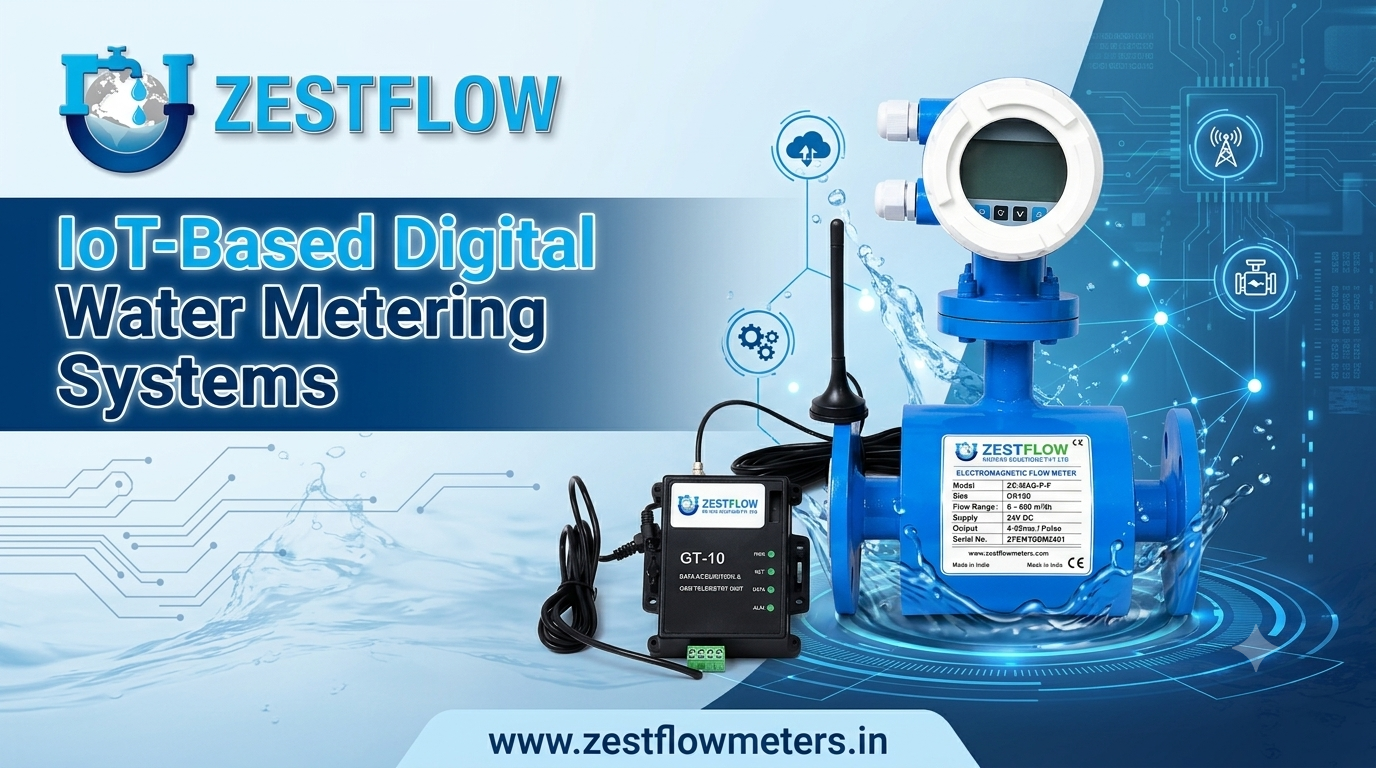
Zestflow’s IoT-based water-metering technology is designed to collect data from connected sensors through interfaces such as Modbus RS-485 and communicate with cloud systems. The company’s ZESTFLOW GT-10, for example, can integrate with water meters and other sensors for remote monitoring and automation.
Why Choose an IoT-Based Water Metering System?
Traditional metering systems often require personnel to visit individual locations to record readings. This approach can consume time and resources, particularly when meters are installed across large industrial plants, housing communities, agricultural areas, or municipal networks.
An IoT-enabled system can reduce dependence on manual data collection by transmitting measurements remotely.
1. Remote Water Consumption Monitoring
One of the major advantages of connected water metering is remote monitoring. Operators can access consumption information without physically visiting every meter location.
This is particularly useful when meters are installed across large facilities, multiple buildings, water distribution networks, or geographically separated locations.
2. Better Data Visibility
Digital water metering can provide structured consumption information that can be used for analysis. Instead of relying on handwritten readings, organizations can maintain digital records for monitoring and planning.
Better data visibility can help identify unusual consumption patterns and support more informed water-management decisions.
3. Leak Detection Support
Unexpected changes in water consumption can indicate potential leakage or abnormal usage. When water-consumption data is continuously or periodically monitored, operators can investigate unusual patterns more quickly.
Early identification of potential leaks can help reduce water wastage and prevent unnecessary operating costs.
4. Reduced Manual Meter Reading
Manual meter reading can become difficult when a project has hundreds or thousands of meters. IoT connectivity provides an opportunity to automate the collection and transmission of readings.
This can save time and allow personnel to focus on analysis and maintenance instead of repetitive meter-reading activities.
5. Improved Operational Efficiency
Water management involves more than simply measuring consumption. Organizations need to understand where water is being used, how consumption changes over time, and whether distribution systems are operating efficiently.
IoT-enabled digital metering provides data that can support these operational decisions.
Key Features of IoT-Based Digital Water Metering
When selecting an IoT Based Digital Water Metering System Supplier in India, it is important to evaluate the communication, integration, measurement, and monitoring capabilities of the proposed solution.
- Digital Measurement
Digital measurement technology enables water-consumption information to be processed electronically. Depending on the selected meter and application, data can be used by monitoring, automation, billing, or analytics systems.
- IoT Connectivity
IoT connectivity enables the metering system to communicate with remote platforms. Zestflow’s IoT flow-meter solution supports cellular communication and protocols including TCP, HTTP, and MQTT.
- RS-485 and Modbus Integration
Industrial water-management projects often require communication with multiple devices. Zestflow’s IoT-based solution supports RS-485 and Modbus-based connectivity, allowing multiple compatible devices to be connected depending on system configuration.
- Remote Data Access
Connected water-metering systems can transmit data to online platforms, enabling users to monitor information remotely rather than depending exclusively on local readings.
- Automation Compatibility
IoT-based water metering can be integrated with automation architectures where required. Zestflow’s broader instrumentation portfolio includes solutions designed to interface with automation and control environments.
- Customization
Different applications have different requirements. Meter size, communication method, sensor configuration, data frequency, environmental conditions, and integration requirements can vary from project to project.
Therefore, choosing a supplier capable of providing customized solutions can be valuable for large-scale installations.
Applications of IoT Based Digital Water Metering Systems
IoT-enabled water metering can be used across several sectors.
- Municipal Water Distribution
Municipalities and water utilities need accurate information about water distribution and consumption. Smart metering can help improve visibility across distribution networks and support more efficient resource management.
- Smart Cities
Smart-city infrastructure depends on connected systems that can collect and exchange data. IoT water meters can become part of a larger smart water-management network.
Zestflow also offers Automatic Meter Reading (AMR) water-meter solutions designed for automated data collection and remote monitoring.
- Industrial Water Management
Factories and industrial facilities often use water for production, cooling, cleaning, processing, and other activities. Digital metering can help organizations monitor water use across different sections of a facility.
- Residential Buildings and Apartments
Housing societies, apartment complexes, and residential communities can use smart metering to monitor individual or common-area consumption and improve water-management practices.
- Agriculture and Irrigation
Agricultural operations can benefit from accurate water measurement for irrigation management. Monitoring consumption can help users understand water requirements and improve resource utilization.
- Commercial Buildings
Hotels, offices, shopping centers, educational institutions, and other commercial properties can use digital water meters to track consumption and identify abnormal usage.
IoT Water Metering vs. Traditional Water Metering
Traditional water meters are useful for measuring water consumption, but the main difference is how information is collected and used.
A conventional meter may require someone to physically inspect the meter and record the reading. An IoT-enabled digital system can automatically communicate measurement data to a remote platform.
This provides several potential advantages:
* Less dependence on manual readings
* Remote access to consumption data
* Better historical data management
* Faster identification of unusual consumption
* Easier integration with digital monitoring systems
* Improved visibility across multiple locations
Zestflow’s product portfolio includes conventional water meters, pulse-output water meters, AMR water meters, and IoT-based flow-meter solutions, allowing customers to select technologies according to their application requirements.
How to Select an IoT Based Digital Water Metering System Supplier in India
Selecting the right supplier is important because water-metering requirements can vary significantly between applications.
Consider the following factors before purchasing.
- Product Quality
Choose a supplier that focuses on measurement accuracy, durability, and reliable construction. Quality becomes especially important when meters are expected to operate continuously in industrial or outdoor environments.
- Communication Compatibility
Check whether the system supports the communication technology required for your project. Depending on the application, this may include GPRS, cellular connectivity, RS-485, Modbus, MQTT, or other protocols.
- Integration Capabilities
If the water meter needs to communicate with an existing PLC, SCADA, cloud platform, or automation system, confirm compatibility before installation.
- Technical Support
A reliable supplier should provide assistance with product selection, installation, configuration, troubleshooting, and maintenance.
- Customization
Large industrial and infrastructure projects may require customized meter sizes, communication options, data-logging configurations, or sensor integration.
- Experience in Instrumentation
A supplier with broader experience in industrial instrumentation can better understand how water metering needs to fit into a complete measurement and automation system.
Zestflow Meters Solutions states that it has more than 15 years of experience in industrial process instrumentation and offers a broad product portfolio covering flow, level, temperature, pressure, and related measurement requirements.
Why Choose Zestflow Meters Solutions?
Zestflow Meters Solutions provides flow measurement, water metering, IoT-based monitoring, and industrial instrumentation solutions for different applications.
Its product portfolio includes electromagnetic flow meters, AMR water meters, IoT-based flow meters, Woltmann water meters, pulse-output water meters, ultrasonic flow meters, turbine flow meters, water-level monitoring products, and other instrumentation solutions.
For IoT applications, its ZESTFLOW GT-10 solution is designed for remote monitoring and automation. It can collect information from connected devices through Modbus RS-485 and communicate with cloud platforms through supported communication protocols.
Zestflow also focuses on customized engineering solutions, technical support, and instrumentation products designed for industrial process measurement and control.
Future of Smart Water Metering in India
Water management is increasingly becoming data-driven. As cities expand and industries focus more strongly on resource efficiency, connected metering technologies are expected to become increasingly valuable.
Future water-management systems can combine smart meters with cloud platforms, sensors, analytics, automation, and remote monitoring. These technologies can help organizations move from basic measurement toward proactive resource management.
IoT-based water metering can also become part of larger digital infrastructure where water consumption, pressure, tank levels, flow rates, and other parameters are monitored through centralized systems.
The goal is not simply to install a digital meter. The larger objective is to create a reliable information network that helps organizations understand and manage water resources more effectively.
Conclusion
Choosing the right IoT Based Digital Water Metering System Supplier in India can help organizations move toward smarter, more efficient, and more connected water management.
An IoT-enabled digital water-metering system can provide remote monitoring, digital data collection, communication capabilities, automation support, and improved visibility into water consumption. These advantages can be valuable for municipal networks, smart cities, industries, commercial buildings, residential communities, and agricultural applications.
Zestflow Meters Solutions offers IoT-based flow-metering and water-metering solutions designed for remote monitoring and integration with modern automation systems. Its portfolio and IoT capabilities make it a suitable option for organizations looking to modernize water measurement and monitoring.
If your organization is planning to implement a smart water-monitoring project, explore the available solutions and select a system based on your meter size, application, communication requirements, integration needs, and operating environment.