
Ultrasonic Water Flow Meters: A Complete Guide to Working, Benefits and Applications
Introduction
Accurate water flow measurement is essential for industries, water treatment plants, irrigation systems, commercial buildings, and municipal water networks. Businesses need reliable flow measurement to monitor consumption, identify unusual flow conditions, improve efficiency, and manage valuable water resources. Ultrasonic Water Flow Meters have become an increasingly useful solution because they can measure water flow electronically without relying on conventional mechanical moving parts.
An ultrasonic flow meter uses high-frequency sound waves to determine the velocity of a flowing liquid. Depending on the technology and application, ultrasonic meters can use transit-time or Doppler measurement principles. Transit-time meters are commonly used for relatively clean liquids, while Doppler technology can be useful when the liquid contains sufficient suspended particles or bubbles.
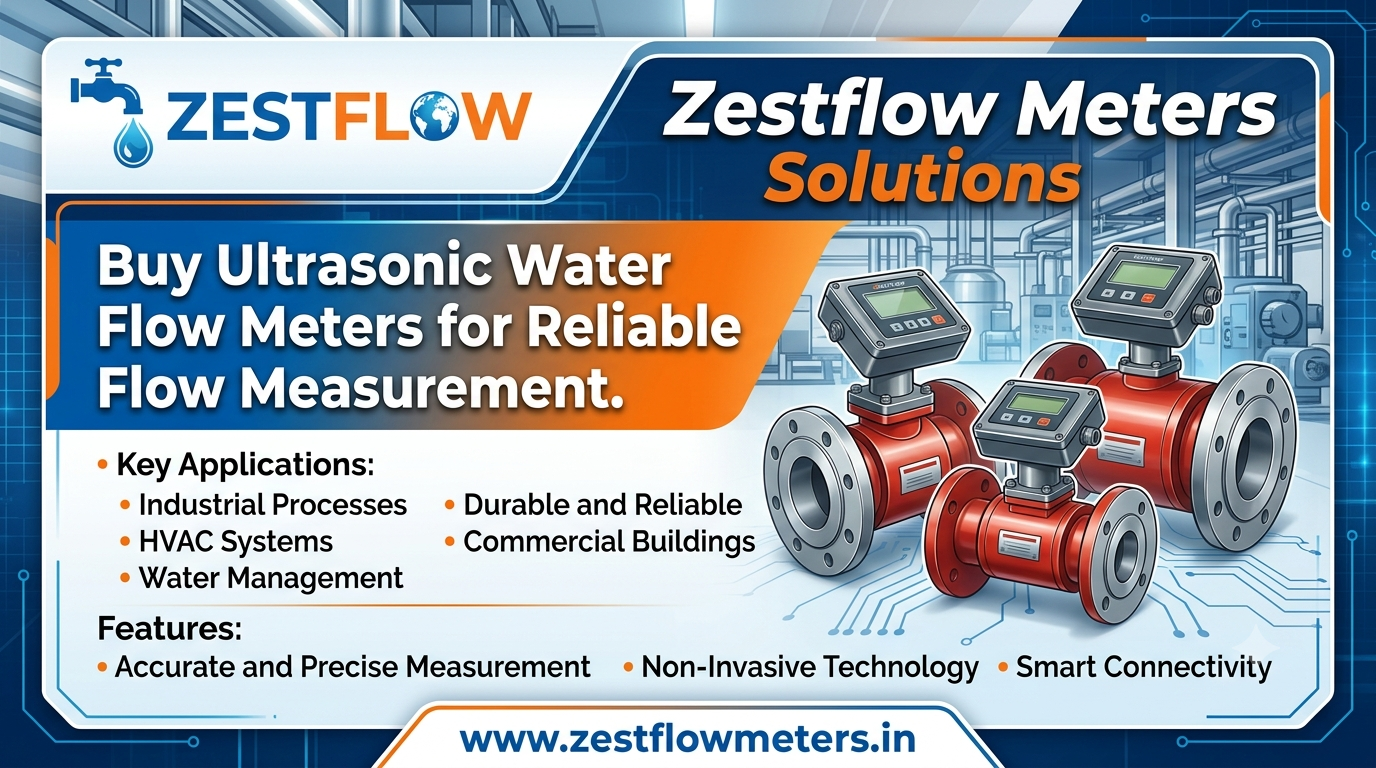
For organizations looking for modern flow measurement equipment, Zestflow Meters Solutions offers ultrasonic flow measurement products alongside electromagnetic flow meters, water meters, turbine flow meters, IoT-based flow meters, and other industrial measurement solutions. Its product portfolio includes an ultrasonic inline flow meter designed for water applications.
What Are Ultrasonic Water Flow Meters?
Ultrasonic Water Flow Meters are electronic instruments designed to measure the velocity and flow rate of water using ultrasonic sound waves.
Unlike many traditional mechanical flow meters, ultrasonic meters do not need a rotating impeller or turbine inside the water stream. Instead, ultrasonic transducers send and receive sound signals through the liquid. The electronics analyze the signals and calculate the velocity of the water.
A basic flow measurement concept is:
Flow Rate = Fluid Velocity × Pipe Cross-Sectional Area
The actual measurement method varies according to the meter design, pipe conditions, fluid characteristics, and ultrasonic technology being used.
Because ultrasonic measurement can be non-invasive, it is particularly attractive for existing pipelines where cutting the pipe or interrupting the water supply would be inconvenient. Clamp-on systems can be installed on the outside of suitable pipes, while inline models are installed as part of the pipeline.
How Do Ultrasonic Water Flow Meters Work?
The working principle depends primarily on the type of ultrasonic flow meter.
1. Transit-Time Principle
Transit-time ultrasonic flow meters use two transducers to send ultrasonic signals both downstream and upstream through the water.
A signal traveling in the same direction as the water generally takes less time than the signal traveling against the flow. The meter measures this difference in transit time and uses it to determine fluid velocity.
Once the velocity is determined, the instrument uses the internal pipe dimensions to calculate volumetric flow.
This technology is widely associated with clean-water applications.
2. Doppler Principle
Doppler ultrasonic flow meters work differently. They transmit ultrasonic signals into the liquid and analyze the frequency shift of signals reflected by particles or bubbles moving with the fluid.
For this reason, Doppler meters generally require enough suspended particles or gas bubbles to reflect the ultrasonic signal. They may therefore be more suitable for certain wastewater and slurry-type applications, whereas very clean water may be better suited to transit-time technology.
Key Components of an Ultrasonic Flow Meter
A typical ultrasonic system consists of several important components:
- Ultrasonic Transducers
The transducers transmit and receive ultrasonic signals. Depending on the design, they may be installed inside the flow body or externally on the pipe.
- Electronic Transmitter
The transmitter processes the ultrasonic signals and converts measurement information into flow data.
- Display
Many modern meters have a digital display that allows operators to view parameters such as flow rate and accumulated volume.
- Output and Communication
Depending on the model, flow meters may provide pulse, analog, or digital communication outputs for integration with monitoring and control systems.
- Pipe and Installation Configuration
Installation configuration has a significant impact on measurement quality. Pipe material, diameter, fluid condition, sensor positioning, and adequate straight pipe sections should be considered when selecting and installing a meter.
Zestflow’s ultrasonic inline flow meter, for example, is listed for water applications and includes an LCD, pulse output, bi-directional flow capability, and a clamp-on installation arrangement.
Benefits of Ultrasonic Water Flow Meters
There are several reasons industries are considering ultrasonic technology for water flow measurement.
1. Non-Invasive Measurement
One of the major benefits is the availability of clamp-on ultrasonic measurement. External transducers can measure flow without directly entering the water stream.
This can simplify retrofits and reduce the need for pipeline modifications.
2. No Moving Parts
Ultrasonic meters generally have no rotating mechanical components in the flow path. This reduces mechanical wear and can help lower maintenance requirements compared to certain mechanical flow measurement technologies.
3. Low Pressure Loss
Because clamp-on sensors remain outside the pipeline, they do not obstruct the water flow. Ultrasonic meters, therefore, can be attractive where minimizing additional pressure loss is important.
4. Suitable for Large Pipelines
Ultrasonic technology can be practical for measuring flow in larger existing pipelines, particularly when installing an inline mechanical meter would be difficult or expensive.
5. Digital Measurement
Electronic processing allows modern flow meters to provide digital readings and outputs that can be integrated into industrial monitoring systems.
6. Useful for Water Management
Accurate flow information helps organizations understand water consumption, monitor distribution systems, evaluate process performance, and identify abnormal operating conditions.
7. Flexible Installation Options
Depending on the application, users can select clamp-on, inline, insertion, portable, or other configurations. The appropriate design depends on pipe size, water quality, accessibility, and measurement requirements.
Applications of Ultrasonic Water Flow Meters
Ultrasonic Water Flow Meters can be used across a wide range of water-related applications.
- Water and Wastewater Treatment Plants
Treatment plants need reliable flow information at different stages of water processing. Ultrasonic meters can be considered for monitoring raw water, treated water, process water, and distribution lines.
- Industrial Water Management
Factories often use large volumes of water for production, cooling, cleaning, and other processes. Flow measurement helps plant operators monitor consumption and improve water management.
- Irrigation Systems
Agricultural and irrigation systems can benefit from flow measurement because operators need to understand how much water is being delivered through pipelines.
- Municipal Water Distribution
Water utilities can use flow measurement to monitor distribution networks and understand water movement through different sections of the system.
- HVAC and Chilled Water Systems
Ultrasonic flow measurement can be used in heating and cooling systems where water circulation needs to be monitored for operational and energy-management purposes.
- Commercial Buildings
Large buildings, campuses, hotels, and institutional facilities can use flow meters to monitor water usage and improve resource management.
- Construction and Infrastructure Projects
Temporary or permanent flow monitoring may be required during infrastructure projects. Portable or clamp-on ultrasonic systems can be useful where pipeline modification is undesirable.
Ultrasonic vs. Mechanical Flow Meters
Mechanical meters measure water using physical movement, such as a turbine or impeller. Ultrasonic meters determine flow electronically through sound-wave measurements.
A mechanical meter may be appropriate for certain conventional applications, but ultrasonic technology can provide advantages such as no moving parts and, for clamp-on systems, non-invasive installation.
The right choice should not be based solely on technology. Pipe diameter, water quality, expected flow range, accuracy requirements, installation conditions, budget, and maintenance requirements should all be evaluated.
Factors to Consider Before Buying an Ultrasonic Flow Meter
Choosing the right Ultrasonic Water Flow Meters requires more than simply selecting a meter based on pipe diameter.
- Pipe Size
Know the internal pipe diameter and pipe material before selecting the meter.
- Water Quality
Determine whether the water is clean or contains suspended solids, bubbles, or other contaminants. This can influence the appropriate ultrasonic technology.
- Flow Range
Consider minimum, normal, and maximum expected flow rates. The meter should be appropriately sized for the actual operating conditions.
- Installation Method
Decide whether an inline, clamp-on, insertion, or portable configuration is most appropriate.
- Temperature and Pressure
The operating temperature and pressure of the water should be compatible with the selected instrument.
- Output Requirements
If the meter needs to connect with a PLC, SCADA system, data logger, or other monitoring equipment, check the available output and communication options.
- Installation Conditions
Proper sensor positioning and adequate upstream and downstream pipe conditions are important for stable measurement. Installation errors can significantly affect ultrasonic measurement performance.
Why Choose Zestflow Meters Solutions?
Zestflow Meters Solutions provides flow measurement and water monitoring solutions for industrial and utility applications. Its product portfolio includes ultrasonic flow meters, electromagnetic flow meters, turbine flow meters, water meters, IoT-based flow meters, and analytical instruments.
The company states that it focuses on accurate measurement, reliable operation, low maintenance, and customized solutions according to application requirements. The offerings can be configured around factors such as flow range, meter size, material, and application requirements.
For customers evaluating an ultrasonic solution, discussing the actual pipeline conditions and measurement requirements with the supplier can help determine the appropriate configuration.
Maintenance Tips for Ultrasonic Water Flow Meters
Although ultrasonic meters can require less mechanical maintenance because they generally have no moving parts, proper inspection and installation remain important.
Here are some useful practices:
- Keep the transmitter and electrical connections protected from unsuitable environmental conditions.
- Check sensor mounting and alignment periodically for clamp-on installations.
- Inspect cables and connections for damage.
- Verify readings against expected process conditions.
- Keep the pipe surface suitable for external sensor installation where applicable.
- Follow the manufacturer’s installation and calibration recommendations.
- Investigate sudden changes in readings rather than assuming they are normal.
- Check whether air bubbles, suspended solids, pipe conditions, or installation changes could affect measurement.
The Future of Water Flow Measurement
Water management is becoming increasingly data-driven. Modern organizations want more than a simple flow reading; they want reliable information that can support monitoring, reporting, automation, and resource optimization.
This is why electronic flow meters are increasingly relevant in industrial water management. When ultrasonic measurement is combined with digital outputs, remote monitoring, IoT technologies, and data logging, businesses can create more connected water-monitoring systems.
For applications where non-invasive measurement, low maintenance, and digital monitoring are important, Ultrasonic Water Flow Meters can be an effective option.
Conclusion
Ultrasonic Water Flow Meters offer a modern approach to measuring water flow by using ultrasonic signals instead of conventional mechanical measurement methods. Their potential advantages include non-invasive installation options, no moving measurement components, low pressure loss for clamp-on configurations, digital measurement, and suitability for many industrial and water-management applications.
However, selecting the correct ultrasonic meter requires careful consideration of water quality, pipe size, flow range, installation conditions, and communication requirements. A properly selected and installed meter can provide valuable flow data for improving water management and operational efficiency.
For businesses looking for modern flow measurement solutions, Zestflow Meters Solutions offers ultrasonic flow meters along with a broader range of industrial water and flow measurement products.