Smart Water Metering Solution by Zestflow Meters Solutions
Introduction
Water is one of the most important resources for homes, industries, commercial buildings, agriculture, municipalities, and infrastructure projects. As water demand continues to increase, organizations need better ways to measure, monitor, and manage water consumption. Traditional water meters can provide consumption readings, but modern applications often require real-time data, remote monitoring, automated reporting, and better control.
A Smart Water Metering Solution combines accurate water measurement with digital communication, data monitoring, and automation. With the help of smart meters and Internet of Things technology, users can collect water consumption information and monitor their systems more efficiently.
Zestflow Meters Solutions provides advanced water and flow measurement solutions designed for modern industrial and water-management applications. Its product portfolio includes water meters, AMR water meters, IoT-based flow meters, electromagnetic flow meters, ultrasonic flow meters, and other instrumentation solutions.
One of the important technologies in this field is IOT Smart Water Flow Meters. These connected meters can help organizations move from manual meter reading to digital and remote water monitoring.
What Is a Smart Water Metering Solution?
A Smart Water Metering Solution is a technology-based system designed to measure water consumption and provide useful information for monitoring and management. Depending on the application, the solution can combine a water flow meter, sensors, communication equipment, data logging, and a cloud-based or centralized monitoring platform.
Unlike conventional systems that depend heavily on manual readings, smart metering can automatically collect and transmit water-use information.
This can help organizations understand:
- How much water is being
- consumed
- When water consumption increases
- Whether abnormal flow is occurring
- Where water losses may be taking place
- How consumption changes over time
- Which locations require attention
How water resources can be managed more efficiently
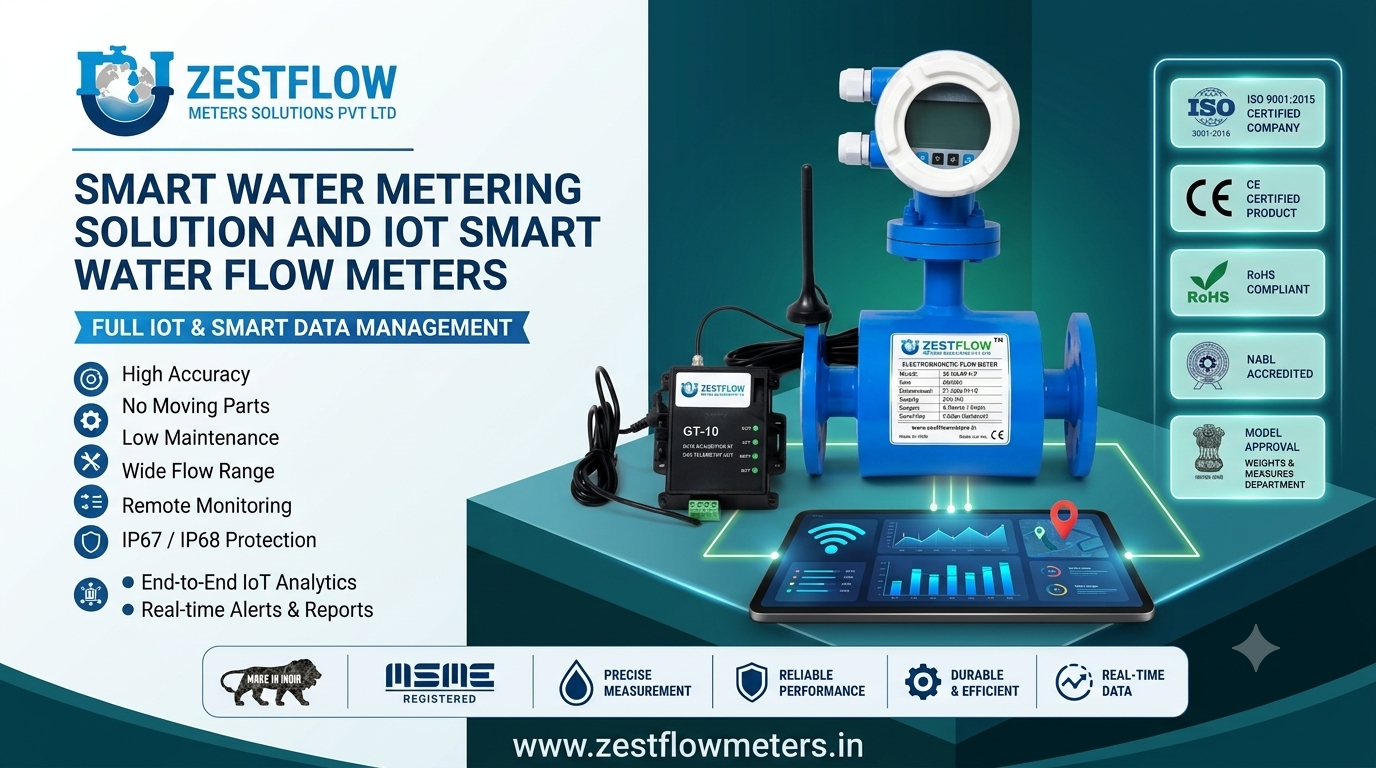
Zestflow’s IoT-based water meter, for example, is designed for remote monitoring and automation and can communicate with sensors and other devices through interfaces such as RS-485 and Modbus.
How Do IOT Smart Water Flow Meters Work?
IOT Smart Water Flow Meters use sensors and digital communication technologies to collect water-flow information and make that information available remotely.
The basic process can be explained in four steps.
1. Measuring Water Flow
The meter measures the volume or flow rate of water passing through the pipeline. Depending on the selected meter technology, measurement can be performed using electromagnetic, ultrasonic, turbine, mechanical, or other flow-measurement methods.
2. Collecting Digital Data
The measured information is converted into digital data. This makes it easier to store, process, analyze, and transmit consumption information.
3. Transmitting Information
A communication module can transmit the collected data to a monitoring platform. Depending on the system configuration, technologies such as GSM, GPRS, LTE, RS-485, Modbus, MQTT, or other communication methods may be used.
Zestflow’s IoT-based water meter supports communication through technologies and interfaces including GPRS, TCP, HTTP, MQTT, RS-232, and RS-485.
4. Monitoring and Analysis
The information can then be viewed through a suitable dashboard, software platform, or centralized monitoring system. This allows users to analyze consumption patterns and identify unusual conditions.
Key Benefits of a Smart Water Metering Solution
- Real-Time Water Monitoring
One of the biggest advantages of smart metering is improved visibility. Instead of depending only on periodic manual readings, users can receive more frequent information about water usage.
Real-time or near-real-time monitoring can help identify sudden changes in consumption and allow operators to respond faster.
- Remote Monitoring
Remote monitoring is particularly useful for large facilities, multiple locations, water distribution networks, and industrial sites.
Operators can monitor water-flow information without physically visiting every meter location. This can save time and reduce the manpower required for routine meter-reading activities.
- Improved Leak Detection
Unexpected increases in water consumption can indicate a possible leakage or abnormal flow condition.
A smart monitoring system can help users identify unusual consumption patterns earlier. Detecting leaks sooner can reduce water loss, operating costs, and potential damage.
Zestflow’s AMR water meter solutions are designed for automated reading and can support early identification of leaks and unusual water usage.
- Better Water Conservation
Water conservation starts with accurate information. When users understand where and when water is being consumed, they can make better decisions about usage.
A Smart Water Metering Solution can support water conservation by providing consumption data for:
- Residential communities
- Commercial buildings
- Industrial facilities
- Agriculture
- Irrigation systems
- Municipal networks
- Water treatment plants
- Smart-city projects
- Reduced Manual Work
Traditional meter-reading processes can require personnel to visit individual locations and record readings. Digital metering can automate much of this process.
Automated data collection can improve efficiency and reduce the possibility of errors associated with manual recording.
- Data-Driven Decision Making
Historical water consumption data can reveal trends that may not be visible from occasional readings.
Organizations can use this information to understand consumption patterns, compare different locations, plan maintenance, and improve water-management strategies.
Applications of IOT Smart Water Flow Meters
- Industrial Water Management
Industries consume water for manufacturing, cooling, processing, cleaning, and other activities. Accurate flow monitoring helps plant operators understand how water is being used across different processes.
IoT connectivity can make this information easier to monitor from a centralized location.
- Water and Wastewater Treatment Plants
Flow measurement is an important part of water and wastewater management. Smart flow meters can provide digital information that can be integrated with automation and monitoring systems.
Zestflow offers a broad range of instrumentation for water and wastewater applications, including flow meters and online water-monitoring equipment.
- Agriculture and Irrigation
Efficient irrigation requires effective water management. Smart water meters can help agricultural users monitor water consumption and improve irrigation planning.
This can be particularly useful where water availability is limited or where several irrigation points need to be monitored.
- Commercial Buildings
Hotels, offices, shopping complexes, institutions, and residential communities can use smart water meters to understand water consumption.
Monitoring individual zones or buildings can help facility managers identify unusual consumption and improve overall efficiency.
- Municipal Water Distribution
Municipal water networks can benefit from automated meter reading, remote monitoring, and digital consumption records.
AMR systems from Zestflow are designed to automatically collect water usage information and transmit readings to an online platform.
- Smart Cities
Smart cities require connected infrastructure that can collect information and support efficient resource management.
Smart water meters can become an important part of this infrastructure by connecting water consumption data with digital monitoring systems.
Smart Water Metering and IoT Integration
The real value of smart water measurement comes from connecting measurement devices with communication and data systems.
IoT integration can allow water meters to communicate with centralized platforms. Depending on the application, systems can also connect with PLCs, SCADA systems, sensors, and other automation equipment.
Zestflow’s IoT-based water meter is designed to connect with multiple types of sensors and devices, including water meters, energy meters, PLCs, temperature sensors, pressure sensors, and level sensors.
This type of integration can create a more complete monitoring environment.
Why Choose Zestflow Meters Solutions?
Zestflow Meters Solutions focuses on automation and instrumentation products for process measurement and control. Its product range includes electromagnetic flow meters, AMR water meters, IoT-based flow meters, water meters, turbine flow meters, ultrasonic flow meters, and other industrial measurement products.
For organizations looking for a Smart Water Metering Solution, Zestflow can provide solutions based on application requirements.
Important advantages include:
- Digital water-flow monitoring
- IoT integration
- Remote data accessibility
- Automated data collection
- Multiple communication options
- Integration with industrial systems
- Customized instrumentation solutions
- Support for different water-management applications
The correct meter should always be selected according to pipeline size, flow range, fluid characteristics, installation conditions, communication requirements, power availability, and the desired monitoring platform.
How to Select the Right Smart Water Meter
Before purchasing a smart water meter, organizations should evaluate several technical requirements.
- Pipeline Size
The meter size should match the pipeline and expected flow conditions. An incorrectly selected meter can affect measurement performance.
- Flow Range
The expected minimum, normal, and maximum flow rates should be considered before selecting the meter.
- Communication Requirements
Determine whether the application requires RS-485, Modbus, GSM, GPRS, LTE, MQTT, or another communication technology.
- Power Supply
Power availability is important, especially for remote installations. Some applications may require battery-powered or low-power solutions.
- Installation Environment
Outdoor, industrial, underground, and exposed installations may require different levels of protection and appropriate construction materials.
- Data Requirements
Consider whether the system needs simple readings, automated meter reading, historical data logging, cloud connectivity, alarms, or complete IoT-based monitoring.
The Future of Smart Water Management
The future of water management is increasingly connected, automated, and data-driven. Smart meters can provide the measurement foundation needed to develop more intelligent water systems.
Future systems may combine IoT sensors, cloud platforms, advanced analytics, artificial intelligence, automated alerts, and predictive maintenance.
The objective is not simply to measure water. The goal is to understand how water is being used and take timely action to improve efficiency.
For industries and organizations managing large quantities of water, the transition from traditional measurement to connected IOT Smart Water Flow Meters can provide greater visibility and control.
Conclusion
A Smart Water Metering Solution can transform conventional water measurement into a connected and data-driven management system. By combining accurate flow measurement, digital communication, remote monitoring, and data analysis, organizations can improve water visibility and make more informed operational decisions.
IOT Smart Water Flow Meters are especially useful for industries, municipalities, commercial buildings, agriculture, irrigation systems, water-treatment facilities, and smart-city infrastructure.
Zestflow Meters Solutions offers a range of water and flow measurement technologies designed for modern monitoring and automation requirements. Its IoT-based water meters support remote monitoring and communication with sensors and industrial devices, helping organizations move toward smarter water management.
For businesses looking to improve water monitoring, reduce unnecessary consumption, identify abnormal flow, and introduce digital control, adopting a suitable smart metering system can be an important step toward efficient and sustainable water management.