
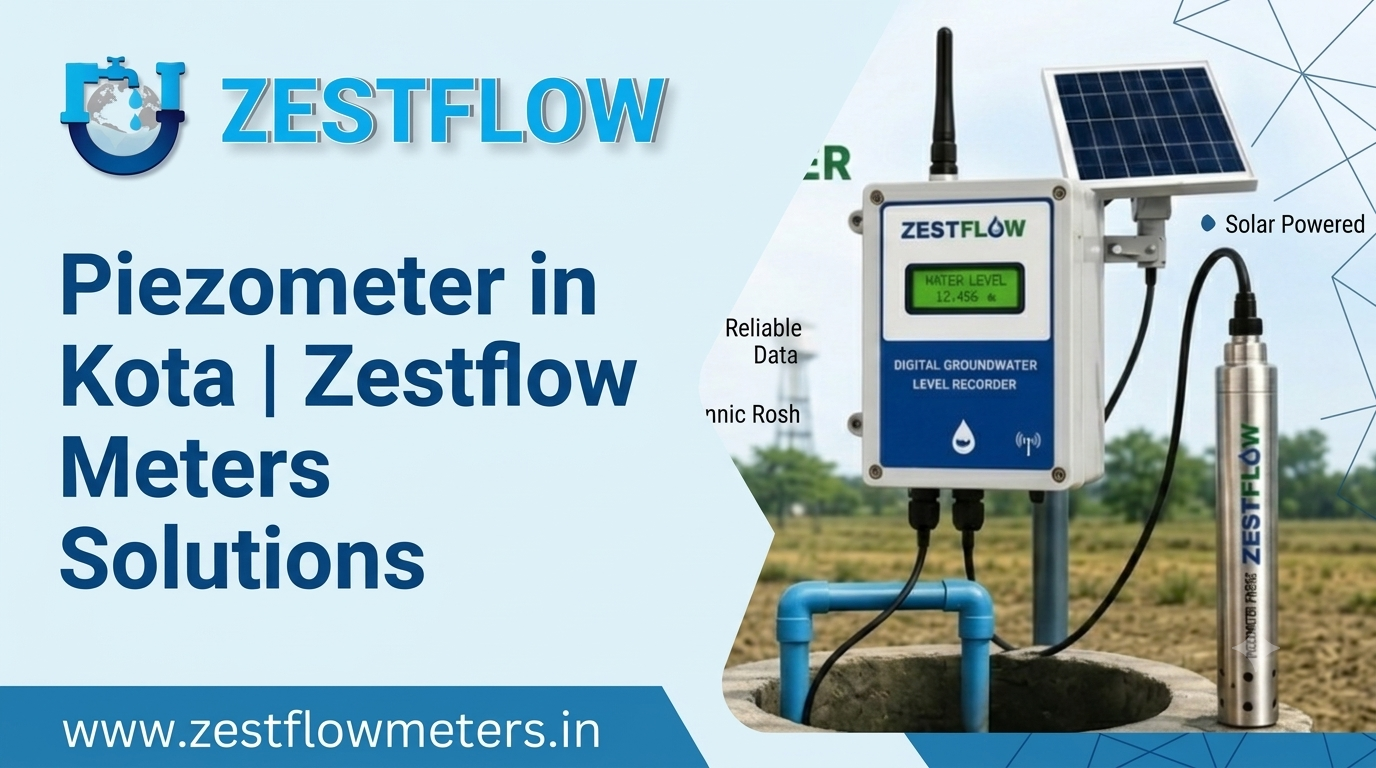
Piezometer in Kota – Reliable Groundwater Monitoring Solutions by Zestflow Meters Solutions
Introduction
Water management, construction safety, and geotechnical engineering depend on accurate information about underground water conditions. Whether a project involves building foundations, road infrastructure, dams, embankments, or groundwater investigations, monitoring water pressure within soil and rock is an important part of engineering assessment. A piezometer is an instrument used to measure pore water pressure or hydraulic pressure at a selected point beneath the ground.
If you are searching for a Piezometer in Kota, Zestflow Meters Solutions is a relevant company to contact for information about measurement instruments and monitoring requirements. Selecting the right piezometer can help engineers collect useful data, assess groundwater conditions, and make informed decisions during construction and long-term infrastructure monitoring.
Kota, Rajasthan, is an important industrial, educational, and infrastructure centre. Construction and development projects in the region may require dependable groundwater monitoring equipment to understand subsurface conditions. This guide explains what a piezometer is, how it works, its applications, available types, and the factors to consider when choosing a suitable instrument.
What Is a Piezometer?
A piezometer is a measurement instrument designed to determine the pressure of water within soil, rock, or other porous materials. In geotechnical engineering, it is commonly used to measure pore water pressure, which influences soil strength, effective stress, slope stability, and foundation performance.
Groundwater pressure can change because of rainfall, seasonal variations, excavation, pumping, construction activities, and changes in nearby water levels. Measuring these changes provides engineers with important information about the behaviour of the ground.
A piezometer may be installed in boreholes, earth embankments, foundations, dams, retaining structures, and other locations where underground water pressure needs to be monitored.
For projects requiring a Piezometer in Kota, the instrument should be selected according to the ground conditions, required measurement range, installation depth, accuracy requirements, and monitoring objectives.
Why Is a Piezometer Important?
Water pressure beneath the ground can influence the stability and performance of civil engineering structures. Without appropriate monitoring, changes in groundwater pressure may remain unnoticed until they contribute to settlement, seepage, instability, or other engineering concerns.
Piezometers help project teams understand these conditions by providing measurements at specific locations and depths.
The main benefits include:
Groundwater pressure monitoring: Measures pore water pressure at selected points.
Construction safety support: Provides data that engineers can use when evaluating changing ground conditions.
Slope stability assessment: Helps identify changes in pore pressure that may affect soil stability.
Foundation monitoring: Supports the assessment of groundwater conditions around foundations.
Dam and embankment monitoring: Helps engineers evaluate seepage-related conditions and pressure changes.
Long-term data collection: Enables comparison of measurements over time.
Engineering decision-making: Supplies information for geotechnical analysis and risk assessment.
A piezometer does not independently guarantee structural safety. Its readings must be interpreted alongside site investigations, design information, other monitoring instruments, and professional engineering assessments.
Types of Piezometers Available for Different Applications
Understanding the different types of piezometers is essential when choosing a suitable instrument.
1. Standpipe Piezometer
A standpipe piezometer is a relatively simple instrument commonly used to measure groundwater levels or pressure head in soil and rock.
It generally consists of a perforated or porous intake section connected to a pipe installed in a borehole. Water enters the intake section and rises within the pipe to a level corresponding to the groundwater pressure at the installation point.
Standpipe piezometers can be suitable for geotechnical investigations, groundwater observation, and projects where manual readings are acceptable.
Their suitability depends on soil permeability, response time, installation design, and the required measurement frequency.
2. Vibrating Wire Piezometer
A vibrating wire piezometer is an instrument designed to measure pore water pressure using a pressure-sensitive diaphragm and a vibrating wire sensing mechanism.
Changes in water pressure affect the diaphragm, which changes the tension and frequency response of the wire. The instrument’s readout system converts the measurement into pressure values.
Vibrating wire piezometers are commonly used in dams, embankments, tunnels, excavations, foundations, and other geotechnical monitoring applications.
Depending on the model and installation, they can support repeated readings and integration with automated data acquisition systems.
3. Pneumatic Piezometer
A pneumatic piezometer measures pore water pressure through a pneumatic sensing arrangement. Pressure is transmitted through a gas line, and the resulting measurement is used to determine the water pressure at the installed sensor.
These instruments may be appropriate for certain geotechnical applications where pneumatic measurement methods are specified.
Selection should consider tubing arrangements, site conditions, measurement range, maintenance requirements, and the monitoring procedure.
4. Electrical Piezometer
Electrical piezometers use electrical sensing technology to measure pressure. Depending on the design, the sensor may employ a pressure transducer that converts applied pressure into an electrical signal.
These instruments can be useful where electronic measurement, remote observation, or integration with monitoring systems is required.
The available output, power requirements, environmental protection, and compatibility with the data logger should be checked before selection.
5. Digital Piezometer
A digital piezometer is a general term used for instruments or measurement systems that provide readings in digital form. The underlying sensing technology may vary.
Digital measurement can simplify data recording, improve consistency in monitoring routines, and support computer-based analysis. Some systems also enable remote data transmission when connected to suitable equipment.
Before purchasing, confirm the actual sensor technology, display or output format, accuracy, calibration requirements, and communication compatibility.
Applications of Piezometers in Kota
A Piezometer in Kota may be relevant to various construction, groundwater, and infrastructure projects, depending on the site’s requirements.
Building and Foundation Construction
Groundwater conditions can influence excavation, foundation design, and construction methods. Piezometers provide information about subsurface pressure conditions that may be needed during site preparation and foundation work.
Engineers can use these readings with geotechnical investigation results to evaluate conditions around the proposed structure.
Road and Highway Projects
Road embankments and elevated approaches may be affected by changes in pore water pressure. Piezometers can help monitor the response of soil during construction and after completion.
The data may be used to assess consolidation, drainage behaviour, and changing ground conditions.
Dams and Earth Embankments
Piezometers are widely used in the monitoring of earth dams and embankments. They help engineers observe pore water pressure and evaluate changes that may be associated with seepage or variations in reservoir conditions.
Readings should be compared with design expectations, historical measurements, and other relevant monitoring information.
Tunnels and Underground Excavations
Excavation can change groundwater flow and pressure around underground structures. Piezometers installed at suitable locations help engineers observe these changes.
Monitoring data can support the evaluation of groundwater inflow, excavation conditions, and the performance of ground support measures.
Groundwater Investigations
Environmental studies, hydrogeological investigations, and water resource assessments may require groundwater observations at particular depths.
Piezometers can help measure hydraulic head or pore pressure at the intended monitoring interval. Correct installation is essential because a poorly sealed borehole may allow water to move between different geological layers and distort the readings.
Industrial and Infrastructure Development
Industrial facilities, retaining walls, storage areas, and other infrastructure projects may require groundwater pressure monitoring as part of their geotechnical instrumentation programmes.
The instrument should be selected according to the project design and the monitoring plan prepared by qualified professionals.
How Does a Piezometer Work?
Although the operating principle varies by instrument type, the overall purpose is to measure water pressure at a specific point underground.
First, engineers identify the required monitoring location and depth. A borehole or suitable installation arrangement is then prepared according to the site investigation and instrument specifications.
The piezometer’s sensing section is positioned at the required interval. Appropriate filter material and sealing arrangements are installed to ensure that the instrument measures the intended zone rather than unwanted water movement from other layers.
After installation, the instrument is allowed to stabilise according to the manufacturer’s instructions. Initial readings are recorded to establish a baseline.
Subsequent measurements are collected at planned intervals. Engineers compare the readings over time and evaluate them alongside rainfall, excavation progress, groundwater observations, and other site information.
For automated monitoring, compatible data loggers may collect readings at scheduled intervals. The resulting dataset can be used to identify trends, unusual changes, and potential deviations from expected behaviour.
How to Choose the Right Piezometer in Kota
Selecting the right instrument requires more than comparing prices. The monitoring objective and site conditions should guide the decision.
Consider the following factors:
Measurement range: Select an instrument that covers the expected pressure range without compromising the required resolution.
Required accuracy: Review the accuracy specification and calibration documentation.
Installation depth: Confirm that the instrument and its associated cables or tubing are suitable for the planned depth.
Ground conditions: Consider soil permeability, groundwater chemistry, temperature, and the geological setting.
Response time: Determine whether the application requires rapid response or whether slower manual monitoring is sufficient.
Reading method: Decide between manual observation, portable readout equipment, and automated data acquisition.
Environmental protection: Check the instrument’s suitability for moisture, temperature variations, and site exposure.
Data compatibility: For electronic systems, confirm that the output works with the intended readout unit or data logger.
Calibration and support: Ask about calibration records, installation guidance, technical documentation, and maintenance requirements.
Project budget: Compare the total cost of equipment, installation, accessories, calibration, and ongoing monitoring.
For major infrastructure works, consult a qualified geotechnical engineer or instrumentation specialist before finalising the instrument specification.
Why Consider Zestflow Meters Solutions?
When looking for a Piezometer in Kota, choosing an appropriate supplier or instrumentation provider is an important step in the procurement process.
Zestflow Meters Solutions can be contacted to enquire about the availability of suitable piezometer options and related measurement requirements. Before making a purchase, request product specifications and verify that the proposed model matches your project’s technical needs.
When evaluating any supplier, consider the following:
Availability of the required piezometer type.
Product datasheets and technical specifications.
Measurement range and accuracy information.
Calibration documentation, where applicable.
Installation and operating instructions.
Compatibility with readout units and data loggers.
Warranty terms and after-sales support.
Delivery timelines and overall project costs.
It is advisable to confirm the current product range, service coverage in Kota, and any installation or technical support offered directly with Zestflow Meters Solutions. These details should be verified before being treated as confirmed company services.
Installation and Maintenance Best Practices
Proper installation is essential for obtaining reliable piezometer readings. Even a high-quality instrument may produce misleading measurements if the installation is poorly designed or executed.
A suitable installation procedure generally includes reviewing the geotechnical design, selecting the correct depth, preparing the borehole, installing the sensing element, and sealing the surrounding area as specified.
The installation record should document the instrument identification, location, depth, sensor details, installation date, and baseline measurements.
For ongoing monitoring, establish a consistent reading schedule and retain all observations in an organised database. Check cables, connections, protective enclosures, and readout equipment at appropriate intervals.
Unexpected changes in measurements should be checked for instrument faults, installation issues, environmental influences, and genuine changes in ground conditions. Where the readings may indicate a safety concern, notify the responsible engineer promptly and follow the project’s monitoring and emergency procedures.
Calibration checks and maintenance should follow the manufacturer’s instructions and the project’s quality assurance requirements.
Piezometer in Kota: Supporting Better Engineering Decisions
Accurate groundwater pressure measurements are valuable for understanding subsurface conditions and evaluating the performance of civil engineering structures.
Whether the requirement involves a building foundation, road embankment, dam, excavation, or groundwater investigation, the right piezometer can provide information that supports informed engineering decisions.
The most suitable instrument depends on the required measurement range, installation conditions, monitoring frequency, accuracy, and data collection method.
If you are searching for a Piezometer in Kota, contact Zestflow Meters Solutions to enquire about suitable product options and obtain the technical information needed to evaluate your requirements. Compare specifications carefully and consult qualified professionals for instrument selection, installation, and interpretation of monitoring results.
Frequently Asked Questions (FAQs)
1. What is a piezometer used for?
A piezometer measures pore water pressure or hydraulic pressure at a particular point in soil or rock. It is commonly used in geotechnical engineering, groundwater investigations, dam monitoring, foundation projects, and excavation monitoring.
2. Where can I enquire about a Piezometer in Kota?
You can contact Zestflow Meters Solutions to enquire about suitable piezometer options. Confirm the current product range, technical specifications, availability, and delivery arrangements directly with the company.
3. Which type of piezometer is best for construction projects?
The best type depends on the project requirements. Standpipe piezometers may suit basic groundwater observations, while vibrating wire or electronic piezometers may be more appropriate for specialised or repeated monitoring. A geotechnical professional should determine the specification.
4. What is the difference between a piezometer and a water level meter?
A piezometer is designed to measure pressure or hydraulic head at a defined point or monitoring interval. A water level meter typically identifies the depth to the water surface in a well or borehole. The instruments serve related but different purposes.
5. Can piezometers be used for dam monitoring?
Yes. Piezometers are commonly used to monitor pore water pressure in dams and earth embankments. The readings help engineers evaluate pressure trends and compare observed conditions with the design and other monitoring data.
6. Are digital piezometers suitable for continuous monitoring?
Some digital or electronic piezometer systems can support frequent or automated monitoring when paired with compatible data acquisition equipment. Confirm the model’s output, logger compatibility, power requirements, and operating specifications.
7. How often should piezometer readings be taken?
Reading frequency depends on the project design, site conditions, construction stage, and potential consequences of changing groundwater pressure. The responsible engineer should establish the schedule and define thresholds for further investigation.
8. Does a piezometer require maintenance?
Yes. Inspection of connections, cables, protective enclosures, readout equipment, and data quality may be required. Maintenance and calibration checks should follow the manufacturer’s recommendations and the project’s monitoring plan.
9. What factors affect piezometer selection?
Important factors include pressure range, accuracy, response time, installation depth, soil permeability, environmental conditions, output type, data logging requirements, calibration, and budget.
10. Why is groundwater pressure monitoring important?
Groundwater pressure affects soil behaviour and can influence slope stability, excavation conditions, foundation performance, and seepage assessment. Monitoring helps engineers identify changes and evaluate whether further investigation or action is required.
Conclusion
A piezometer is an important instrument for measuring groundwater pressure and supporting geotechnical monitoring. From foundations and road embankments to dams, tunnels, and groundwater investigations, piezometers provide useful information about changing subsurface conditions.
Choosing the correct instrument involves evaluating the application, pressure range, installation depth, accuracy, reading method, and maintenance requirements. Equally important are proper installation, consistent data collection, and professional interpretation of the results.
For anyone searching for a Piezometer in Kota, Zestflow Meters Solutions is a potential point of contact for product enquiries and technical information. Verify the available models and specifications before purchasing, and work with qualified professionals to ensure that the instrument meets the project’s requirements.
Reliable measurement begins with the right equipment, correct installation, and a well-planned monitoring programme.