
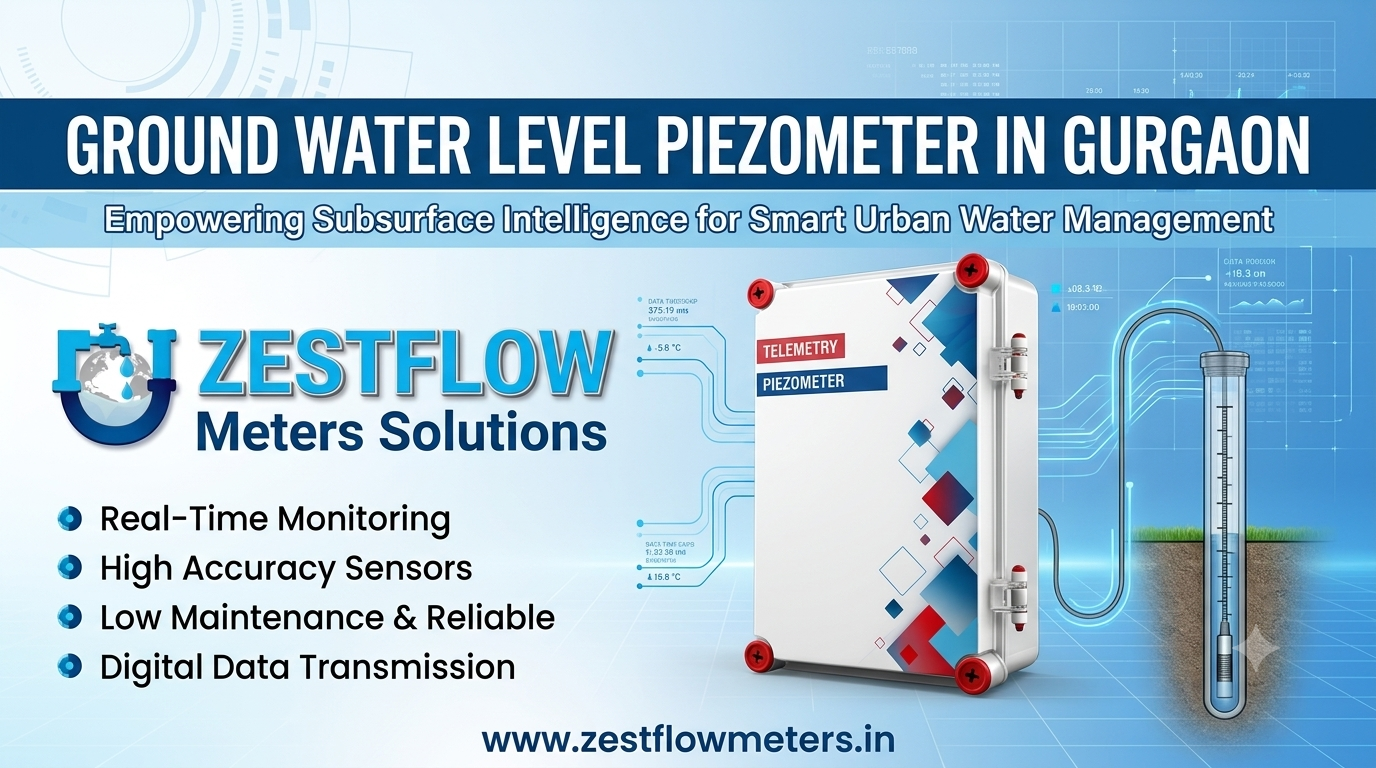
Ground Water Level Piezometer in Gurgaon: Reliable Groundwater Monitoring Solutions by Zestflow Meters Solutions
Groundwater is one of the most important natural resources for residential buildings, commercial complexes, industrial facilities, infrastructure projects, and agricultural activities. As water demand continues to grow, monitoring groundwater levels has become essential for responsible water management. Businesses and infrastructure developers need reliable equipment to understand groundwater conditions, monitor changes, and make informed decisions about water usage.
If you are looking for a Ground Water Level Piezometer in Gurgaon, Zestflow Meters Solutions can be introduced as a solution provider for groundwater monitoring requirements, helping customers identify suitable instrumentation and monitoring approaches for their projects.
A piezometer is a monitoring instrument or specially constructed observation well used to measure groundwater levels or hydraulic pressure under defined conditions. Depending on the project requirements, monitoring may be performed manually or with automated digital instruments. These measurements help organizations understand groundwater fluctuations, assess site conditions, and support environmental monitoring programs.
In this article, we explore the importance of groundwater level monitoring, the applications of piezometers, their benefits, and the factors to consider when selecting groundwater monitoring equipment in Gurgaon.
What Is a Ground Water Level Piezometer?
A ground water level piezometer is a device or monitoring installation used to determine the groundwater level or piezometric pressure at a particular location. It helps engineers, environmental professionals, and facility managers understand how groundwater conditions change over time.
A conventional groundwater observation piezometer may consist of a borehole, casing, a screened section, and suitable sealing and filter materials. The exact construction depends on the geological conditions and the aquifer being monitored. Water levels can be measured using a manual water level indicator or an appropriate automatic monitoring system.
Digital monitoring systems may include electronic sensors, data loggers, and telemetry features that transfer measurements to a central platform. These systems can be useful when frequent observations or remote access to groundwater data is required.
For projects seeking a Ground Water Level Piezometer in Gurgaon, choosing the appropriate monitoring arrangement starts with understanding the site, the groundwater zone of interest, and the level of measurement accuracy required.
Why Is Groundwater Monitoring Important in Gurgaon?
Gurgaon, also known as Gurugram, has a diverse mix of residential developments, office buildings, industrial facilities, construction sites, and commercial infrastructure. These developments often require reliable information about groundwater conditions.
Groundwater levels can vary because of rainfall, seasonal recharge, pumping, nearby construction activities, and local geological conditions. Without systematic monitoring, it may be difficult to understand whether observed changes represent normal seasonal fluctuations or a more significant groundwater trend.
Groundwater monitoring provides several advantages:
Water resource management: Helps organizations understand changes in groundwater availability and plan water use more responsibly.
Construction planning: Supports the assessment of groundwater conditions that may affect excavation, foundation work, and underground structures.
Environmental monitoring: Helps establish groundwater trends around industrial sites and other locations where environmental observation is necessary.
Data-based decisions: Provides measurements that can be reviewed over time instead of relying on occasional visual observations.
Regulatory monitoring: May support groundwater monitoring obligations where applicable, subject to the project’s current authorization conditions and regulatory requirements.
A properly planned piezometer installation can therefore contribute to better groundwater management and more informed engineering decisions.
Applications of Ground Water Level Piezometers
Piezometers are used in a variety of industries and infrastructure projects. Their specific purpose depends on the instrument type, installation design, and monitoring objectives.
1. Construction and Infrastructure Projects
Groundwater conditions can affect excavation, foundation construction, basements, retaining walls, tunnels, and other underground structures. Monitoring helps project teams understand groundwater levels and identify changes that may require further investigation.
Engineers can use monitoring records alongside geotechnical investigations to assess site conditions and plan appropriate construction measures.
2. Industrial Facilities
Industrial facilities may need to monitor groundwater as part of water management, environmental assessment, or site observation programs. A suitable piezometer installation can provide information about groundwater levels and, where the monitoring arrangement permits, support groundwater sampling.
3. Residential and Commercial Developments
Large residential societies, commercial buildings, and integrated townships may rely on groundwater for certain operational needs, subject to applicable permissions. Monitoring helps property managers and project operators maintain records of groundwater conditions and understand seasonal variations.
4. Environmental Monitoring
Environmental consultants and site managers may install piezometers to monitor groundwater around potentially sensitive areas. Where contamination is a concern, specially designed monitoring wells can be used for sampling and laboratory analysis in addition to measuring groundwater levels.
5. Water Resource and Hydrogeological Studies
Hydrogeologists use groundwater level observations to investigate aquifer behavior, seasonal changes, and the relationship between groundwater levels and water extraction. Long-term records can improve the understanding of local groundwater conditions.
Types of Piezometers and Groundwater Monitoring Systems
Selecting the right instrument depends on the purpose of the investigation, the required measurement range, site conditions, and monitoring frequency.
Manual Groundwater Level Monitoring
Manual monitoring uses an appropriate water level indicator or sounder to measure the depth to water in an observation well. It can be suitable for projects where measurements are taken at planned intervals and personnel can access the monitoring point safely.
Manual monitoring requires consistent procedures, accurate recording, and suitable measurement equipment.
Digital Water Level Monitoring Systems
Digital monitoring instruments use electronic sensing technology to record groundwater levels or related measurements. Depending on the model, readings may be stored locally or transferred to a data collection system.
These systems can help reduce repetitive manual measurements and improve the consistency of monitoring records when installed and maintained correctly.
Automatic Water Level Recorders
Automatic water level recorders collect readings at configured intervals. They can be useful when groundwater changes need to be observed more frequently than manual monitoring permits.
Telemetry-Enabled Monitoring Systems
Telemetry-enabled systems can transmit readings to a remote platform, depending on their communication capabilities and configuration. They are particularly useful for sites that require remote access to monitoring data or oversight of multiple monitoring locations.
It is important to distinguish a groundwater observation piezometer from other instruments, such as vibrating-wire piezometers used to measure pore-water pressure in soil or rock. The appropriate technology depends on what the project needs to measure.
Key Benefits of Installing a Ground Water Level Piezometer in Gurgaon
Organizations considering a Ground Water Level Piezometer in Gurgaon should evaluate the long-term benefits of systematic monitoring.
1. Better groundwater visibility: Regular measurements provide a clearer picture of groundwater fluctuations and seasonal patterns.
2. Improved project planning: Groundwater observations can help engineers evaluate site conditions and determine whether further geotechnical assessment is needed.
3. Reliable monitoring records: Consistently recorded measurements help project teams compare readings over time and identify unusual changes.
4. Efficient data collection: Automated systems can reduce the need for frequent site visits when remote monitoring is properly configured.
5. Support for environmental management: Monitoring can contribute to environmental assessments and groundwater management plans.
6. Better-informed decisions: Historical records provide useful evidence for evaluating groundwater trends and reviewing water management practices.
These benefits depend on correct instrument selection, suitable installation, routine maintenance, and consistent data interpretation.
How to Choose the Right Piezometer for Your Project
Choosing suitable groundwater monitoring equipment requires more than comparing instrument prices. The following factors should be evaluated before purchasing or installing a system.
Measurement Requirements
Determine whether you need to measure the depth to groundwater, hydraulic head, or pore-water pressure. These objectives may require different instruments and installation methods.
Installation Depth and Geological Conditions
The groundwater zone, soil profile, rock formations, and site geology influence the installation design. A qualified professional should establish the appropriate monitoring depth and screened interval.
Required Accuracy
Check the instrument’s measurement range, stated accuracy, resolution, and calibration requirements. The selected equipment should meet the project’s technical specifications.
Manual or Automatic Operation
Consider how frequently readings must be collected. Manual measurement may be adequate for periodic observations, while automated systems can be more suitable for frequent monitoring or remote locations.
Data Logging and Connectivity
If your project requires long-term records, evaluate data storage, reporting, power supply, connectivity, and compatibility with the intended monitoring platform.
Installation and Maintenance
A groundwater monitoring system needs appropriate installation, site protection, inspection, and maintenance. Discuss these requirements before finalizing the equipment.
Regulatory and Project Requirements
Where groundwater authorization or environmental conditions specify monitoring arrangements, confirm the current requirements with the relevant authority or qualified consultant. Requirements may vary according to the location, groundwater use, project category, and applicable permissions.
Groundwater Monitoring and Compliance Considerations
Groundwater monitoring is not limited to collecting readings. The measurements must be representative, traceable, and suitable for the project’s purpose.
India’s Central Ground Water Authority (CGWA) has published guidelines addressing the installation and monitoring of piezometers. These guidelines discuss matters such as installation design, monitoring frequency, measurement accuracy, equipment selection, and recording site details.
For example, the applicable monitoring instructions may specify monthly measurements, a particular measurement accuracy, or the use of digital water level recorders and telemetry. Requirements should be verified against the current applicable authorization and official guidelines rather than assumed to be identical for every site.
Learn more through the Central Ground Water Authority.
For projects in Gurgaon, consulting the relevant groundwater authority or an experienced environmental professional can help determine which requirements apply to the site.
Why Consider Zestflow Meters Solutions?
When evaluating groundwater monitoring equipment, customers should look for a provider that understands measurement requirements and can help identify suitable instrumentation for the intended application.
Zestflow Meters Solutions can position its offerings around the needs of customers seeking groundwater monitoring solutions in Gurgaon. Before choosing a product or service, buyers should confirm the company’s current product range, technical specifications, installation capabilities, and after-sales support.
Important considerations include:
Guidance on selecting a suitable groundwater monitoring instrument.
Clear technical specifications and operating instructions.
Assistance in identifying compatible water level sensors or data logging arrangements, where available.
Information about installation requirements and site preparation.
Support for routine maintenance, calibration, and troubleshooting, where offered.
Documentation that helps customers maintain consistent monitoring records.
By assessing these factors, customers can select a solution that fits their project’s technical requirements instead of choosing equipment based on price alone.
If you need a Ground Water Level Piezometer in Gurgaon, discuss your project requirements with Zestflow Meters Solutions and confirm the availability of the specific instrument, relevant technical documentation, and support services you need.
Installation and Maintenance Best Practices
Correct installation is essential for obtaining meaningful groundwater measurements. Even a high-quality instrument can produce unreliable information if the installation does not properly isolate the groundwater zone or if readings are recorded inconsistently.
Follow these best practices:
Conduct a site assessment: Review the geology, groundwater conditions, nearby pumping wells, and the objective of monitoring.
Select the correct location: Position the piezometer to capture representative conditions while considering site access, safety, and potential interference.
Design the installation appropriately: Use a suitable casing, screen, filter pack, and seal where required by the monitoring design.
Establish a reference point: Record the measuring point and relevant elevation data so that readings can be compared consistently.
Use a consistent measurement procedure: Record the date, time, measurement method, and site conditions.
Consider nearby pumping: Pumping can temporarily affect groundwater levels. Follow the monitoring plan and applicable instructions when deciding when to take readings.
Inspect the installation regularly: Check the protective cover, access point, instrument condition, and data collection system.
Maintain accurate records: Store readings in a consistent format and review them for trends, unexpected variations, and possible measurement errors.
For monitoring installations subject to regulatory requirements, follow the approved monitoring plan and current official instructions.
Conclusion
Groundwater monitoring is an important part of responsible water management, construction planning, and environmental observation. A correctly selected and installed piezometer can help organizations understand groundwater fluctuations, maintain dependable records, and make better-informed technical decisions.
For businesses, builders, industrial facilities, and environmental professionals searching for a Ground Water Level Piezometer in Gurgaon, the right solution should match the site’s geological conditions, measurement objectives, accuracy requirements, and applicable monitoring obligations.
Zestflow Meters Solutions can be considered when exploring groundwater monitoring equipment and instrumentation options. Confirm product availability, technical specifications, installation support, and service arrangements before making a purchase.
Investing in a suitable groundwater monitoring system helps establish a stronger foundation for informed decisions and long-term groundwater management.