
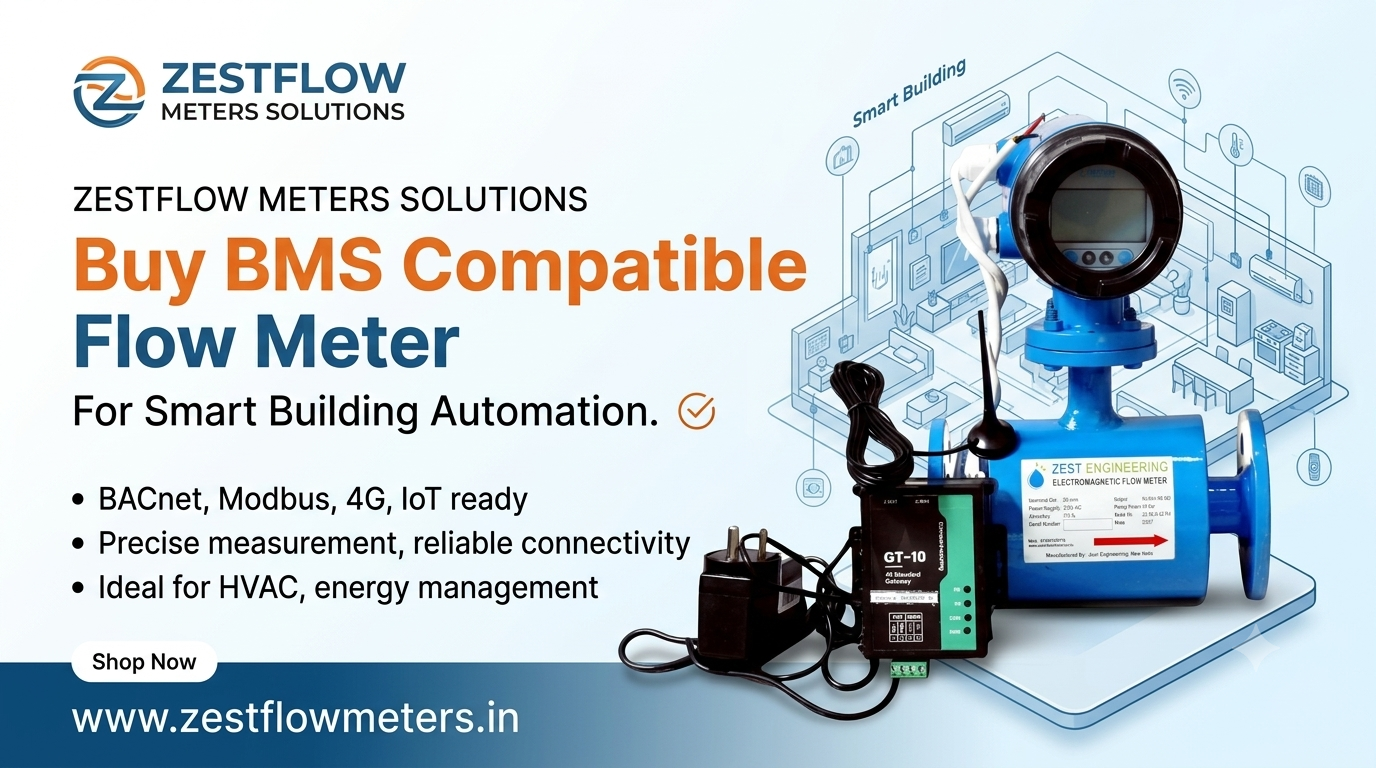
Buy BMS Compatible Flow Meter for Smart Building Automation
Modern buildings are becoming more connected, automated, and energy-efficient. Building owners and facility managers increasingly rely on smart monitoring systems to track water consumption, HVAC performance, energy usage, and other critical parameters. A reliable flow measurement system plays an important role in this process. A BMS Compatible Flow Meter allows flow data to be integrated with a Building Management System (BMS), making it easier to monitor and manage water and fluid movement across a facility.
Zestflow Meters Solutions provides flow measurement solutions designed for industrial, commercial, institutional, and infrastructure applications. If you are looking to Buy BMS Compatible Flow Meter, selecting a meter with suitable communication and output options can help simplify monitoring and automation.
A BMS-compatible flow meter can provide real-time flow information to a centralized monitoring platform. Instead of checking individual meters manually, facility teams can view flow readings through an integrated system. This can support better operational control, consumption monitoring, maintenance planning, and identification of unusual flow conditions.
What Is a BMS Compatible Flow Meter?
A BMS Compatible Flow Meter is a flow measurement device that can communicate its readings with a Building Management System or another automation platform. The meter measures the flow rate of a liquid and provides an output that can be received by the BMS controller, automation system, PLC, or monitoring software.
Depending on the flow meter model and application, communication may be supported through different electrical outputs or communication protocols. Common options can include pulse output, 4–20 mA output, RS-485-based communication, or other digital communication interfaces.
The primary purpose is to connect flow measurement with centralized building or facility monitoring.
For example, a commercial building may have separate water lines for:
- Domestic water supply
- HVAC systems
- Cooling towers
- Chilled-water systems
- Process applications
- Utility areas
- Irrigation systems
Installing suitable flow meters at important points allows facility managers to monitor these systems more effectively.
Why Use a BMS Compatible Flow Meter?
Traditional flow meters can display flow locally, but manual readings may not provide the level of visibility required for a modern automated facility. A BMS-compatible meter can send measurement information to a centralized system.
This can offer several practical benefits.
1. Centralized Flow Monitoring
A BMS provides a centralized interface for monitoring different building systems. When flow meters are integrated into the system, operators can view flow information without visiting every meter location.
This is particularly useful in large buildings, factories, hospitals, hotels, malls, educational institutions, and commercial facilities.
2. Real-Time Data Availability
Continuous flow information can help facility teams understand how water or another compatible fluid is being consumed. Real-time monitoring can make it easier to identify changes in normal operating conditions.
For example, an unexpected increase in flow during a period of low building occupancy may indicate a possible leakage or an operating issue that requires inspection.
3. Improved Water Management
Water is an important operational resource for many facilities. Monitoring consumption at different locations can help organizations understand usage patterns.
A BMS compatible flow meter can contribute to a broader water management strategy by providing measurement data that can be reviewed alongside other building parameters.
4. Easier Automation
When flow information is available to the building automation system, it can be used as part of programmed monitoring and control logic, depending on the BMS architecture and meter output.
This can help connect flow measurement with other building processes.
5. Better Maintenance Monitoring
Flow readings can provide useful information about system performance. Changes in expected flow may indicate conditions such as clogged filters, valve problems, pump issues, or other abnormalities.
Flow data should be considered alongside pressure, temperature, pump status, and other relevant parameters when diagnosing a system.
Applications of BMS Compatible Flow Meters
A BMS compatible flow meter can be used in many types of buildings and facilities.
- Commercial Buildings
Office buildings often have multiple water and HVAC systems. Flow monitoring can help facility managers understand utility consumption and monitor important building services.
- Hotels
Hotels can have significant water consumption across guest rooms, kitchens, laundry facilities, swimming pools, cooling systems, and other areas. Flow measurement can help provide greater visibility into these systems.
- Hospitals
Hospitals require reliable utility infrastructure. Water flow monitoring can be useful for different supply and service lines where centralized monitoring is required.
- Shopping Malls
Shopping malls have multiple tenants, common areas, cooling systems, water supply networks, and utility services. Flow measurement can support consumption monitoring and facility management.
- Industrial Facilities
Industrial plants may use water or other compatible fluids in production, cooling, cleaning, and utility applications. Integrating flow meters with automation systems can provide centralized operational information.
- HVAC and Chilled Water Systems
Flow measurement is important in many HVAC applications. Monitoring water circulation through chilled-water or related systems can provide useful information for facility operators.
- Educational Institutions
Schools, colleges, universities, and campuses may have multiple buildings and water distribution networks. Centralized monitoring can help facility teams manage consumption across different areas.
Types of Flow Meters for BMS Integration
The appropriate flow meter depends on the fluid, pipe size, flow range, installation conditions, accuracy requirements, and communication requirements.
- Electromagnetic Flow Meter
Electromagnetic flow meters are commonly considered for conductive liquid applications. They have no moving parts in the measuring section and are suitable for water and many other process liquids.
Depending on the model, electromagnetic flow meters can provide outputs suitable for integration with automation and monitoring systems.
- Ultrasonic Flow Meter
Ultrasonic flow meters use ultrasonic signals to determine fluid flow. Certain models can provide digital communication and output options suitable for centralized monitoring.
Ultrasonic technology can be considered for applications where non-mechanical measurement and flexible installation options are important.
- Vortex Flow Meter
Vortex flow meters measure flow based on vortices generated around a bluff body. They are commonly used for various industrial fluid applications, including some liquid, steam, and gas measurement requirements depending on the instrument specification.
- Turbine Flow Meter
Turbine flow meters use a rotating element to measure fluid movement. They can be used in suitable clean-fluid applications where their operating requirements are met.
- Digital Water Flow Meter
Digital water flow meters can provide easily readable measurements and may offer multiple output options depending on the model. For BMS applications, it is important to verify the communication interface before purchasing.
Communication Options for BMS Integration
When you Buy BMS Compatible Flow Meter, communication compatibility should be one of the most important selection factors.
Different BMS installations use different communication architectures. Some systems may receive analog signals, while others may use digital communication.
Common interfaces can include:
- 4–20 mA Output
A 4–20 mA signal is widely used in industrial automation. It can transmit flow information to a compatible controller or input module.
- Pulse Output
Pulse output can be useful when the system needs to count flow volume or receive pulse-based measurement information.
- RS-485 Communication
RS-485 is a physical communication interface commonly used in industrial automation. Depending on the instrument, it may support protocols such as Modbus RTU.
- Digital Communication
Some advanced flow meters offer digital communication options that allow multiple parameters and diagnostic information to be transferred to compatible systems.
Before purchasing, users should confirm that the flow meter’s communication protocol and electrical specifications match the BMS controller or gateway.
How Does a BMS Compatible Flow Meter Work?
The basic operating process is straightforward.
First, the flow meter measures the movement of liquid through a pipeline. The meter’s electronics process the measurement and generate an output signal or communication data.
The information is then transferred to a compatible BMS controller, PLC, gateway, or building automation network.
The BMS can display the received information on a monitoring interface. Depending on the system configuration, operators may be able to monitor flow rates, accumulated consumption, alarms, and other available parameters.
The exact functionality depends on the flow meter, communication protocol, BMS platform, controller, and software configuration.
Benefits of Buying from Zestflow Meters Solutions
When selecting a flow meter for building automation, the product should be matched to the actual application rather than selected only by price.
Zestflow Meters Solutions offers flow measurement solutions for different industrial and commercial requirements. When you plan to Buy BMS Compatible Flow Meter, important factors such as pipe size, fluid type, flow range, operating pressure, temperature, installation arrangement, output requirements, and communication interface should be considered.
A suitable meter can provide reliable flow measurement while supporting integration with an existing monitoring system.
Factors to Consider Before You Buy BMS Compatible Flow Meter
Before ordering a meter, review the following specifications:
- Fluid Type
Determine whether the meter will measure water, wastewater, chemicals, process liquids, or another compatible fluid.
- Pipe Size
The meter should be selected according to the actual pipeline size and installation arrangement.
- Flow Range
Check the minimum, normal, and maximum expected flow rates. The selected meter should operate effectively across the required range.
- Accuracy Requirement
Different applications have different accuracy requirements. Choose a suitable model based on the measurement objective.
- Operating Pressure and Temperature
Confirm that the meter’s pressure and temperature ratings are suitable for the application.
- Communication Protocol
This is particularly important for BMS integration. Verify whether the BMS requires 4–20 mA, pulse, RS-485, Modbus, or another interface.
- Power Supply
Check the available power supply and ensure that the selected flow meter is compatible with the installation.
- Installation Conditions
Consider straight pipe requirements, available installation space, flow direction, pipe material, and accessibility for maintenance.
BMS Integration for Better Building Efficiency
A BMS is designed to bring different building systems into a centralized monitoring and control environment. Flow measurement can become an important part of this connected infrastructure.
For example, a facility manager can monitor water flow together with pump status, tank levels, valve conditions, temperature, and other parameters. This creates a more complete picture of building operations.
Flow monitoring can also support consumption analysis. By comparing flow information across different zones, facility teams may identify areas with unusually high usage and investigate them.
However, the actual energy or water savings depend on how the data is used, the building’s equipment, operating practices, and control strategy. Installing a connected flow meter alone does not automatically guarantee savings.
Smart Water Monitoring with BMS
Water management is becoming increasingly data-driven. Instead of relying only on periodic manual readings, connected meters can provide more frequent information.
A BMS compatible water flow meter can be particularly useful where facility managers need centralized visibility across multiple zones.
For example, a large commercial building may install flow meters at:
- Main water inlet
- HVAC water lines
- Cooling Tower Supply
- Separate building blocks
- Tenant areas
- Irrigation lines
- Utility rooms
The collected data can then be monitored through the building management infrastructure, subject to the capabilities of the selected system.
Why Digital Flow Measurement Matters
Digital flow measurement provides more than a number displayed on a local screen. When the meter offers suitable outputs and communication capabilities, the measurement can become part of a larger automation ecosystem.
This is especially relevant for smart buildings where different systems need to exchange information.
A properly integrated flow meter can support:
- Centralized monitoring
- Consumption tracking
- Automated data collection
- Flow alarms
- Maintenance analysis
- Utility Management
- Building automation
- Operational reporting
The exact functions depend on the connected BMS and selected meter.
Choosing the Right BMS Compatible Flow Meter
There is no single flow meter that is suitable for every building. The selection should begin with the application requirements.
Consider the fluid characteristics, pipe size, expected flow range, installation environment, required accuracy, power supply, output type, and BMS communication requirements.
It is also important to check whether the meter supports the required communication protocol directly or whether a gateway or converter will be required.
For complex projects, technical consultation before installation can help prevent compatibility problems.
Buy BMS Compatible Flow Meter from Zestflow
If you are planning to Buy BMS Compatible Flow Meter, Zestflow Meters Solutions can provide flow measurement options for commercial, industrial, and building automation applications.
The right flow meter can help connect physical flow measurement with digital monitoring systems. Before selecting a model, share the application details, pipe size, fluid type, flow range, installation conditions, and BMS communication requirements.
This allows the flow measurement solution to be matched more closely to the actual project requirements.
Conclusion
A BMS Compatible Flow Meter can be an important component of modern building and facility monitoring. By connecting flow measurement with a centralized Building Management System, organizations can gain better visibility into water and fluid movement across different areas.
For applications such as commercial buildings, hotels, hospitals, industrial plants, HVAC systems, malls, and institutional facilities, integrated flow monitoring can support centralized data collection and operational management.
If you want to Buy BMS Compatible Flow Meter, focus on the complete application rather than only the meter price. Check the fluid type, pipe size, flow range, accuracy, installation requirements, power supply, and communication protocol. Most importantly, confirm compatibility between the selected flow meter and your BMS architecture.
Zestflow Meters Solutions can help you identify suitable flow measurement options based on your project requirements. With the right meter and proper integration, flow measurement can become a useful part of a connected and data-driven building management system.