
Why Choose Digital Air Flow Meters for Industrial Airflow Monitoring?
Introduction
Accurate airflow measurement is an important requirement in many industrial, commercial, laboratory, and process applications. Air and gas flow must often be monitored to maintain process efficiency, control energy consumption, protect equipment, and achieve consistent operating conditions. This is where Digital Air Flow Meters provide an effective solution.
Unlike basic mechanical flow indicators, modern digital air flow meters can provide easy-to-read measurements through electronic displays and, depending on the model, may support communication and output options for monitoring or automation systems. Zestflow Meters Solutions offers air flow measurement products designed for applications where reliable and convenient measurement of air or gas flow is required.
A digital air flow meter measures the quantity or rate of air moving through a specified point in a system. Depending on the technology and application, airflow can be displayed in units such as L/min, m³/min, or other selected flow units.
In this blog, we will explain what Digital Air Flow Meters are, how they work, their major benefits, applications, important specifications, installation considerations, and how to select a suitable meter for your requirements.
What Are Digital Air Flow Meters?
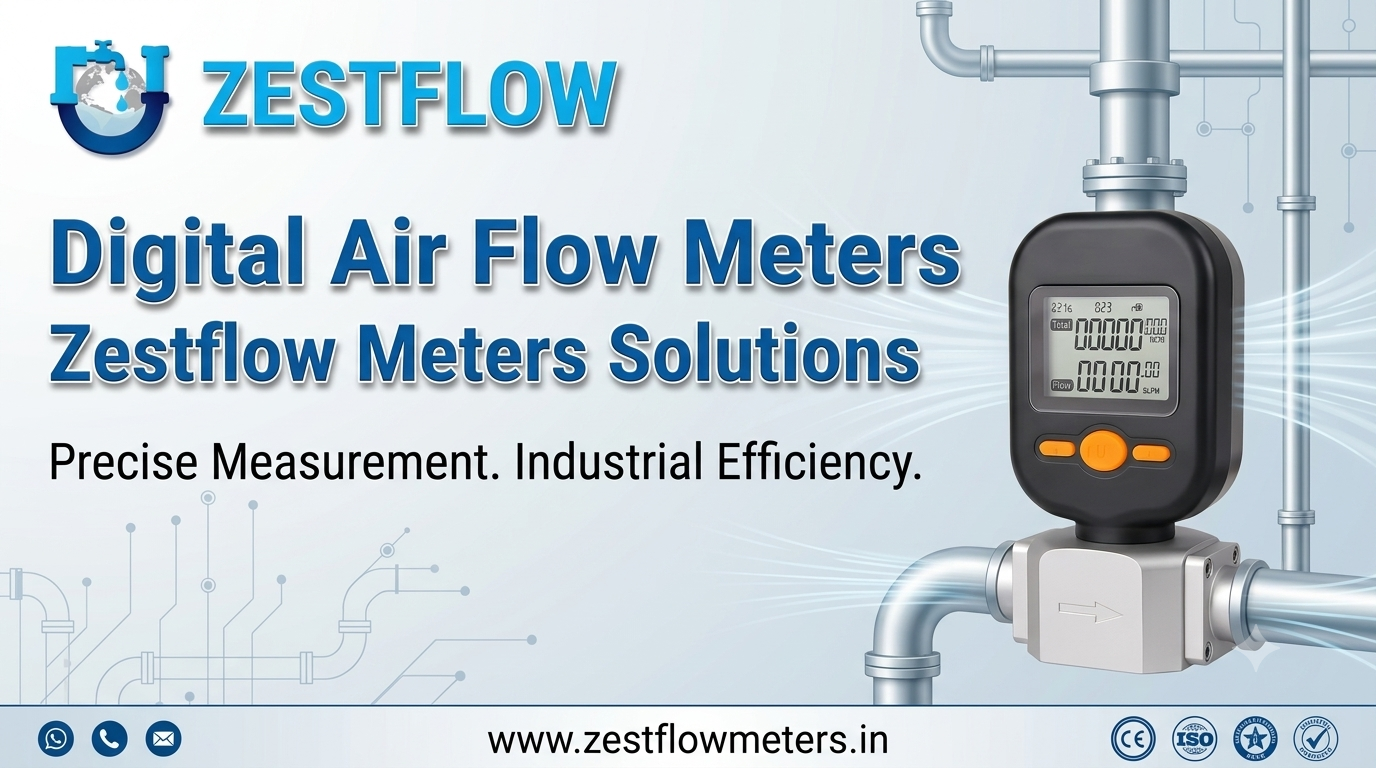
Digital Air Flow Meters are electronic instruments used to measure and display the flow of air or other compatible gases. Instead of relying only on a mechanical scale, these instruments use sensors and electronic processing to determine the flow rate and present the measurement on a digital display.
Zestflow’s Air Flow Meter range includes models designed around flow sensor technology. Its published specifications include LCD display, selectable flow ranges, optional RS485 output, and measurement accuracy listed at approximately 2% for the referenced models.
The appropriate meter depends on several factors, including:
- Required flow range
- Type of gas
- Operating pressure
- Operating temperature
- Required accuracy
- Pipe or tubing connection size
- Display requirements
- Communication requirements
- Installation environment
Choosing the right instrument is essential because a flow meter that is incorrectly sized or unsuitable for the application may provide unreliable readings.
How Do Digital Air Flow Meters Work?
The working principle depends on the specific flow-meter technology. Airflow meters can use different sensing methods, including thermal, differential-pressure, vortex, variable-area, and other technologies.
For the air flow meter models published by Zestflow, the working methodology is based on flow sensor chip technology involving heat and mass transfer principles. The sensor detects changes associated with gas flow and the electronics process the signal to calculate and display the flow rate.
A simplified measurement process can be understood as follows:
1. Air enters the meter through the inlet connection.
2. The sensor detects the movement of air through the measurement section.
3. The sensor produces an electronic signal corresponding to the flow.
4. Internal electronics process the signal.
5. The measured value is displayed digitally.
6. Where supported, the meter can transmit data through an output such as RS485.
This electronic measurement approach makes digital instruments useful for applications requiring convenient monitoring and integration with industrial systems.
Key Features of Digital Air Flow Meters
Modern Digital Air Flow Meters can provide several useful features for industrial and technical applications.
1. Digital Display
A digital display makes it easier for operators to read the measured airflow directly. Zestflow’s referenced air flow meter models use LCD displays and provide flow readings in specified units.
2. Multiple Measuring Ranges
Different applications require different flow capacities. Zestflow’s published ZEA1005 and ZEA1008 models cover ranges including 0–10 L/min, 0–25 L/min, and up to 0–200 L/min, depending on the model.
3. Optional RS485 Output
Digital communication can be valuable when airflow data needs to be transferred to another monitoring or control system. The referenced Zestflow models offer RS485 as an optional output.
4. Compact Construction
Compact airflow meters can be particularly useful where installation space is limited. Selecting the correct connection and physical dimensions is nevertheless important before installation.
5. Adjustable Functions
The published Zestflow specifications include functions such as password setting, zero reset, and alert setting for the referenced models.
6. Electronic Measurement
Electronic sensing can provide convenient measurement without depending exclusively on a mechanical indicator. This makes digital meters suitable for modern monitoring applications.
Benefits of Using Digital Air Flow Meters
There are several reasons industries choose digital airflow measurement instead of relying on basic visual indicators.
- Improved Monitoring
Digital displays provide direct measurement information, helping operators monitor airflow conditions more conveniently.
- Better Process Control
Airflow can affect combustion, ventilation, pneumatic equipment, laboratory processes, and other industrial operations. Accurate airflow information can therefore help operators maintain desired process conditions.
Industrial airflow measurement is commonly used for process optimization, equipment efficiency, and operational control.
- Easy Data Integration
Models supporting communication outputs can be connected with monitoring and automation systems, depending on the system architecture and communication requirements.
- Energy Management
Air and compressed-air systems can consume significant energy. Monitoring airflow can help identify abnormal consumption, leaks, or inefficient operating conditions. Industrial manufacturers also use airflow measurement for resource and energy optimization.
- Convenient Operation
A digital display can make routine inspection easier because operators can directly read the measurement instead of interpreting a mechanical scale.
- Flexible Applications
Airflow measurement is relevant to several industries, including mechanical and electrical equipment, pharmaceuticals, research institutions, glass, beverage, chemical, and analytical instrumentation applications.
Applications of Digital Air Flow Meters
Digital Air Flow Meters can be used in many environments where controlled airflow measurement is required.
- Pharmaceutical Industry
Pharmaceutical manufacturing and laboratory environments can require controlled air and gas flow for different processes and equipment. Suitable flow measurement instruments can help operators monitor required flow conditions.
- Chemical Industry
Chemical processes frequently use gases as part of manufacturing or processing operations. An appropriate airflow or gas-flow instrument can help monitor these systems.
- Research Laboratories
Laboratories may require accurate measurement of air, oxygen, or other gases for testing and research equipment.
- Mechanical and Electrical Industries
Manufacturing equipment and testing systems may require airflow measurement for cooling, pneumatic processes, or controlled gas supply.
- Beverage Industry
Air and gas flow can be relevant to processing and production equipment. Digital measurement can assist operators in monitoring system conditions.
- Glass Industry
Glass manufacturing can involve controlled combustion and gas-flow processes. Airflow measurement can contribute to process monitoring.
- Analytical Instruments
Air and gas flow can be important for analytical and laboratory instruments where stable flow conditions are necessary.
- Compressed Air Systems
Compressed air is widely used in industrial facilities. Flow measurement can help businesses understand consumption and improve resource management. Airflow meters are also used for monitoring compressed air and specialty gases in manufacturing applications.
Important Specifications to Consider
Before purchasing Digital Air Flow Meters, users should carefully evaluate the technical requirements of their application.
- Measuring Range
The first consideration should be the minimum and maximum expected flow rate.
For example, Zestflow’s published air flow meter specifications include models covering 0–10 L/min, 0–25 L/min, and 0–200 L/min.
The meter should be selected according to the actual operating range rather than simply choosing the largest available range.
- Accuracy
Accuracy determines how closely the measured value represents the actual flow. Zestflow lists 2% accuracy for the referenced air flow meter models.
Applications with strict measurement requirements may require a more detailed evaluation of accuracy across the complete operating range.
- Operating Pressure
The meter must be capable of operating safely at the pressure present in the application. Zestflow’s referenced models list a working pressure of up to 0.8 MPa.
- Operating Temperature
Temperature can affect sensor performance. The referenced Zestflow models specify a working temperature range of approximately -10°C to +55°C.
- Connection Size
Connection compatibility is essential for installation. Zestflow lists 1/4-inch NPT and 1/2-inch NPT connections for the referenced models.
- Output
If the meter needs to communicate with another system, check whether an appropriate output is available. RS485 is listed as an optional output for the referenced Zestflow air flow meter models.
Installation Considerations
Correct installation is essential for reliable airflow measurement.
Before installation, check the manufacturer’s technical documentation and confirm:
- Flow direction
- Pipe or tube size
- Connection type
- Operating pressure
- Operating temperature
- Gas compatibility
- Electrical supply
- Output requirements
- Environmental conditions
The meter should be installed according to the manufacturer’s recommendations. Improper installation, unsuitable piping arrangements, contamination, or operating conditions outside the specified limits can affect measurement performance.
Maintenance of Digital Air Flow Meters
Digital air flow meters generally require routine inspection and appropriate maintenance based on the application.
A basic maintenance program may include:
1. Inspecting the meter and connections.
2. Checking for leaks.
3. Confirming that the display operates correctly.
4. Inspecting electrical connections.
5. Checking communication output where applicable.
6. Keeping the measurement system clean.
7. Comparing readings with reference measurements when required.
8. Following recommended calibration procedures.
The maintenance interval should depend on the operating environment, measurement criticality, gas quality, and manufacturer’s recommendations.
Why Choose Zestflow Meters Solutions?
Zestflow Meters Solutions focuses on flow measurement, process instrumentation, and automation solutions. Its product portfolio includes electromagnetic flow meters, digital water flow meters, turbine flow meters, ultrasonic flow meters, gas flow meters, air flow meters, analytical instruments, and other measurement products.
The company’s published Air Flow Meter information identifies applications across mechanical and electrical industries, pharmaceuticals, research institutions, glass, beverage, chemical, and analytical instrument industries.
Zestflow also highlights precision measurement, automation, customized engineering, and ongoing technical support as part of its instrumentation approach.
For businesses looking for an airflow measurement solution, the correct product should be selected based on the actual application rather than choosing a meter only by price. Flow range, pressure, temperature, gas type, accuracy, connection, display, and communication requirements should all be considered.
Conclusion
Digital Air Flow Meters are valuable instruments for applications where accurate, convenient, and reliable airflow measurement is required. By providing electronic measurement and digital display capabilities, they can make airflow monitoring easier while supporting modern process-control and monitoring requirements.
The correct meter should always be selected according to the application’s gas type, flow range, pressure, temperature, accuracy requirements, connection, and communication needs. Zestflow Meters Solutions provides Air Flow Meter solutions alongside a broader portfolio of industrial flow measurement and instrumentation products.
Whether the requirement is for laboratory equipment, pharmaceutical applications, chemical processes, industrial systems, or other airflow-related applications, selecting a properly specified instrument is essential for dependable measurement.
For businesses searching for Digital Air Flow Meters, Zestflow Meters Solutions can be considered for flow measurement and instrumentation requirements.