
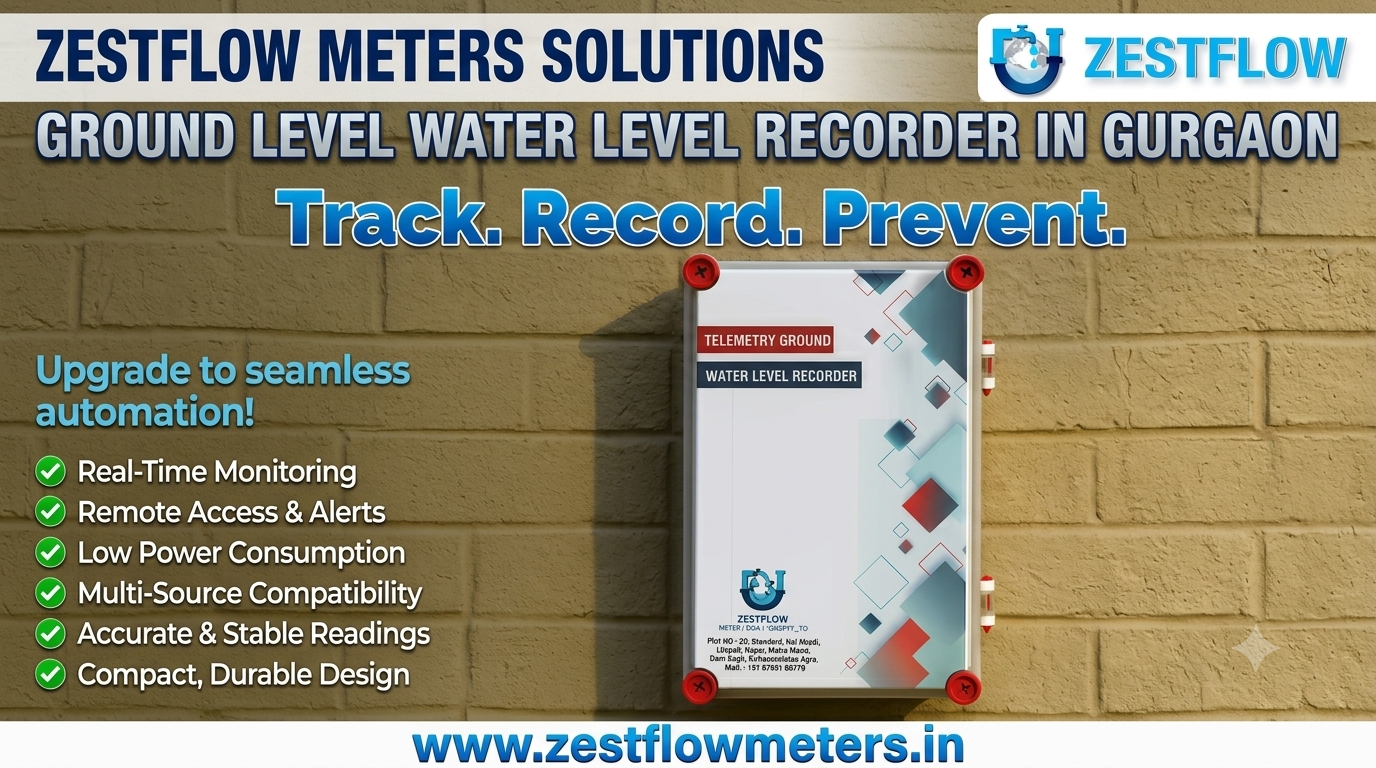
Ground Level Recorder in Gurgaon for Efficient Groundwater Management - Zestflow Meters Solutions
Water management has become an essential part of modern residential, commercial, and industrial infrastructure. As cities continue to grow and water consumption increases, monitoring groundwater levels accurately is more important than ever. Whether it is a residential complex, an industrial facility, a construction project, or a groundwater monitoring station, having the right equipment can make a significant difference in maintaining water resources and improving operational efficiency.
Zestflow Meters Solutions understands the importance of dependable water monitoring technology and provides solutions designed to support accurate measurement, reliable data collection, and efficient water resource management. If you are searching for a Ground level recoder in Gurgaon, choosing the right equipment and supplier can help you monitor groundwater conditions more effectively and make informed decisions.
A ground level recorder is a useful instrument for recording changes in groundwater levels over time. It helps engineers, facility managers, environmental professionals, and water resource specialists understand how water levels fluctuate under different conditions. With appropriate monitoring equipment, organizations can improve groundwater assessment, identify unusual changes, and plan water usage more responsibly.
In this article, we explore the importance of groundwater level recording, the benefits of using reliable monitoring instruments, their applications, and why Zestflow Meters Solutions can be considered when looking for groundwater monitoring solutions in Gurgaon.
What Is a Ground Level Recorder?
A ground level recorder, commonly referred to in groundwater monitoring as a groundwater level recorder, is an instrument used to measure and record changes in the water level below the ground surface.
Depending on the equipment design, a groundwater level recording system may use sensors, pressure measurement technology, data logging capabilities, or other measurement methods to track water levels in wells, borewells, and observation points.
Unlike occasional manual measurements, an automated recording system can collect data at predetermined intervals. This provides a more detailed picture of groundwater fluctuations and makes it easier to identify patterns over days, weeks, or months.
For example, an industrial facility that relies on groundwater may need to understand whether the water level is declining during periods of high consumption. Similarly, a construction company may need groundwater information to plan excavation activities and assess site conditions.
A suitable recording instrument can support these activities by providing consistent measurements and a useful historical record.
When looking for a Ground level recoder in Gurgaon, it is important to understand your monitoring requirements before selecting a product. Measurement range, installation conditions, recording frequency, data accessibility, and compatibility with existing monitoring infrastructure are all important considerations.
Why Groundwater Level Monitoring Is Important in Gurgaon
Gurgaon, also known as Gurugram, has experienced substantial residential, commercial, and industrial development. This growth has increased the importance of responsible water management across housing societies, office buildings, manufacturing facilities, infrastructure projects, and other establishments.
Groundwater can be an important water source for various applications. However, groundwater availability can change because of rainfall, seasonal demand, extraction rates, recharge conditions, and local geological characteristics.
Without dependable monitoring, it can be difficult to understand these changes accurately.
1. Understanding Groundwater Fluctuations
Groundwater levels can rise or fall throughout the year. Rainfall may contribute to recharge in some locations, while increased pumping can cause water levels to decline.
A groundwater level recorder helps users observe these fluctuations and compare measurements over time.
This information can be useful when evaluating the performance of a borewell, studying seasonal changes, or assessing the effects of groundwater extraction.
2. Supporting Responsible Water Consumption
Organizations that depend on groundwater need reliable information to understand their water sources.
Recording groundwater levels can help facility managers identify changes that may require further investigation. For example, a consistent decline in water levels may indicate that extraction patterns, recharge conditions, or other local factors need closer attention.
Although a recorder does not independently determine the cause of a decline, its data can support better investigation and planning.
3. Improving Construction Site Planning
Construction activities often require careful consideration of underground conditions. Groundwater information may be relevant to excavation, foundation planning, basement construction, and dewatering operations.
Depending on the project, engineers may use groundwater monitoring data to assess changes in water levels and support site management decisions.
A suitable monitoring solution can provide useful records throughout different stages of a construction project.
4. Supporting Environmental Monitoring
Groundwater monitoring is also important for environmental assessments and water resource studies.
Researchers and environmental professionals may use recorded measurements to evaluate seasonal patterns, observe long-term changes, and compare groundwater conditions at different monitoring locations.
Reliable measurements can improve the quality of the information available for environmental planning.
Ground Level Recorder in Gurgaon: Why Choose the Right Equipment?
Choosing a suitable Ground level recoder in Gurgaon involves more than comparing prices or selecting the first available instrument.
The equipment should match the specific conditions in which it will be used. Different monitoring projects have different requirements, and the right solution depends on the intended application.
For instance, a basic observation well may require a different monitoring arrangement from an industrial facility that needs frequent measurements and remote access to recorded data.
Before making a decision, consider the following factors.
Measurement Accuracy
Measurement accuracy is one of the most important considerations when selecting a groundwater monitoring instrument.
Accurate measurements help users compare readings over time and identify meaningful changes in groundwater levels.
When evaluating equipment, review the manufacturer’s stated accuracy, measurement range, calibration requirements, and recommended operating conditions.
It is also important to consider installation quality because an incorrectly installed instrument may produce unreliable readings even when the equipment itself meets its specifications.
Recording Frequency
Different applications require different measurement intervals.
Some projects may only need periodic readings, while others may require measurements every few minutes or hours.
A suitable recording frequency depends on how quickly groundwater levels are expected to change and how the collected information will be used.
Before purchasing a recorder, determine whether it supports the required sampling intervals and provides sufficient storage for the expected monitoring period.
Data Storage and Accessibility
Groundwater monitoring is most useful when measurements can be reviewed, compared, and interpreted conveniently.
Depending on the model, recording systems may store readings internally, allow data transfer to a computer, or support remote monitoring through compatible communication systems.
If your project involves several monitoring locations, consider how easily the collected data can be accessed and organized.
Durability and Operating Conditions
Groundwater monitoring instruments may operate in demanding environments, including wells, borewells, outdoor observation points, and industrial sites.
The selected instrument should be appropriate for the expected moisture exposure, temperature range, installation depth, and other site conditions.
Review the equipment’s environmental ratings and maintenance requirements before installation.
Installation and Maintenance
A monitoring system should be practical to install and maintain.
Ask about installation procedures, sensor placement, calibration requirements, battery replacement where applicable, and recommended inspection schedules.
Understanding these requirements in advance can help reduce operational interruptions and improve the long-term reliability of recorded measurements.
Key Features to Look for in a Groundwater Level Recorder
The best groundwater monitoring solution is one that meets the actual needs of the project. While features vary by model, several capabilities are worth evaluating when searching for a Ground level recoder in Gurgaon.
Automatic Data Logging
Automatic data logging allows an instrument to record measurements without requiring an operator to take every reading manually.
This feature can be particularly useful for long-term monitoring projects where regular measurements are needed over an extended period.
Automated recording can also help create a consistent historical dataset for later analysis.
Sensor-Based Measurement
Depending on the system, groundwater levels may be measured using pressure-based sensors, level sensors, or other measurement technologies.
The appropriate technology depends on the monitoring environment, required accuracy, installation arrangement, and the nature of the water source.
Users should confirm that the selected sensor is suitable for the intended well or borewell configuration.
Data Download and Analysis
Some groundwater recorders provide options for transferring recorded measurements to external devices or software.
This can make it easier to generate reports, compare readings, and identify changes over time.
For organizations that maintain multiple observation points, convenient data management can improve monitoring efficiency.
Remote Monitoring Capabilities
Certain advanced systems support remote data access through compatible communication technologies.
Remote monitoring can be useful when observation wells are spread across a large site or when regular physical visits are inconvenient.
However, remote connectivity depends on the particular product, communication infrastructure, and available network coverage. Buyers should confirm these capabilities before selecting a system.
Reliable Long-Term Performance
A groundwater monitoring instrument should provide dependable performance under its specified operating conditions.
Important factors include build quality, sensor stability, calibration procedures, data retention, and the availability of technical support.
Selecting equipment based on these practical requirements can help support more consistent monitoring over time.
Applications of Ground Level Recorders
Groundwater level recorders can be used in a variety of sectors where understanding underground water conditions is important.
1. Industrial Facilities
Manufacturing units, processing plants, and other industrial establishments may depend on groundwater for specific operational requirements, subject to applicable permissions and regulations.
Monitoring groundwater levels can help facility managers understand changes in water availability and review the performance of their monitoring wells.
Recorded information may also support internal water management reports and environmental monitoring activities.
2. Residential Societies and Commercial Buildings
Large residential communities, office complexes, hotels, and commercial establishments may maintain borewells or groundwater observation points.
A suitable monitoring instrument can help facility management teams observe water level trends and investigate unusual changes.
This information can contribute to better water planning, particularly where groundwater is an important part of the overall water supply.
3. Construction and Infrastructure Projects
Construction companies may need groundwater information during excavation, foundation work, tunnelling, or other activities that interact with subsurface conditions.
Monitoring groundwater levels can help engineers assess site conditions and evaluate changes during project execution.
The data should be interpreted alongside geotechnical investigations and other relevant engineering information.
4. Agricultural Applications
Farmers and agricultural organizations may use groundwater monitoring to understand changes in well water levels and support irrigation planning.
When combined with rainfall information, irrigation records, and local groundwater assessments, recorded measurements can contribute to more informed water management decisions.
A recorder does not directly measure soil moisture or determine crop water requirements, but groundwater information can be useful when interpreted within a broader agricultural management plan.
5. Environmental Research and Water Resource Studies
Environmental consultants, research institutions, and water resource professionals may install groundwater monitoring instruments at observation wells.
These instruments can help collect data for seasonal assessments, groundwater studies, and long-term environmental monitoring.
Where multiple monitoring points are involved, consistent measurement procedures are particularly important for meaningful comparisons.
6. Government and Institutional Monitoring Projects
Certain public-sector and institutional projects require groundwater observations for research, resource assessment, or environmental management.
Equipment selection should follow the project’s technical specifications, applicable standards, and procurement requirements.
A reliable recording arrangement can help maintain a structured history of groundwater measurements.
Benefits of Using a Groundwater Level Recorder
Investing in appropriate groundwater monitoring equipment can provide several practical advantages.
Better Understanding of Water Availability
Regular measurements help users understand how groundwater levels change over time.
This information can support decisions about water usage, investigation of declining levels, and planning for future monitoring activities.
However, groundwater level alone does not establish the total volume of water available in an aquifer. A complete assessment may require additional hydrogeological information.
Reduced Dependence on Manual Readings
Automated recording can reduce the need for repeated manual measurements, depending on the monitoring system and the frequency of observations required.
This may save staff time and make it easier to collect data consistently.
Manual checks can still be valuable for verification, maintenance, and quality assurance.
Improved Historical Data Collection
Groundwater conditions can change gradually, making historical records important for identifying trends.
A recorder can provide a structured dataset that allows users to compare measurements across different periods.
These records may help identify recurring seasonal patterns or changes that deserve further investigation.
More Informed Operational Decisions
Facility managers and engineers can use groundwater monitoring information alongside other operational data to make more informed decisions.
For example, a sustained change in recorded levels may prompt a review of pumping schedules, site conditions, or water management practices.
The instrument provides the measurements; qualified professionals interpret those measurements in the context of the project.
Support for Monitoring and Reporting
Organizations may need to maintain groundwater records for project documentation, environmental studies, or internal reporting.
An appropriate recording system can simplify the collection and organization of measurements.
Any formal regulatory reporting should follow the relevant authority’s requirements for measurement methods, documentation, and data quality.
Why Consider Zestflow Meters Solutions for Groundwater Monitoring?
Selecting a supplier is an important part of purchasing measurement equipment. The supplier should be able to help you understand product specifications, evaluate compatibility with your application, and identify the technical information needed before installation.
Zestflow Meters Solutions is the business featured in this article for customers exploring water measurement and monitoring solutions.
If you are searching for a Ground level recoder in Gurgaon, consider discussing your requirements with Zestflow Meters Solutions to determine which available product, if any, matches your project.
When evaluating the right solution, it is helpful to discuss the following areas.
Understanding Your Application
Every groundwater monitoring project has different requirements.
A construction site may need groundwater measurements during excavation, while an industrial establishment may require long-term observations at one or more borewells.
Clearly explaining your application helps establish the necessary measurement range, recording interval, installation arrangement, and data access requirements.
Product Specifications and Compatibility
Before selecting an instrument, request the technical specifications for the relevant model.
These may include measurement range, accuracy, sensor type, recording interval, memory capacity, communication options, power requirements, and environmental ratings.
The specifications should be compared with the actual requirements of your monitoring site.
Technical Guidance
Understanding installation and operation is essential for obtaining useful measurements.
Ask for information about sensor placement, installation depth, calibration, maintenance, and data retrieval.
If your project has specialized requirements, confirm whether the supplier can provide the necessary technical guidance or direct you to an appropriate service professional.
Long-Term Usability
Groundwater monitoring is often a continuing activity rather than a one-time measurement.
Consider the availability of replacement components, maintenance instructions, technical documentation, and any required software or communication accessories.
These factors can influence the overall practicality of the monitoring system throughout its service life.
Transparent Commercial Information
Before placing an order, obtain a clear quotation covering the selected model, supplied accessories, applicable taxes, delivery arrangements, installation responsibilities, warranty conditions, and support provisions.
This allows you to compare solutions on their overall suitability rather than price alone.
Specific product availability, pricing, warranty terms, and service capabilities should be confirmed directly with Zestflow Meters Solutions.
How to Select the Right Ground Level Recorder for Your Project
Finding the appropriate instrument becomes easier when you follow a structured selection process.
Step 1: Define the Monitoring Objective
Begin by identifying why groundwater levels need to be recorded.
Are you monitoring a borewell for operational purposes? Studying seasonal groundwater changes? Supporting a construction project? Or collecting environmental monitoring data?
The objective determines which features are necessary.
Step 2: Assess the Monitoring Location
Evaluate the physical conditions at the site.
Consider the type of well, its depth, access restrictions, environmental exposure, and whether the instrument will be installed permanently or used for temporary monitoring.
These details help determine which sensor arrangement and installation method are appropriate.
Step 3: Determine the Required Measurement Range
Identify the expected range of groundwater fluctuations.
The selected instrument should be capable of measuring the required water levels within its specified operating limits.
If the expected range is uncertain, consult a qualified groundwater professional or the equipment supplier before purchasing.
Step 4: Decide How Often Data Must Be Recorded
Choose a recording interval that reflects the monitoring objective.
Short intervals may be necessary when water levels change rapidly, whereas longer intervals may be suitable for some routine observation programs.
Ensure that the instrument can maintain the required recording schedule and store the resulting measurements.
Step 5: Review Data Management Requirements
Determine whether measurements will be downloaded manually, reviewed through compatible software, or accessed remotely.
For projects involving multiple locations, consider how readings will be identified, organized, backed up, and analyzed.
Good data management practices are just as important as selecting suitable measurement equipment.
Step 6: Confirm Installation and Maintenance Requirements
Ask about installation procedures, calibration, routine inspections, and replacement parts.
A practical maintenance plan can help preserve measurement reliability and reduce the risk of unexpected interruptions.
Step 7: Compare Suitable Options
Once your technical requirements are clear, compare available models based on their specifications, suitability, operating costs, support arrangements, and warranty conditions.
Avoid choosing an instrument solely because it offers more features. The most appropriate solution is the one that reliably meets your actual monitoring needs.
Ground Level Recorder Installation and Maintenance Best Practices
Even a suitable groundwater monitoring instrument requires correct installation and regular attention to provide dependable measurements.
Install the Equipment According to Its Specifications
Follow the manufacturer’s installation instructions and use an appropriate mounting arrangement.
The sensor must be positioned correctly for the intended measurement method. Improper installation can introduce errors or interfere with normal operation.
For permanent monitoring installations, qualified personnel should assess the site and confirm that the installation method is suitable.
Establish a Baseline Measurement
Where practical, collect an initial reference measurement and document the conditions under which it was taken.
A baseline provides a useful starting point for comparing subsequent observations.
Record relevant details such as the measurement date, monitoring location, reference elevation where applicable, and any known pumping activity.
Maintain Consistent Measurement References
Groundwater level measurements should use a consistent reference point and a clearly documented measurement method.
This is particularly important when comparing readings collected by different people or instruments.
If the reference point changes, document the change carefully so that the resulting measurements can be interpreted correctly.
Check Calibration and Sensor Performance
Follow the manufacturer’s recommendations for calibration and functional checks.
Periodic verification can help identify sensor drift, damage, or other issues that may affect measurement quality.
The appropriate inspection schedule depends on the instrument, operating environment, and project requirements.
Protect and Back Up Recorded Data
For systems that store electronic measurements, establish a suitable process for downloading and backing up records.
Maintain clear file names, dates, monitoring point identifiers, and measurement units.
A structured recordkeeping process makes it easier to review long-term trends and investigate unexpected readings.
Investigate Unusual Measurements
If the recorder indicates a sudden or unexpected change, verify the reading before drawing conclusions.
Check for potential equipment issues, changes in pumping activity, sensor disturbance, or actual changes in groundwater conditions.
Where necessary, obtain an independent measurement or consult a qualified professional.
Common Mistakes to Avoid When Buying a Groundwater Level Recorder
Selecting the wrong monitoring equipment can lead to unnecessary costs and unreliable information. Avoiding a few common mistakes can make the purchasing process more effective.
Choosing equipment without defining requirements: A recorder should be selected according to the monitoring objective, installation conditions, and required measurement range.
Ignoring data storage capacity: Projects with frequent readings may generate substantial amounts of data. Confirm that the selected system can store or transfer the expected volume of information.
Overlooking environmental suitability: Equipment must be suitable for the conditions in which it will operate. Review applicable protection ratings and installation limitations.
Assuming all recorders offer remote monitoring: Wireless connectivity, cloud access, and remote reporting are product-specific features. Confirm their availability rather than assuming they are included.
Neglecting maintenance requirements: Sensors and recording systems may require inspection, calibration, battery replacement, or other routine maintenance.
Comparing products on price alone: A low initial purchase price may not represent the best overall value if the instrument does not meet your requirements or requires costly additional components.
Failing to document measurements: Even accurate readings become less useful when dates, locations, reference points, and units are missing.
By addressing these issues before purchasing, you can improve the chances of choosing a suitable groundwater monitoring solution.
Understanding Groundwater Monitoring Data
A groundwater level recorder provides measurements, but understanding what those measurements mean requires careful interpretation.
Groundwater levels can respond to rainfall, pumping, seasonal changes, nearby construction, and local geological conditions. These influences may differ significantly from one location to another.
Water Level and Groundwater Depth
Groundwater depth generally refers to the distance from a defined ground reference point to the water surface in a well.
Water level elevation, by contrast, expresses the water surface relative to a common elevation datum.
These measurements serve different purposes. When comparing multiple observation wells, using a consistent reference system can be essential.
Seasonal Variations
Groundwater levels may fluctuate between seasons depending on local recharge, extraction, and hydrogeological conditions.
Long-term recording can help distinguish recurring seasonal patterns from unusual changes, provided the monitoring period and data quality are sufficient.
The Influence of Pumping
Groundwater extraction may cause water levels to decline near a pumping well. The magnitude and duration of the change depend on several factors, including pumping rate, aquifer properties, and nearby water use.
Monitoring data can help identify changes associated with pumping, but additional information may be needed to establish a reliable explanation.
Why Consistent Records Matter
Measurements collected using consistent methods are easier to compare and interpret.
Maintaining accurate timestamps, reference elevations where relevant, sensor information, and records of major site activities can improve the usefulness of the collected data.
These practices help organizations turn raw measurements into information that supports practical water management.
Who Should Consider a Ground Level Recorder in Gurgaon?
Groundwater recording equipment may be useful for a broad range of users, depending on their water monitoring responsibilities.
Builders and construction contractors may need groundwater information for excavation planning, foundation work, and site observation.
Industrial operators may monitor groundwater conditions at facilities where borewells or observation wells form part of their water management infrastructure.
Residential property managers may use groundwater observations to better understand changes in water levels at monitored locations.
Environmental consultants may require recorded groundwater measurements for assessments, investigations, and monitoring programs.
Agricultural users may benefit from observing groundwater trends when managing irrigation sources and planning water use.
Research institutions and technical professionals may use recording instruments to collect data for groundwater studies and related investigations.
Before choosing a product, each user should establish whether the instrument meets the technical and documentation requirements of the intended application.
Questions to Ask Before Purchasing a Groundwater Level Recorder
If you are considering a groundwater monitoring instrument from Zestflow Meters Solutions or another supplier, the following questions can help you make a more informed decision.
What measurement range does the instrument support?
What is the specified measurement accuracy?
Which sensor technology does the system use?
Can the recording interval be adjusted?
How are measurements stored and retrieved?
Does the model support remote monitoring, if required?
What power supply or battery arrangement does it use?
What installation conditions and environmental limitations apply?
How frequently should the instrument be inspected or calibrated?
What warranty, technical documentation, and after-sales support are available?
Are installation services or compatible accessories included in the quotation?
Does the equipment satisfy the relevant project specifications and applicable requirements?
Getting clear answers to these questions can help you compare available products and avoid purchasing equipment that is unsuitable for your monitoring needs.
Why Reliable Groundwater Monitoring Matters for the Future
As water demand and infrastructure development continue to evolve, dependable groundwater information will remain important for responsible water resource management.
Monitoring does not replace conservation, recharge planning, regulatory compliance, or professional hydrogeological assessment. Instead, it provides one of the information sources needed to understand groundwater conditions and evaluate the effectiveness of water management practices.
For businesses and institutions in Gurgaon, adopting a suitable groundwater monitoring approach can support better documentation, improved awareness of changing water levels, and more informed operational decisions.
Modern recording systems may also offer opportunities to streamline data collection and improve access to historical measurements, depending on the selected technology.
The key is to choose equipment that fits the application, maintain it properly, and interpret its measurements within the broader context of local groundwater conditions.
Choose Zestflow Meters Solutions for Your Groundwater Monitoring Requirements
Finding an appropriate groundwater monitoring instrument starts with understanding your site, measurement objectives, and data requirements.
Zestflow Meters Solutions is a relevant point of contact for readers exploring water measurement equipment and seeking information about suitable monitoring solutions. If you are looking for a Ground level recoder in Gurgaon, prepare your technical requirements before contacting the company so that the available options can be evaluated against your specific needs.
Discuss the required measurement range, installation depth, recording frequency, data storage, connectivity, maintenance, and project conditions. Request the relevant product specifications and confirm pricing, availability, warranty terms, and technical support directly with the supplier.
Taking these steps can help you identify an instrument that is appropriate for your groundwater monitoring project rather than relying on assumptions about product capabilities.
Conclusion
Groundwater monitoring plays an important role in understanding water availability, observing seasonal fluctuations, supporting construction planning, and improving water management practices. A suitable ground level recorder can help collect consistent measurements, maintain historical records, and provide useful information for technical and operational decisions. For organizations, builders, industrial facilities, and other users seeking a Ground level recoder in Gurgaon, the right choice depends on measurement accuracy, recording frequency, sensor suitability, data accessibility, and long-term maintenance requirements. Zestflow Meters Solutions is the business featured here for customers exploring water measurement and monitoring equipment. By defining your requirements, reviewing product specifications, and confirming the available technical and commercial support, you can make a more informed decision and establish a groundwater monitoring system that supports your project’s objectives and responsible water management.