
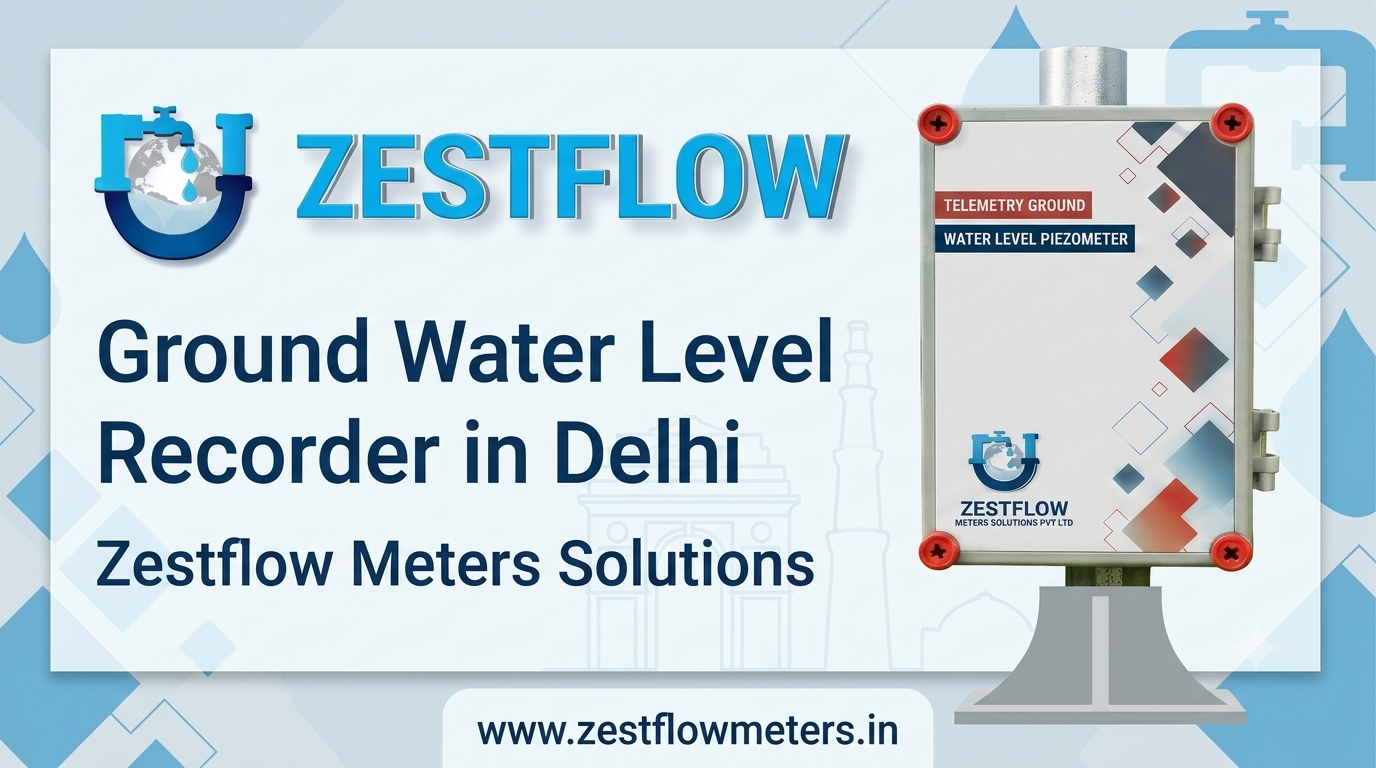
Ground Water Level Recorder in Delhi: A Complete Guide to Accurate Groundwater Monitoring
Water is one of the most valuable natural resources, and groundwater plays an essential role in supporting residential communities, industries, agriculture, and infrastructure development. In a rapidly developing metropolitan area like Delhi, monitoring groundwater levels is increasingly important for responsible water management. Businesses, environmental consultants, construction companies, research institutions, and water management professionals need reliable information about groundwater fluctuations to make informed decisions.
This is where a Ground Water Level Recorder in Delhi becomes an important monitoring solution. These instruments help measure and record changes in groundwater levels over time, enabling users to understand water availability, identify trends, and support effective groundwater management strategies.
Zestflow Meters Solutions aims to serve customers seeking groundwater measurement and monitoring solutions for different applications. Selecting the right groundwater level recorder can help improve data collection, simplify monitoring activities, and support better planning for water conservation.
In this article, we explore groundwater level recorders, their working principles, key features, benefits, applications, selection criteria, and the importance of choosing a suitable solution for groundwater monitoring in Delhi.
What Is a Ground Water Level Recorder?
A groundwater level recorder is an instrument designed to measure and record the level of groundwater within a borewell, observation well, piezometer, or other suitable monitoring point. Depending on the model, it can provide manual readings, automated measurements, or continuous data logging.
Some groundwater monitoring systems use pressure sensors to determine the water level based on the pressure exerted by the water column. Other systems use water-level sensing probes, measuring tapes, or specialized electronic sensors.
Modern automatic groundwater level recorders can store measurements at predefined intervals. Certain models also support remote data transmission, allowing authorized users to access monitoring information without visiting the measurement location for every reading.
A suitable groundwater level recorder can help users collect consistent information about seasonal variations, water extraction effects, recharge patterns, and long-term groundwater trends.
Why Is Groundwater Monitoring Important in Delhi?
Delhi experiences significant demand for water from residential areas, commercial establishments, industrial facilities, and public infrastructure. Groundwater may supplement other water supplies, making its responsible management an important consideration.
Regular groundwater monitoring helps organizations understand how water levels change over time. It can also provide useful information when evaluating the effects of pumping, rainfall, recharge activities, and seasonal demand.
A reliable Ground Water Level Recorder in Delhi can support several important objectives:
Water resource management: Track groundwater levels and understand changes in local water availability.
Environmental monitoring: Collect information for groundwater studies and environmental assessments.
Construction projects: Monitor groundwater conditions around excavation sites, foundations, and other infrastructure works.
Industrial applications: Support groundwater observation at industrial premises and water management facilities.
Research and surveys: Generate time-based measurements for hydrogeological studies and technical reports.
Water conservation: Help organizations evaluate groundwater trends and plan appropriate conservation measures.
Groundwater monitoring data should be interpreted alongside relevant site conditions, rainfall information, pumping records, and hydrogeological assessments. A recorder provides measurements; it does not independently establish whether a groundwater source is sustainable.
Key Features of a Ground Water Level Recorder
When evaluating groundwater monitoring equipment, it is important to consider the technical features required for the intended application. Different projects need different measurement ranges, recording intervals, installation arrangements, and communication capabilities.
1. Accurate Water-Level Measurement
Measurement accuracy is one of the most important factors when choosing a groundwater level recorder. The appropriate instrument should meet the accuracy and resolution requirements of the project.
Users should review the manufacturer’s specifications, calibration information, measurement range, and recommended operating conditions before selecting a device.
2. Automatic Data Logging
Automatic data logging reduces the need for repeated manual measurements. Depending on the model, a recorder can capture readings at scheduled intervals and store them for later analysis.
This capability is particularly useful for long-term monitoring projects where groundwater levels may change throughout the day, across seasons, or in response to pumping activity.
3. Long-Term Monitoring Capability
For monitoring programs that run over several months or years, equipment reliability and storage capacity are important considerations. Battery life, sensor durability, memory capacity, and maintenance requirements should be evaluated before installation.
4. Digital Data Access
Some advanced recorders provide digital data access through compatible software, data interfaces, or remote communication systems. These capabilities can simplify reporting and reduce the effort required to collect measurements from multiple monitoring points.
Data transmission options depend on the selected product and the availability of suitable connectivity at the installation site.
5. Suitable Sensor and Probe Options
Different wells and monitoring environments require different sensor configurations. Pressure-based sensors may be suitable for continuous water-level monitoring, while manual water-level indicators may be appropriate for periodic readings.
The selected sensor should be compatible with the well depth, water conditions, installation arrangement, and required measurement range.
6. Easy Installation and Maintenance
An appropriate instrument should be practical to install, inspect, and maintain. Users should consider cable length, mounting arrangements, sensor protection, access to the monitoring point, and the availability of technical support.
Proper installation and periodic verification help improve measurement consistency over the life of the monitoring system.
Benefits of Choosing a Ground Water Level Recorder in Delhi
Investing in suitable groundwater monitoring equipment can offer practical benefits for organizations that depend on reliable water-level information.
Better Decision-Making
Recorded groundwater measurements provide a clearer picture of changing water conditions. Organizations can use this information to review water management practices, investigate unusual fluctuations, and plan future monitoring activities.
Reduced Manual Monitoring Effort
Automatic recording can reduce the frequency of site visits required solely for collecting readings. This is particularly valuable when several wells or monitoring points must be observed regularly.
Improved Trend Analysis
Historical measurements help users compare groundwater levels across different periods. This can support the identification of seasonal patterns, responses to pumping, and changes following rainfall or recharge activities.
More Consistent Reporting
Structured monitoring records can make it easier to prepare technical reports, review project performance, and share information with environmental consultants or project stakeholders.
Support for Environmental Planning
Groundwater observations can contribute to environmental studies, water resource assessments, and monitoring programs. When combined with other relevant information, they help create a more complete understanding of local groundwater conditions.
Applications of Groundwater Level Recorders
Groundwater level recorders can be used across a wide range of industries and monitoring activities.
Construction and infrastructure: Construction companies may monitor groundwater levels around basements, tunnels, foundations, retaining structures, and excavation sites. Monitoring requirements should be established by the project’s qualified geotechnical or hydrogeological professionals.
Industrial facilities: Manufacturing plants and commercial facilities may use groundwater monitoring systems to observe water levels near borewells and other approved monitoring points.
Agriculture and irrigation: Farmers, agricultural consultants, and irrigation planners can use groundwater measurements to understand changes in water availability and inform responsible irrigation planning.
Environmental consulting: Environmental professionals may collect groundwater data for site assessments, baseline studies, remediation projects, and ongoing environmental monitoring.
Government and research projects: Water resource agencies, educational institutions, and research organizations may use recorded measurements to study groundwater behavior and evaluate water management strategies.
Rainwater harvesting and recharge projects: Monitoring before and after recharge initiatives can help assess changes in groundwater levels, provided measurements are interpreted in the context of rainfall, pumping, and local geology.
How to Choose the Right Ground Water Level Recorder
Choosing the correct instrument starts with understanding the project’s technical requirements. Before purchasing a Ground Water Level Recorder in Delhi, consider the following factors.
Define Your Monitoring Objective
Determine whether you need occasional manual measurements, automatic recording, or continuous monitoring with remote access. A basic observation program may not require the same equipment as a multi-well monitoring network.
Check the Measurement Range
The instrument must be suitable for the expected depth to groundwater and the conditions of the monitoring point. Confirm the required range and sensor placement before ordering.
Evaluate Accuracy and Resolution
Accuracy describes how closely a measurement reflects the actual value, while resolution describes the smallest change the instrument can display or record. Review both specifications to determine whether the equipment meets your project’s needs.
Review Data Storage and Connectivity
If you need long-term records, examine the logging interval, internal memory, data export options, and compatibility with your preferred reporting workflow. For remote monitoring, confirm communication requirements and network availability.
Consider Environmental Conditions
Temperature, humidity, water chemistry, sediment, installation depth, and potential flooding can influence equipment selection. Choose a device designed for the actual site conditions.
Ask About Calibration and Technical Support
Calibration guidance, documentation, spare parts, maintenance assistance, and technical support can affect the long-term usefulness of a monitoring instrument.
Compare Total Ownership Costs
Purchase price is only one part of the cost. Consider installation, accessories, calibration, batteries, software, communication charges, maintenance, and replacement requirements when comparing solutions.
Why Consider Zestflow Meters Solutions?
When searching for groundwater monitoring equipment, buyers should look for a supplier that understands the application and can help identify a suitable instrument.
Zestflow Meters Solutions is the brand featured in this article for customers exploring measurement and monitoring solutions. If you are evaluating a Ground Water Level Recorder in Delhi, consider discussing your monitoring objectives and technical requirements with the company before making a purchase.
When contacting Zestflow Meters Solutions, you can ask about:
Available groundwater level recorder models and configurations.
Measurement range, accuracy, and sensor specifications.
Manual versus automatic data recording options.
Data storage, software compatibility, and remote monitoring features.
Installation requirements and accessories.
Calibration documentation, warranty terms, and maintenance support.
Product availability, pricing, and delivery arrangements in Delhi.
Confirm the specifications and availability of the particular model directly with the supplier. Selecting equipment based on documented requirements is more effective than choosing a product solely on price or general descriptions.
Installation and Maintenance Best Practices
Correct installation is essential for collecting dependable groundwater measurements. Before installation, identify the monitoring location and confirm that the well or piezometer is suitable for the selected instrument.
Follow the manufacturer’s installation instructions, including sensor positioning, cable management, electrical protection, and data logger configuration. Where required, installation should be carried out by trained personnel.
Once the system is operational, establish a regular maintenance schedule. Inspect cables, connectors, sensor condition, battery status, data records, and mounting arrangements according to the manufacturer’s recommendations.
Periodic calibration checks and comparisons against an appropriate reference measurement can help identify measurement drift or other problems. Keep installation records and document any changes to the sensor or monitoring point.
For reliable trend analysis, maintain consistent measurement methods and record important events such as pump operation, well maintenance, and unusual rainfall. These details can help explain changes that might otherwise be misinterpreted.
The Role of Technology in Groundwater Management
Groundwater monitoring technology continues to develop, with digital sensors, automatic data loggers, and remote communication options making it easier to collect measurements over extended periods.
In suitable applications, automated systems can provide more frequent observations than occasional manual readings. This can improve the visibility of short-term changes and help monitoring teams manage several observation points more efficiently.
However, technology works best when paired with good monitoring practices. Instruments should be selected for the site’s needs, installed correctly, maintained regularly, and supported by appropriate data quality checks.
Organizations considering groundwater monitoring in Delhi should establish clear objectives, determine how the collected data will be used, and choose equipment that fits both present requirements and future monitoring plans.
Frequently Asked Questions (FAQs)
1. What is a Ground Water Level Recorder in Delhi?
A Ground Water Level Recorder in Delhi is a device used to measure and, depending on the model, record groundwater levels in borewells, observation wells, piezometers, and other suitable monitoring points. It supports groundwater observation for construction, industrial, environmental, agricultural, and research applications.
2. How does a groundwater level recorder work?
The working principle depends on the instrument. Electronic systems may use pressure sensors to estimate water depth, while manual instruments use probes or measuring tapes to identify the water surface. Automatic models can store measurements at programmed intervals.
3. Can groundwater levels be monitored automatically?
Yes. Automatic groundwater level recorders can collect readings at scheduled intervals, depending on the model. Some systems also support digital data downloads or remote transmission.
4. Which factors should I consider before purchasing a groundwater level recorder?
Consider measurement range, accuracy, resolution, sensor type, logging interval, storage capacity, connectivity, environmental conditions, installation requirements, calibration, and technical support.
5. Who can use groundwater level recorders?
Construction companies, environmental consultants, industrial facilities, agricultural professionals, researchers, water management organizations, and infrastructure project teams may use groundwater level recorders for appropriate monitoring applications.
6. Why is groundwater monitoring important in Delhi?
Groundwater monitoring helps users understand water-level fluctuations, observe seasonal changes, review the effects of pumping, and support informed water management and environmental planning.
7. Does a groundwater level recorder require regular maintenance?
Yes. Depending on the model and site conditions, maintenance may include sensor inspection, cable checks, battery replacement, data verification, and periodic calibration checks according to manufacturer guidance.
8. Where can I inquire about a Ground Water Level Recorder in Delhi?
You can contact Zestflow Meters Solutions to discuss your application and ask about suitable models, technical specifications, pricing, availability, and support. Verify the required features and current product availability directly with the company.
Conclusion
Groundwater is an important resource, and monitoring its levels can help organizations make better-informed decisions about water use, construction activities, environmental studies, and resource management. A suitable groundwater level recorder provides measurements that can reveal changes over time and support consistent monitoring practices.
When looking for a Ground Water Level Recorder in Delhi, consider the required measurement range, accuracy, data logging capabilities, site conditions, calibration requirements, and long-term support. These factors help ensure that the selected instrument meets the actual needs of your project.
Zestflow Meters Solutions is the brand to consider when exploring groundwater measurement and monitoring options. Contact the company to discuss your application, confirm available equipment, and identify a solution aligned with your technical and operational requirements.
Reliable measurements, appropriate equipment selection, and consistent monitoring practices are important steps toward more informed groundwater management.