
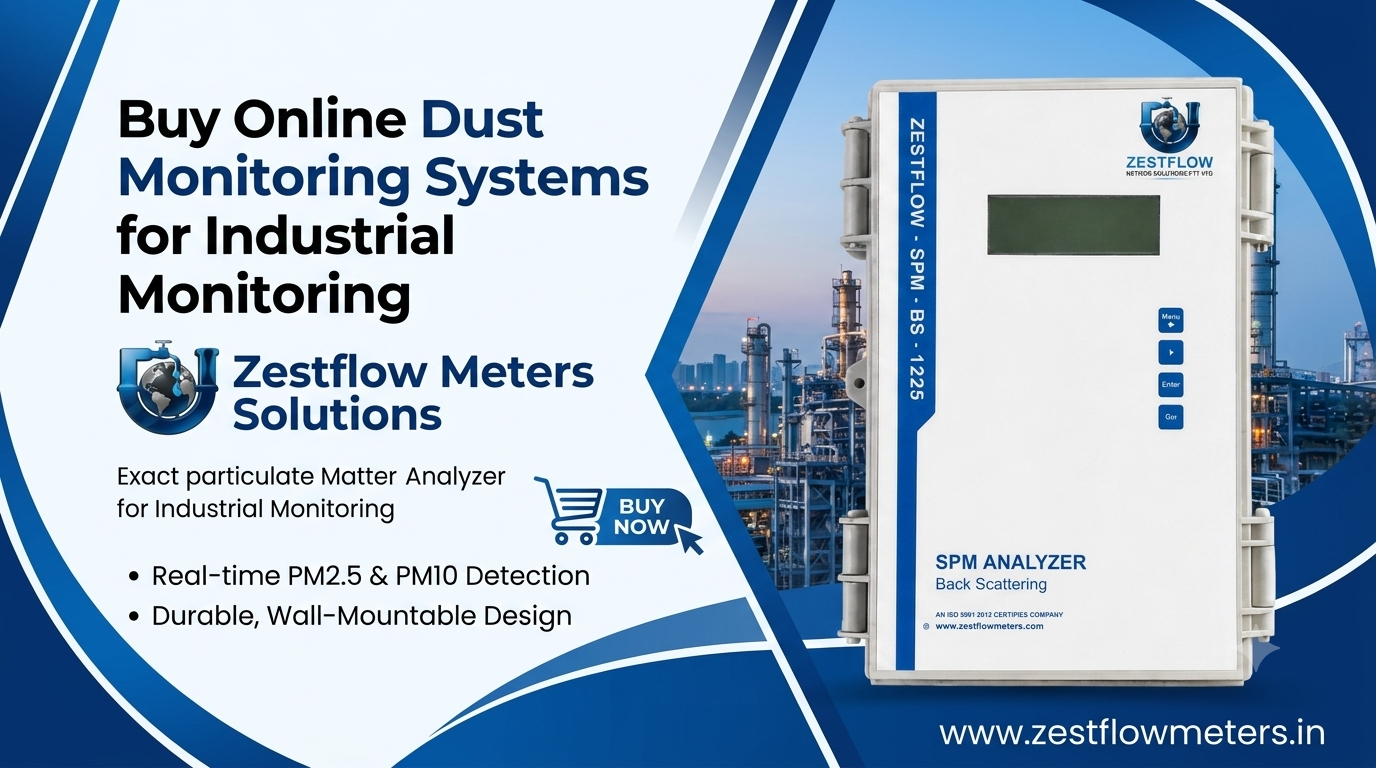
Buy Online Dust Monitoring Systems for Industrial Monitoring
Introduction
Air pollution and particulate emissions have become important concerns for modern industries. Manufacturing plants, cement factories, power plants, steel industries, chemical processing units, mining operations, and other industrial facilities may generate dust and particulate matter during production and combustion processes. Monitoring these emissions is essential for understanding pollution levels, improving pollution-control performance, and supporting environmental management.
This is where Online Dust Monitoring Systems can play an important role.
An online dust monitoring system is designed to continuously measure particulate concentrations and provide real-time information about dust levels. Instead of relying only on occasional manual measurements, industries can use automated monitoring technology to observe dust emissions continuously and identify changes in particulate concentration.
Zestflow Meters Solutions provides industrial measurement and monitoring solutions, including an SPM Laser Backscatter Dust Monitor designed for real-time measurement of suspended particulate matter in industrial flue-gas applications. The monitoring solution uses optical back-scattering technology for in-situ particulate measurement.
Whether your facility requires continuous emissions monitoring, pollution-control performance evaluation, or better visibility into industrial dust emissions, selecting the right Online Dust Monitoring System can make a significant difference.
What Is an Online Dust Monitoring System?
An Online Dust Monitoring System is an automated instrument used to continuously monitor particulate matter or dust concentration in air or industrial exhaust streams.
The system typically uses sensing technology to detect particles and convert the measurement into useful data. Depending on the application and instrument design, the collected information can be displayed locally, stored for analysis, transmitted to a monitoring platform, or integrated with industrial automation systems.
Modern dust monitoring solutions can be useful in applications where continuous visibility is required. Instead of waiting for periodic sampling results, plant operators can monitor changes in dust concentration as they occur.
For industrial facilities, this can help with:
- Continuous particulate monitoring
- Emission trend analysis
- Pollution-control equipment evaluation
- Early identification of abnormal emissions
- Industrial environmental management
- Process monitoring
- Data recording and reporting
CPCB documentation on continuous ambient air-quality monitoring identifies particulate matter such as PM2.5 and PM10 among important monitored parameters, while industrial applications may require appropriate particulate-emission monitoring systems based on the specific process and regulatory requirements.
Why Is Online Dust Monitoring Important for Industries?
Dust emissions can occur from several industrial processes, including material handling, combustion, grinding, crushing, conveying, processing, and exhaust operations.
If particulate emissions increase unexpectedly, the reason could be related to equipment performance, process conditions, filtration problems, or other operational issues.
An online monitoring system provides continuous visibility into these changes.
1. Real-Time Monitoring
One of the primary advantages of an online dust monitor is continuous measurement. Plant operators can observe dust levels without depending exclusively on periodic manual sampling.
Real-time information can help operators respond more quickly when unusual emission patterns appear.
2. Better Pollution-Control Management
Many industrial plants use pollution-control equipment such as bag filters, baghouses, or electrostatic precipitators.
A dust monitoring system can help operators evaluate whether such equipment is performing as expected.
For example, a sudden increase in dust concentration after a filtration system may indicate a potential problem that requires inspection.
3. Early Detection of Filter Problems
Bag filters and baghouses are commonly used to control particulate emissions.
A damaged filter bag can allow higher quantities of dust to pass through the system. Continuous monitoring can help identify unusual increases and support faster maintenance decisions.
Zestflow specifically describes its SPM Laser Backscatter Dust Monitor as suitable for identifying abnormal dust leakage and evaluating bag-filter and baghouse performance.
4. Continuous Data Availability
Manual measurements provide information for a particular sampling period. Online systems, in contrast, can continuously collect data.
This creates a larger dataset that can be useful for understanding:
- Daily emission patterns
- Process-related changes
- Equipment performance
- Abnormal events
- Long-term trends
5. Improved Industrial Decision-Making
Reliable monitoring data can help engineers and plant managers make more informed decisions.
If dust concentration repeatedly increases during a particular production stage, the data can encourage further investigation into the process.
How Does an Online Dust Monitoring System Work?
The operating principle depends on the type of instrument being used.
A laser or optical dust monitoring system can use light-based measurement to detect particles in a gas stream. In a back-scattering arrangement, light interacts with suspended particles, and the scattered light is detected by the instrument.
The resulting signal can then be processed to estimate particulate concentration.
Zestflow’s SPM Laser Backscatter Dust Monitor uses optical back-scattering technology and is designed for in-situ monitoring without requiring a conventional gas extraction and sampling arrangement.
A simplified monitoring process can be understood as:
Industrial Process → Dust/Particulate Emission → Sensor Detection → Signal Processing → Dust Measurement → Data Display/Monitoring
This approach can provide plant personnel with useful information about particulate emissions while reducing the complexity associated with some conventional sampling arrangements.
Key Features to Look for in Online Dust Monitoring Systems
Before choosing an online dust monitoring solution, industries should evaluate the application requirements carefully.
- Real-Time Measurement
The system should provide timely measurement information so operators can identify changes in dust concentration.
- Optical Measurement Technology
Optical technologies can provide fast particulate detection and may be suitable for applications requiring continuous measurement.
- Wide Measurement Capability
Industrial environments can experience both relatively low and high particulate concentrations. Selecting a system with an appropriate measurement range is important.
- Low Maintenance Requirements
Maintenance requirements can significantly affect the long-term operating cost of monitoring equipment.
Zestflow states that its laser backscatter dust monitor is designed without pumps, filters, and extraction systems, which can reduce maintenance complexity in appropriate applications.
- Industrial Durability
Dust-monitoring equipment may operate in challenging environments involving temperature variations, vibration, humidity, and particulate loading.
Therefore, industrial construction and suitable installation are important considerations.
- Data Integration
For modern facilities, monitoring equipment may need to communicate with plant automation, data acquisition, or remote-monitoring systems.
Before purchasing, users should confirm available communication and integration options according to their project requirements.
Applications of Online Dust Monitoring Systems
Online Dust Monitoring Systems can be used across various industrial applications.
- Cement Plants
Cement manufacturing involves several dust-generating processes, including raw-material handling, grinding, kiln operations, and material transfer.
Continuous dust monitoring can help plants observe particulate emissions and evaluate pollution-control performance.
- Power Plants
Power-generation facilities may produce particulate emissions from combustion and ash-handling processes.
Dust monitoring can support emission management and help operators observe changes in stack conditions.
- Steel Industries
Steel manufacturing and processing can involve high-temperature operations, material handling, and combustion processes.
Continuous particulate monitoring can provide valuable information for industrial environmental management.
- Chemical Industries
Chemical manufacturing facilities may require monitoring around process exhausts and other emission sources.
The appropriate monitoring method depends on the process, gas characteristics, temperature, dust concentration, and application requirements.
- Mining and Material Processing
Mining, crushing, screening, and material-transfer operations can produce significant amounts of dust.
Monitoring solutions can help identify changes in particulate levels and support dust-control strategies.
- Refineries and Process Industries
Industrial process facilities may use emission monitoring systems to observe exhaust conditions and support environmental management.
Online Dust Monitoring for Bag Filters and Baghouses
Bag filters are important pollution-control devices in many industrial facilities.
Their performance can change due to several factors, including damaged bags, improper cleaning, excessive dust loading, or other operational problems.
An online dust monitor installed at a suitable monitoring point can provide continuous information about particulate emissions.
For example:
Normal Dust Level → Continuous Monitoring → Sudden Increase → Alarm/Investigation → Filter Inspection → Corrective Maintenance
This does not mean every increase automatically indicates filter damage. Operators should evaluate the complete process and other operating conditions before taking corrective action.
Nevertheless, continuous monitoring can provide an early indication that something has changed.
Zestflow identifies applications including detecting damaged or leaking bags, identifying abnormal dust leakage, optimizing cleaning cycles, and improving filtration efficiency.
Monitoring Electrostatic Precipitator Performance
Electrostatic precipitators, commonly called ESPs, are used in various industrial applications to remove particulate matter from gas streams.
Their performance can change because of operating conditions, electrical performance, ash characteristics, or other factors.
A suitable dust monitoring system can help plant personnel observe particulate emissions after pollution-control equipment.
This information can support:
- ESP performance evaluation
- Detection of abnormal particulate carryover
- Trend monitoring
- Maintenance planning
- Emission management
Benefits of Choosing an Online Dust Monitoring System
There are several reasons why industries may consider installing continuous dust monitoring equipment.
- Continuous Visibility
Operators receive ongoing information instead of relying only on periodic measurements.
- Faster Response
Unexpected changes in dust concentration can be identified more quickly.
- Better Maintenance Planning
Monitoring trends can help maintenance teams investigate equipment before problems become more serious.
- Improved Process Understanding
Historical data can help identify relationships between production activities and particulate emissions.
- Reduced Manual Monitoring Dependency
Automation can reduce the need for repeated manual observation, depending on the application’s monitoring requirements.
- Better Environmental Management
Continuous data can support an organization’s broader pollution-control and environmental-management activities.
Factors to Consider Before You Buy Online Dust Monitoring Systems
If you are planning to Buy Online Dust Monitoring Systems, choosing the right product requires more than comparing prices.
1. Type of Application
Determine whether you need ambient-air monitoring, stack emission monitoring, process monitoring, or another application.
2. Dust Concentration
Understand the expected particulate concentration range.
3. Gas Temperature
The operating temperature of the gas stream can affect instrument selection and installation requirements.
4. Gas Composition
The composition and characteristics of the monitored gas should be evaluated before selecting the instrument.
5. Installation Point
The location of the sensor is critical for obtaining representative measurements.
6. Required Data Output
Check whether you need local display, analog output, digital communication, remote data access, or integration with an existing system.
7. Maintenance Requirements
Consider calibration, cleaning, inspection, and other routine maintenance requirements.
8. Industry and Regulatory Requirements
Always select and configure monitoring equipment according to the applicable environmental regulations, project specifications, and industry requirements.
Why Choose Zestflow Meters Solutions?
Zestflow Meters Solutions focuses on industrial measurement, instrumentation, and automation solutions. Its product portfolio includes flow meters, water meters, level measurement products, analytical instruments, and other industrial monitoring solutions.
The company’s SPM Laser Backscatter Dust Monitor is designed for continuous particulate monitoring in industrial flue-gas applications.
According to Zestflow, the instrument provides:
- Real-time particulate measurement
- Optical back-scattering technology
- In-situ monitoring
- Low maintenance requirements
- Wide dust measurement capability
Industrial application suitability - Continuous environmental monitoring support
The company also emphasizes customized engineering and industrial instrumentation solutions for different application requirements.
For organizations searching for a reliable Online Dust Monitoring System, discussing the application with a qualified supplier is important before selecting the final configuration.
Online Dust Monitoring Systems and Industrial Automation
Industrial plants are increasingly using connected monitoring technologies to improve visibility and automation.
A dust monitoring system can potentially become part of a larger industrial monitoring architecture.
For example:
Dust Sensor → Monitoring Instrument → PLC/SCADA/Data System → Dashboard → Alert → Operator Action
This type of setup can make monitoring data more useful because plant personnel can analyze dust levels together with other operating parameters.
When selecting a system, organizations should therefore consider not only the sensor itself but also how the monitoring solution will fit into the existing plant infrastructure.
Importance of Regular Maintenance
Even advanced monitoring equipment requires appropriate maintenance.
The exact maintenance schedule depends on the instrument, installation environment, process conditions, and manufacturer recommendations.
Regular activities may include:
- Sensor inspection
- Optical-window cleaning where applicable
- Connection inspection
- Verification of instrument operation
- Calibration or performance checks
- Data validation
- Review of abnormal readings
A proper maintenance program helps maintain measurement reliability over the long term.
Conclusion
Online Dust Monitoring Systems have become valuable tools for industries that need continuous information about particulate emissions and dust levels. By providing real-time measurements, these systems can help plant operators understand emission trends, evaluate pollution-control equipment, identify abnormal conditions, and improve environmental monitoring practices.
From cement plants and power stations to steel, chemical, mining, and other process industries, the correct dust monitoring solution depends on application-specific factors such as dust concentration, gas temperature, process conditions, installation location, measurement requirements, and applicable regulations.
For businesses looking to Buy Online Dust Monitoring Systems, Zestflow Meters Solutions offers industrial monitoring expertise and an SPM Laser Backscatter Dust Monitor designed for continuous particulate monitoring in industrial flue-gas applications.
Choosing the right monitoring technology and implementing it correctly can help organizations build a more effective approach to industrial emission monitoring and pollution-control management.