
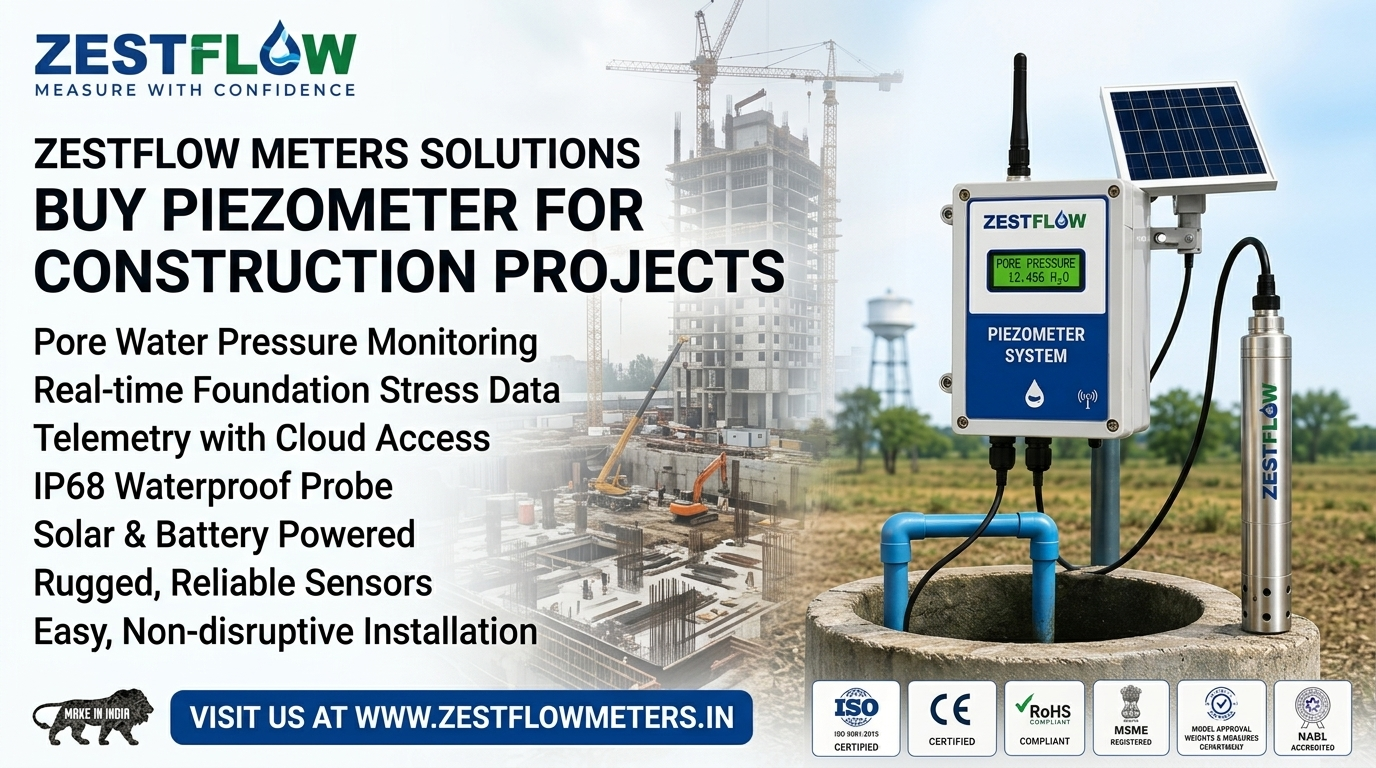
Piezometer for Construction Projects: Reliable Groundwater & Pore Pressure Monitoring
Piezometer for Construction Projects: An Essential Instrument for Groundwater Monitoring
Modern construction projects require more than strong materials and advanced engineering designs. Understanding what is happening beneath the ground is equally important. Groundwater levels, pore water pressure, soil conditions, and changes in subsurface water can significantly influence excavation stability, foundation performance, embankments, slopes, tunnels, dams, and other civil engineering structures.
A piezometer for construction projects is an important monitoring instrument used to measure groundwater level or pore water pressure at a specific location and depth. By collecting reliable subsurface water data, engineers can better understand groundwater behavior and make informed decisions during different stages of construction.
For contractors, civil engineers, geotechnical consultants, infrastructure companies, and project managers, choosing the right monitoring equipment can improve project control and support safer construction practices.
If you are planning a construction or infrastructure project and need dependable groundwater monitoring equipment, you can Buy Piezometer for Construction Projects from Zestflow Meters Solutions, a supplier of water and groundwater monitoring solutions in India.
Groundwater monitoring is widely used in geotechnical investigations and major civil engineering projects. Piezometers can help monitor groundwater conditions and pore pressure variations, which are important factors in construction and geotechnical engineering.
What Is a Piezometer?
A piezometer is a specialized instrument or monitoring installation designed to measure water pressure at a particular depth within soil, rock, or another subsurface formation. Depending on the type of piezometer and application, it can be used to monitor groundwater levels or pore water pressure.
In construction projects, the information obtained from a piezometer can help engineers understand how groundwater conditions are changing before, during, and after construction.
A conventional standpipe piezometer may consist of a sensing tip or screened section, filter material, and a pipe extending toward the surface. More advanced systems can use pressure sensors and data logging technology for automated monitoring.
The correct installation method depends on factors such as soil conditions, monitoring depth, project requirements, groundwater characteristics, and the required measurement accuracy.
For large infrastructure projects, piezometer monitoring can become an important part of a broader geotechnical instrumentation program.
Why Is Piezometer Monitoring Important in Construction?
Water beneath the ground can affect soil behavior and construction conditions. During excavation, foundation work, tunneling, embankment construction, or slope development, unexpected groundwater conditions can create engineering challenges.
A properly installed piezometer provides project teams with valuable information about subsurface water conditions.
1. Monitoring Groundwater Levels
Piezometers can be installed at selected depths to monitor groundwater levels. Regular readings help engineers understand seasonal variations, pumping effects, recharge patterns, and changes caused by construction activities.
Government groundwater monitoring specifications in India also describe piezometers as borewell or tubewell-type installations used for monitoring groundwater levels and, where required, groundwater quality.
2. Measuring Pore Water Pressure
Pore water pressure is an important consideration in soil and rock mechanics. Changes in pore pressure can influence the effective stress and behavior of soil.
Monitoring this pressure can therefore help engineers evaluate changing ground conditions around excavations, slopes, embankments, and other structures.
3. Supporting Excavation Monitoring
Deep excavation can change groundwater conditions around and beneath an excavation. Dewatering systems may be used to control groundwater, but excessive or unexpected drawdown can potentially affect surrounding ground and structures.
Piezometers installed at appropriate monitoring locations can provide data that helps engineers evaluate groundwater behavior during excavation.
4. Monitoring Dewatering Performance
When construction requires groundwater lowering, monitoring is essential.
Piezometers can be placed inside and outside the influence area of a dewatering system to help determine whether groundwater pressure is changing as expected.
Monitoring groundwater behavior can also help identify unexpected drawdowns that may require investigation or adjustment of the construction approach.
5. Supporting Foundation Engineering
Groundwater conditions can influence foundation construction and subsurface behavior. Monitoring groundwater levels before and during construction can provide engineers with useful information for evaluating site conditions.
Piezometer data can be considered alongside borehole logs, soil investigation reports, laboratory testing, and other geotechnical information.
Applications of Piezometers in Construction Projects
Piezometers are useful across many types of civil engineering and infrastructure projects.
- Building Foundations
Large commercial buildings, residential towers, industrial facilities, and other structures may require detailed geotechnical investigation.
Piezometers can be incorporated into site monitoring programs where groundwater conditions are important to foundation or excavation activities.
- Basement and Deep Excavation Projects
Deep basements can extend below the natural groundwater table. Monitoring groundwater pressure can help engineers understand subsurface conditions while excavation and construction work are underway.
- Metro and Tunnel Projects
Tunneling and underground transportation projects can encounter complex groundwater conditions.
Piezometers can help monitor groundwater behavior around selected sections of a project, providing valuable information for geotechnical teams.
- Dams and Embankments
Water pressure within soil and foundation materials is an important consideration for dams and embankments. Piezometer monitoring can provide information about pore pressure behavior and changing subsurface conditions.
- Highways and Railway Projects
Large road and railway projects often cross different soil formations and groundwater environments.
Piezometers can be used at selected locations to support groundwater and geotechnical monitoring programs.
- Bridges and Flyovers
Bridge foundations and associated construction areas may require monitoring where groundwater or subsurface pressure is a concern.
- Mining Projects
Mining operations frequently involve complex groundwater conditions. Piezometers can help monitor water pressure and groundwater behavior around selected areas of mining operations.
- Slope Stability Projects
Groundwater is an important factor in slope behavior. Changes in pore water pressure can influence soil strength and stability.
Piezometer readings can therefore contribute to slope monitoring programs.
How Does a Piezometer Work?
The working principle depends on the type of piezometer being used.
In a basic standpipe arrangement, water enters the sensing or screened section installed at the monitoring depth. The water level inside the pipe corresponds to the hydraulic pressure at the monitored location. The level can then be measured using suitable equipment.
Electronic and vibrating-wire piezometers use pressure-sensitive sensing technology. These instruments can provide electrical measurements corresponding to changes in pressure.
When connected to a data logger or telemetry system, measurements can be recorded automatically at predefined intervals.
The selection between manual and automated monitoring depends on the project’s requirements, monitoring frequency, accessibility, desired data resolution, and budget.
Proper installation is extremely important. Technical guidance for piezometers emphasizes appropriate contact between the measuring system and the ground and maintaining suitable saturation conditions for accurate pore-pressure measurements.
Types of Piezometers for Construction Applications
Different construction projects may require different types of piezometers.
- Standpipe Piezometer
A standpipe piezometer is a simple and widely used solution for measuring groundwater levels. It can be suitable for projects where readings are taken manually at scheduled intervals.
- Vibrating Wire Piezometer
A vibrating wire piezometer is designed for electronic measurement of pore water pressure. It is commonly considered for geotechnical monitoring applications where continuous or automated data collection is required.
- Pneumatic Piezometer
Pneumatic systems use pressure transmission principles to measure pore pressure and can be used in selected geotechnical applications.
- Digital Piezometer Monitoring Systems
Modern monitoring systems can combine pressure sensors, data loggers, communication devices, and software platforms. Such systems can support remote data collection and centralized monitoring.
The appropriate type should be selected according to the project design, monitoring objective, soil conditions, installation depth, required accuracy, and data collection method.
Key Benefits of Using a Piezometer for Construction Projects
Choosing a suitable piezometer can provide several advantages to construction and engineering teams.
- Accurate Groundwater Monitoring
Reliable measurements help engineers understand groundwater conditions and identify changes over time.
- Early Identification of Changes
Regular monitoring can reveal unexpected changes in groundwater level or pore pressure, allowing engineers to investigate conditions promptly.
- Better Construction Planning
Groundwater information can support decisions related to excavation, drainage, dewatering, foundation construction, and other site activities.
- Continuous Data Collection
When combined with automatic data loggers, electronic piezometers can provide continuous monitoring without requiring manual readings at every interval.
- Remote Monitoring Capability
Telemetry-enabled monitoring systems can transmit data remotely, reducing the need for frequent physical visits to difficult-to-access monitoring locations.
- Historical Data Analysis
Recorded measurements can be stored and analyzed to identify trends, seasonal variations, pressure changes, and project-related impacts.
- Improved Geotechnical Decision-Making
Piezometer data can be combined with other geotechnical measurements to develop a more complete understanding of subsurface conditions.
Factors to Consider Before You Buy Piezometer for Construction Projects
Before purchasing a piezometer, project teams should evaluate several technical requirements.
- Monitoring Objective
First determine whether the project requires groundwater-level monitoring, pore-pressure monitoring, or both.
- Installation Depth
The required depth has a major impact on the selection and installation arrangement.
- Soil and Geological Conditions
Soil type, rock formation, permeability, groundwater conditions, and borehole stability should be considered.
- Required Measurement Accuracy
Projects with critical geotechnical monitoring requirements may need higher-precision electronic instrumentation.
- Manual or Automatic Monitoring
If measurements are required occasionally, a manual system may be sufficient. For frequent or continuous monitoring, an automated system may be more appropriate.
- Data Logging
For long-term monitoring, check whether the instrument can work with a compatible data logger.
- Telemetry
For remote construction locations or projects requiring real-time monitoring, telemetry can make data collection more convenient.
- Environmental Conditions
The instrument should be suitable for the temperature, moisture, chemical, and physical conditions expected at the installation location.
- Installation and Technical Support
Correct installation is essential to reliable measurements. Buyers should consider whether the supplier can provide technical guidance, configuration assistance, and after-sales support.
Why Choose Zestflow Meters Solutions?
Zestflow Meters Solutions provides water measurement and groundwater monitoring solutions for applications across India.
The company offers solutions for groundwater monitoring, borewell water-level measurement, and related water-resource applications. Its groundwater monitoring solutions can include advanced monitoring technologies, customized configurations, and telemetry-enabled options.
When selecting a piezometer supplier in India, customers should look beyond the instrument itself and consider application requirements, technical support, compatibility, installation needs, and long-term monitoring objectives.
Zestflow Meters Solutions focuses on providing monitoring solutions designed around the requirements of different users and applications.
Piezometer Installation: Why Proper Installation Matters
A high-quality piezometer can only provide useful measurements if it is installed correctly.
Depending on the project, installation may involve drilling a borehole, preparing the monitoring zone, placing the sensing element, installing filter material where applicable, sealing the annular space, and protecting the monitoring point.
Government specifications for piezometer construction can include drilling, reaming, pipe lowering, gravel packing, development, and installation of protective components, with the exact arrangement depending on site and geological conditions.
Poor installation can result in inaccurate measurements, unwanted hydraulic connections, contamination, or damage to the instrument.
For this reason, construction teams should follow project-specific engineering specifications and applicable technical requirements.
Piezometer Monitoring During Different Construction Stages
- Before Construction
Baseline groundwater readings can help establish existing site conditions.
- During Excavation
Measurements can help track changes associated with excavation and dewatering activities.
- During Foundation Work
Monitoring can provide additional information where groundwater conditions are relevant to foundation construction.
- During Structural Construction
Longer-term monitoring may be required for selected infrastructure projects.
- After Construction
Some projects continue monitoring after construction to assess long-term groundwater or pore-pressure behavior.
The monitoring duration and frequency should always be established by the responsible engineering team based on project requirements.
Piezoelectric and Groundwater Monitoring Data
The value of a piezometer is not limited to obtaining individual readings. The greatest benefit often comes from analyzing measurements over time.
A monitoring system can help generate information about:
- Groundwater-level fluctuations
- Seasonal changes
- Dewatering effects
- Recharge behavior
- Pore-pressure trends
- Construction-related changes
- Long-term groundwater conditions
- Unexpected pressure variations
When automated data logging and telemetry are used, monitoring data can be collected at predefined intervals and transmitted to a central platform.
Zestflow’s groundwater monitoring solutions also highlight remote and IoT-enabled monitoring capabilities for applications requiring continuous data collection.
Who Should Buy Piezometer for Construction Projects?
A piezometer may be suitable for:
- Civil construction companies
- Infrastructure developers
- Geotechnical consultants
- Structural engineering firms
- Government departments
- Irrigation projects
- Metro and railway projects
- Highway projects
- Dam and reservoir projects
- Mining companies
- Industrial construction projects
- Environmental monitoring agencies
- Groundwater Consultants
- Research institutions
The exact instrument configuration should be selected according to the project’s technical requirements.
How to Select the Right Piezometer Supplier in India
When searching for a piezometer supplier in India, consider the following:
1. Product quality and reliability
2. Measurement requirements
3. Available sensor technologies
4. Installation depth capability
5. Data logging compatibility
6. Telemetry options
7. Technical support
8. Customization options
9. Availability of replacement components
10. After-sales assistance
A supplier that understands both water monitoring and project-specific requirements can help customers choose a suitable solution rather than simply supplying an instrument.
Conclusion
Groundwater and pore water pressure are important factors in many construction and infrastructure projects. Without appropriate monitoring, changes beneath the ground can remain difficult to identify until they affect construction conditions.
A properly selected and installed piezometer for construction projects provides valuable information about subsurface water conditions. It can support groundwater-level monitoring, pore-pressure measurement, excavation monitoring, dewatering assessment, slope monitoring, foundation investigations, and long-term geotechnical observation.
For projects requiring dependable groundwater monitoring solutions, customers can Buy Piezometer for Construction Projects from Zestflow Meters Solutions. The right solution should be selected according to monitoring objectives, installation depth, geological conditions, required accuracy, data logging requirements, and whether remote monitoring is needed.
With appropriate instrumentation and systematic monitoring, construction teams can obtain better visibility into subsurface conditions and support more informed engineering decisions.
Contact Zestflow Meters Solutions to discuss your piezometer and groundwater monitoring requirements for construction and infrastructure projects.