
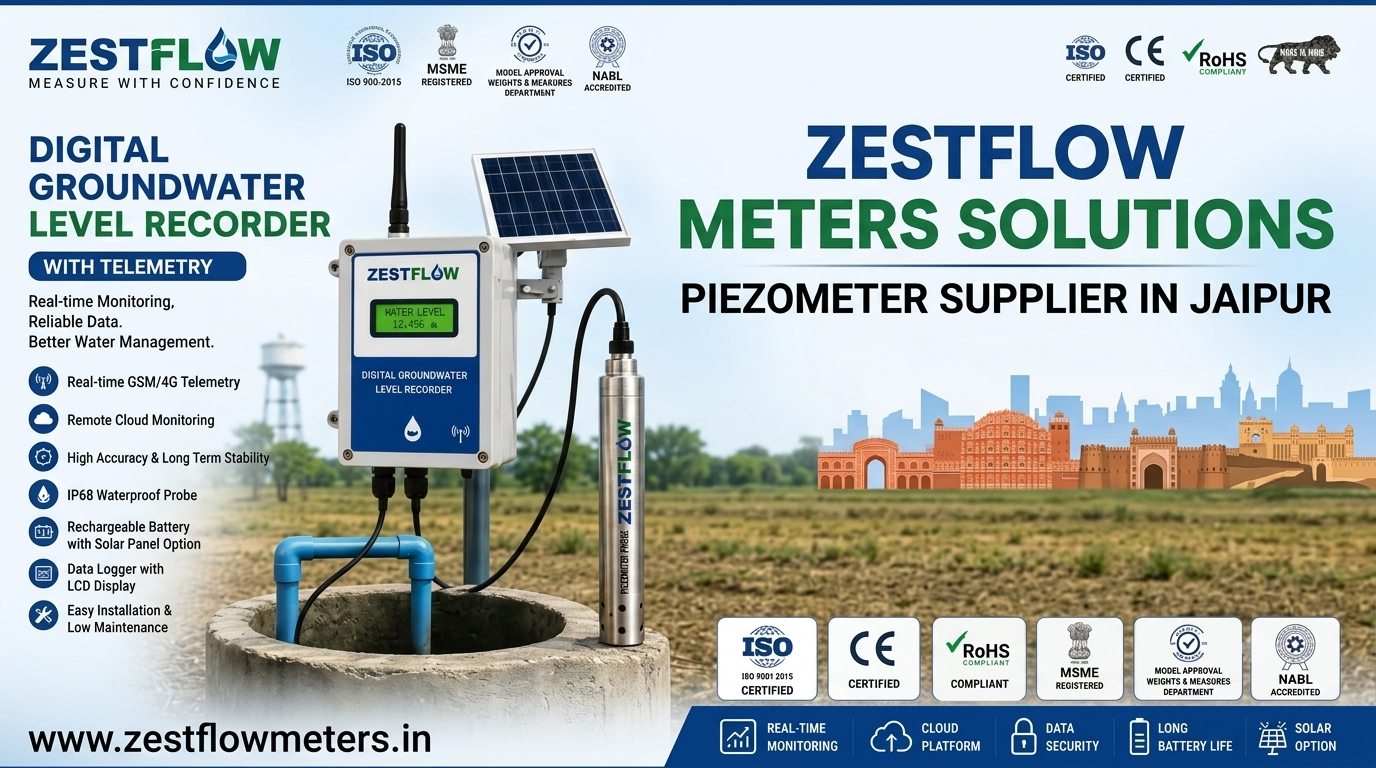
Piezometer Supplier in Jaipur – Reliable Groundwater Monitoring Solutions
Water is one of the most important natural resources, and monitoring groundwater accurately is essential for sustainable water management. Whether the requirement is related to civil engineering, groundwater studies, environmental monitoring, irrigation, mining, infrastructure development, or research, accurate groundwater-level measurement plays a significant role in making informed decisions.
For organizations looking for dependable groundwater monitoring equipment, Zestflow Meters Solutions provides solutions designed to support accurate and efficient water-level monitoring. If you are planning to Buy Piezometer Suppplier in Jaipur, choosing the right supplier is important because the quality of the instrument can directly influence the reliability of collected groundwater data.
A piezometer is a specialized instrument used to measure groundwater pressure or water levels at a particular depth. Modern piezometer systems can provide accurate measurements and can be integrated with data logging and remote monitoring technologies. These capabilities make them useful for projects where continuous and dependable groundwater observations are required.
In this article, we will discuss piezometers, their applications, important features, benefits, and why selecting a reliable supplier in Jaipur can make a difference to your groundwater monitoring project.
What Is a Piezometer?
A piezometer is an instrument used to measure pore-water pressure or hydraulic pressure within soil, rock, or groundwater formations. Depending on the type of piezometer being used, it can help engineers, hydrologists, environmental professionals, and researchers understand groundwater conditions at a specific location and depth.
Groundwater levels are not always constant. They can change because of rainfall, seasonal conditions, groundwater extraction, irrigation, construction activities, and other environmental factors. A suitable piezometer allows these changes to be observed and recorded.
Piezometers are especially valuable when measurements need to be taken below the ground surface or at specific depths. They are widely used in geotechnical investigations, groundwater monitoring programs, dam and embankment projects, mining sites, and infrastructure development.
Why Piezometers Are Important for Groundwater Monitoring
Groundwater monitoring requires reliable information. Without accurate measurements, it can be difficult to understand groundwater movement, pressure conditions, recharge patterns, or changes caused by human activities.
Piezometers help provide important information such as:
- Groundwater pressure at specific depths
- Changes in groundwater levels
- Seasonal groundwater variations
- Water-table fluctuations
- Subsurface hydraulic conditions
- Pore-water pressure in soil and rock
- Data required for geotechnical assessments
For large-scale projects, collecting groundwater information manually at regular intervals may not always be sufficient. Digital monitoring systems can help collect measurements at predefined intervals and store the information for later analysis.
Applications of Piezometers
Piezometers have applications across multiple industries and technical fields. Some of the most common applications include the following.
1. Groundwater Monitoring
One of the primary applications of a piezometer is groundwater-level monitoring. Government agencies, environmental consultants, researchers, and water-management organizations can use piezometers to observe groundwater behavior over time.
2. Civil Engineering Projects
Construction projects often require information about subsurface water conditions. Piezometers can be installed around foundations, excavation areas, retaining structures, embankments, and other critical locations to monitor water pressure.
3. Dams and Embankments
Monitoring pore-water pressure is important for evaluating the performance and stability of dams and embankments. Piezometers can help engineers identify changes in subsurface water pressure and understand how water conditions may affect the structure.
4. Mining Projects
Mining operations may require continuous observation of groundwater conditions. Piezometers can be used to monitor groundwater levels and pressure around mining areas, helping technical teams understand changing subsurface conditions.
5. Environmental Studies
Environmental professionals can use piezometers to monitor groundwater conditions during environmental assessments, remediation projects, and long-term observation programs.
6. Irrigation and Agriculture
Groundwater is an important source of irrigation in many regions. Monitoring groundwater levels can provide useful information for water-resource planning and help support sustainable groundwater management.
7. Research and Hydrology
Universities, research organizations, and hydrology professionals can use piezometers to collect data for groundwater studies, watershed investigations, aquifer research, and environmental monitoring.
Types of Piezometers
Different projects require different types of groundwater monitoring instruments. Some commonly used categories include:
- Vibrating Wire Piezometers
Vibrating wire piezometers are designed for measuring pore-water pressure and are commonly used in geotechnical and structural monitoring applications. They are suitable for long-term monitoring where reliable pressure measurements are required.
- Pneumatic Piezometers
Pneumatic piezometers use gas pressure principles to measure water pressure. They have been used in various geotechnical applications where subsurface pressure monitoring is required.
- Standpipe Piezometers
Standpipe piezometers are relatively simple systems that can be used to observe groundwater levels or pore-water pressure. They are often selected for applications where straightforward monitoring is sufficient.
- Digital and Automated Piezometer Systems
Modern monitoring requirements increasingly involve digital sensors and automatic data collection. These systems can be connected with data loggers and other monitoring equipment to reduce the need for frequent manual measurements.
- Piezometer with DWLR for Automated Monitoring
A Digital Water Level Recorder, commonly referred to as a DWLR, can be used with groundwater monitoring systems to record water-level measurements automatically.
A piezometer with DWLR can provide several advantages when a project requires regular or continuous monitoring. Instead of manually visiting every monitoring point to record water levels, an automated system can collect and store readings according to a predefined monitoring schedule.
Depending on the system configuration, recorded information can be downloaded, analyzed, and used for groundwater assessment.
Automated groundwater monitoring can be particularly helpful for projects involving multiple observation locations, long-term monitoring programs, remote areas, or locations where frequent manual measurements are inconvenient.
Benefits of Choosing a Reliable Piezometer Supplier
Selecting a supplier is an important step when purchasing groundwater monitoring equipment. A dependable supplier should understand the technical requirements of the application and help customers select an appropriate solution.
Here are some key benefits of working with a reliable supplier:
- Accurate Measurement
Quality instruments can provide dependable measurements when properly installed, calibrated, and maintained.
- Application-Based Selection
Different projects have different measurement requirements. A knowledgeable supplier can help determine whether a particular type of piezometer is appropriate for the required depth, pressure range, installation conditions, and monitoring duration.
- Long-Term Monitoring
Groundwater studies often continue for months or years. Equipment selected for long-term applications should be appropriate for the environmental and installation conditions.
- Data Collection
When automated systems are required, piezometers can be integrated with data loggers or DWLR systems to support systematic data collection.
- Technical Support
Proper installation, configuration, calibration, and maintenance can influence the quality of groundwater data. Technical assistance can therefore be an important part of selecting monitoring equipment.
Why Consider Zestflow Meters Solutions?
Zestflow Meters Solutions focuses on measurement and monitoring solutions for applications where dependable field data is important. For customers searching for a Piezometer Supplier in Jaipur, the selection process should consider the project’s monitoring objectives rather than simply choosing equipment based on price.
A suitable groundwater monitoring solution should be selected according to factors such as:
- Required measurement range
- Monitoring depth
- Installation conditions
- Accuracy requirements
- Monitoring frequency
- Data storage requirements
- Manual or automated monitoring
- Communication requirements
- Project duration
- Environmental conditions
Taking these factors into consideration can help organizations choose a solution that matches their technical requirements.
How to Select the Right Piezometer
Before purchasing a piezometer, it is useful to define the project requirements clearly.
- Determine the Monitoring Depth
The required installation depth is one of the first factors to consider. The instrument should be appropriate for the intended monitoring location and depth.
- Identify the Measurement Requirement
Determine whether the project requires groundwater-level measurement, pore-water pressure measurement, or another specific parameter.
- Consider Data Logging
If measurements need to be recorded automatically, a compatible data logger or DWLR can be considered.
- Evaluate Installation Conditions
Ground conditions, temperature, moisture, accessibility, and installation method can all influence equipment selection.
- Consider Long-Term Reliability
For long-term groundwater monitoring projects, the equipment should be selected with durability, maintenance, and environmental exposure in mind.
- Discuss Technical Requirements with the Supplier
Providing the supplier with complete project details can make it easier to identify the appropriate instrumentation.
Piezometer Supplier in Jaipur for Different Industries
Jaipur is an important commercial and industrial center in Rajasthan, with construction, infrastructure, environmental, mining, water-resource, and engineering activities requiring reliable measurement technologies.
Organizations operating in and around Jaipur may require groundwater monitoring equipment for projects such as:
- Building construction
- Road and highway projects
- Water-resource investigations
- Groundwater studies
- Mining and excavation
- Environmental monitoring
- Irrigation projects
- Research and academic studies
- Dam and embankment monitoring
- Infrastructure development
For these applications, selecting a supplier with an understanding of instrumentation requirements can help streamline the purchase and implementation process.
Buy Piezometer Suppplier in Jaipur
If your project requires groundwater-level or pore-pressure monitoring equipment, it is important to purchase from a supplier that can understand your application and provide an appropriate technical solution.
If you are searching online for Buy Piezometer Supplier in Jaipur, make sure you compare more than just the product price. Check the instrument specifications, measurement range, accuracy, installation requirements, compatibility with data loggers, after-sales support, and suitability for your specific application.
Advantages of Automated Groundwater Monitoring
Automation is becoming increasingly important in environmental and engineering monitoring. A digital monitoring system can provide measurements at regular intervals without requiring personnel to manually collect every reading.
Some potential advantages include:
- Reduced manual data collection
- Regular measurement intervals
- Better historical records
- Easier comparison of groundwater trends
- Reduced field visits
- Support for long-term monitoring
- More efficient data management
When combined with appropriate sensors, data loggers, and communication systems, automated monitoring can make large-scale groundwater observation programs more efficient.
Installation and Maintenance Considerations
The performance of a piezometer depends not only on the instrument itself but also on proper installation and maintenance.
Before installation, the monitoring location should be evaluated carefully. The installation method should be appropriate for the soil or geological formation and the intended measurement depth.
After installation, the system should be checked to confirm that measurements are stable and consistent. Periodic inspection and calibration, where applicable, can help maintain measurement reliability.
Monitoring data should also be reviewed regularly. Unexpected changes in readings may indicate natural groundwater variation, seasonal effects, construction activities, equipment issues, or other factors that require investigation.
Conclusion
Reliable groundwater monitoring is essential for understanding subsurface water conditions and supporting effective decisions in engineering, environmental, agricultural, mining, and water-resource projects. Piezometers provide an important method for measuring groundwater pressure or water levels at specific locations and depths.
For organizations planning to Buy Piezometer Supplier in Jaipur, it is important to focus on product suitability, measurement requirements, installation conditions, data logging, long-term reliability, and technical support rather than considering price alone.
Zestflow Meters Solutions can be considered when exploring measurement and groundwater monitoring solutions for different project requirements. Whether the need involves basic groundwater observation or an automated monitoring setup using a piezometer and DWLR, selecting the right instrumentation is an important step toward obtaining useful and dependable field data.
With the right equipment, installation practices, and monitoring strategy, organizations can develop a more reliable understanding of groundwater behavior and make better-informed decisions for their projects.