
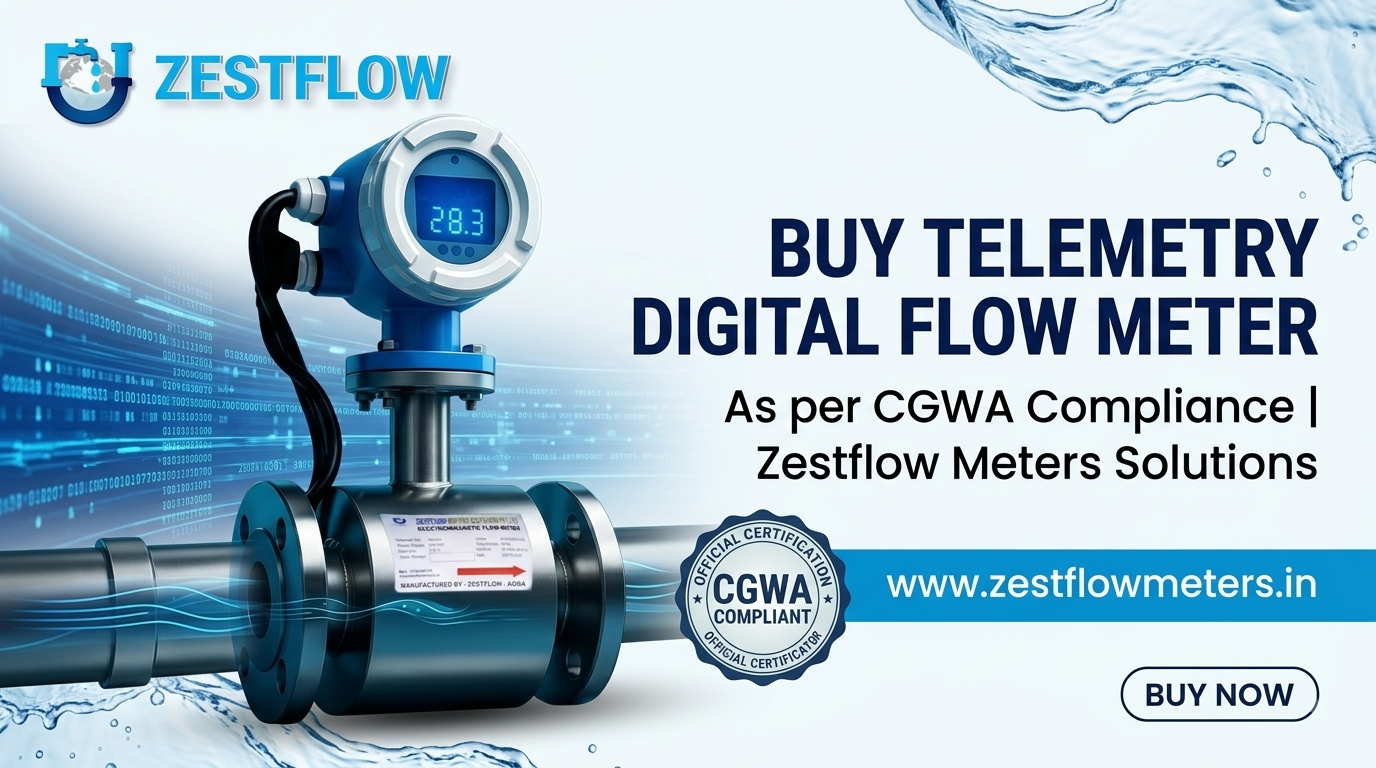
Buy Telemetry Digital Flow Meter as per CGWA Compliance | Zestflow Meters Solutions
Introduction
Groundwater is an important source of water for industries, infrastructure projects, commercial establishments, mining operations, residential projects, and other applications across India. Because excessive groundwater extraction can affect groundwater levels and long-term water availability, monitoring the quantity of groundwater being extracted has become an important part of responsible water management.
The Central Ground Water Authority (CGWA) has prescribed regulatory requirements for groundwater users, including requirements relating to digital water flow meters and telemetry systems. CGWA public notices have specifically required project proponents and groundwater users covered by the applicable requirements to install tamper-proof digital water flow meters with telemetry on groundwater abstraction structures.
For organizations searching for a reliable solution, it is important to Buy Telemetry Digital Flow meter as per CGWA compliance requirements and select equipment appropriate for the project’s NOC conditions and technical requirements.
Zestflow Meters Solutions provides water measurement and groundwater monitoring solutions designed for applications where accurate flow measurement, data recording, and remote monitoring are important.
What Is a Telemetry Digital Flow Meter?
A telemetry digital flow meter is a modern water measurement device that measures the quantity of water passing through a pipeline and can transmit recorded information to a remote monitoring platform.
Unlike a basic mechanical meter that primarily provides a local reading, a digital flow meter equipped with telemetry can support remote collection and transmission of flow information. Depending on the system design, communication may use cellular networks, LAN, or other suitable communication technologies.
This makes telemetry particularly useful for groundwater abstraction monitoring because the user can collect flow information without relying entirely on manual meter readings.
A telemetry-enabled system can help organizations maintain better records of:
- Total water consumption
- Groundwater extraction
- Flow rate
- Cumulative flow
- Date and time of measurements
- Remote meter status
- Communication status
- Possible tampering or abnormal conditions
The exact parameters and communication configuration should be selected according to the applicable CGWA requirements, project NOC, installation conditions, and technical specifications.
Why Is Telemetry Important for CGWA Groundwater Monitoring?
Telemetry provides an additional layer of visibility over groundwater extraction. Instead of depending only on periodic manual readings, a telemetry system can transmit information remotely.
CGWA requirements have emphasized digital water flow meters with telemetry for applicable groundwater abstraction structures. A CGWA public notice dated January 8, 2021 stated that groundwater users drawing groundwater and seeking or holding an NOC were required to install tamper-proof digital water flow meters with telemetry on groundwater abstraction structures.
More recent government material also indicates that telemetry-equipped water flow meters are being promoted to improve real-time monitoring of groundwater extraction.
Therefore, selecting the correct telemetry flow meter can help organizations establish a more systematic groundwater monitoring process.
Key Features of a CGWA-Oriented Telemetry Digital Flow Meter
When you Buy Telemetry Digital Flow meter as per CGWA compliance, several features should be considered before installation.
1. Digital Flow Measurement
The meter should provide reliable digital measurement of water flow and cumulative water volume. Accurate measurement is essential when groundwater extraction data is used for monitoring and reporting.
2. Telemetry Connectivity
The telemetry module allows data to be transmitted to a remote server or monitoring platform. Depending on the installation, communication can be configured using technologies such as cellular connectivity, LAN, or LoRaWAN.
3. Tamper-Resistant Design
Tamper protection is an important consideration for groundwater monitoring. CGWA requirements refer to tamper-proof digital water flow meters for applicable abstraction structures.
A suitable installation should therefore include appropriate physical and electronic security features.
4. Data Logging
A reliable system should be capable of storing flow data locally and/or transmitting it to a remote platform. Data logging becomes particularly useful when communication temporarily fails.
5. Remote Monitoring
Telemetry allows authorized users to view groundwater extraction information remotely. This can reduce dependence on frequent physical visits to the meter location.
6. Flow and Totalizer Information
The system can provide information about current flow and cumulative volume. These measurements help users understand both instantaneous water usage and total extraction.
7. Power Backup
Depending on the site, the meter and telemetry unit may need battery operation, UPS support, or another reliable power arrangement. A suitable power backup strategy helps prevent unnecessary data gaps.
8. Suitable Enclosure and Protection
Groundwater abstraction sites may be exposed to dust, moisture, rain, and other environmental conditions. The meter enclosure and installation arrangement should therefore be selected according to the site’s environmental requirements.
Applications of Telemetry Digital Flow Meters
Telemetry-enabled digital flow meters can be useful across a variety of applications.
- Industrial Groundwater Monitoring
Factories and industrial facilities using groundwater can use digital flow measurement to monitor extraction and maintain better water-use records.
- Borewell Monitoring
A telemetry flow meter can be installed on suitable borewell or tube-well abstraction arrangements to monitor the amount of water being extracted.
- Infrastructure Projects
Construction and infrastructure projects may need groundwater monitoring where dewatering or groundwater abstraction is involved. The applicable NOC and project-specific conditions should always be checked before selecting and installing equipment.
- Mining and Dewatering
Mining projects can require groundwater or dewatering monitoring. CGWA compliance documentation may include flow meter, piezometer, water-level monitoring, and data-submission requirements depending on the project.
- Commercial Establishments
Hotels, commercial complexes, institutions, and other establishments using groundwater can benefit from remote monitoring and digital records.
- Residential and Group Housing Projects
Regulatory requirements can also apply to residential apartments and group housing societies in relevant circumstances. A 2026 National Green Tribunal decision discusses the requirement for digital water flow meters for residential apartments and group housing societies under the applicable groundwater guidelines.
How Does a Telemetry Digital Flow Meter Work?
The working process is relatively straightforward.
First, water passes through the flow meter installed on the appropriate pipeline or abstraction outlet. The meter detects and calculates the quantity of water flowing through the pipeline.
The measured information is processed electronically and stored by the metering system. The telemetry unit then transmits relevant information to the configured monitoring platform through the available communication network.
Authorized users can access the data remotely, depending on the monitoring platform and system configuration.
If the communication network temporarily becomes unavailable, a properly designed system may continue storing data locally and transmit the stored information once communication is restored.
This combination of measurement, data storage, and remote communication makes telemetry useful for continuous groundwater monitoring.
Important CGWA Compliance Considerations
Organizations should not assume that purchasing a meter alone automatically makes an installation compliant. Compliance depends on the applicable CGWA rules, project NOC, technical specifications, installation, calibration, communication, reporting, and other conditions.
The CGWA framework has included requirements for digital water flow meters and reporting of groundwater abstraction data. The applicable guidelines and NOC conditions should be reviewed before installation.
Annual calibration is another important consideration. Applicable CGWA NOC conditions can require the water flow meter to be calibrated by an authorized agency once a year.
Users should also maintain proper records and submit information through the prescribed mechanism wherever required by the applicable NOC or regulations.
Technical Specifications to Consider
Before you Buy Telemetry Digital Flow meter as per CGWA compliance, discuss the following technical points with the supplier:
- Pipeline diameter
- Expected minimum and maximum flow
- Flow meter technology
- Accuracy requirements
- Water quality
- Installation orientation
- Straight pipe requirements
- Power availability
- Battery backup requirements
- Telemetry communication method
- Data transmission frequency
- Local data storage
- Remote dashboard requirements
- Tamper detection
- Enclosure/IP protection
- Calibration certificate
- Installation requirements
- Annual calibration requirements
- Data-reporting requirements
Project-specific CGWA NOC conditions
Some published technical specifications for telemetry-enabled digital water meters describe ultrasonic or electromagnetic measurement, cellular/LAN/LoRaWAN connectivity, tamper protection, data storage during communication or power interruptions, and accuracy requirements. However, buyers should verify the current applicable specification and their project’s NOC before purchasing.
- Electromagnetic vs Ultrasonic Flow Meter
Two common technologies considered for digital water measurement are electromagnetic and ultrasonic flow meters.
- Electromagnetic Flow Meter
Electromagnetic flow meters measure conductive liquids using electromagnetic principles. They can be suitable for many water applications and have no moving mechanical parts in the measuring section.
- Ultrasonic Flow Meter
Ultrasonic flow meters use ultrasonic signals to determine water movement. Depending on the model, they may be available in different installation configurations and can provide digital measurement with telemetry integration.
The correct technology depends on pipeline size, flow conditions, water characteristics, installation requirements, budget, and project specifications.
Benefits of Choosing a Telemetry-Enabled Digital Flow Meter
- Accurate Water Monitoring
Digital measurement provides a more systematic way of monitoring water extraction than manual estimation.
- Remote Data Access
Telemetry enables remote access to water consumption information, reducing the need for frequent physical meter readings.
- Better Record Management
Digital records can make it easier to analyze water extraction and maintain documentation.
- Improved Operational Control
Regular flow information can help organizations identify unusual water consumption patterns and investigate potential issues.
- Reduced Manual Dependency
Automated data transmission reduces reliance on manual readings and data entry.
- Better Groundwater Management
Reliable measurement helps organizations understand how much groundwater is being extracted and supports responsible water-use practices.
Why Choose Zestflow Meters Solutions?
Zestflow Meters Solutions focuses on water flow measurement and groundwater monitoring solutions for industrial, commercial, infrastructure, and water-resource applications.
For organizations looking to Buy Telemetry Digital Flow meter as per CGWA compliance, Zestflow can help customers evaluate suitable flow measurement and telemetry configurations based on their application.
A proper selection process should consider the pipeline size, required flow range, installation location, communication availability, power requirements, monitoring needs, and applicable regulatory conditions.
The goal should not simply be to purchase a flow meter but to establish a dependable water-monitoring system that can support accurate measurement and ongoing compliance documentation.
Installation and Maintenance
Correct installation is just as important as selecting the right meter.
The meter should be installed according to the manufacturer’s installation instructions and the requirements of the selected technology. Pipeline conditions, flow profile, grounding where applicable, power supply, communication signal, and physical security should be checked.
After installation, the system should be tested to confirm that:
- Flow readings are being recorded correctly.
- Totalizer values are functioning properly.
- Telemetry data is reaching the monitoring platform.
- Date and time information is correct.
- Communication is stable.
- Tamper alerts, where provided, are functioning.
- Local data storage is working.
- Backup power is functioning where applicable.
Regular inspection and calibration should also be planned. Applicable CGWA conditions can require annual calibration by an authorized agency.
Conclusion
Groundwater monitoring is becoming increasingly important as industries, infrastructure projects, commercial establishments, and other users focus on responsible water management and regulatory compliance.
A telemetry-enabled digital flow meter provides an effective way to measure groundwater extraction, maintain digital records, and transmit flow information remotely. CGWA requirements have emphasized digital water flow meters with telemetry for applicable groundwater abstraction structures, while applicable NOC conditions can also require annual calibration and reporting of groundwater extraction information.
If you are planning to Buy Telemetry Digital Flow meter as per CGWA compliance, select a solution based on your project’s NOC conditions, pipeline specifications, flow range, communication requirements, installation environment, and data-monitoring needs.
Zestflow Meters Solutions can assist businesses and project operators in identifying suitable digital flow measurement and telemetry solutions for groundwater monitoring applications.
Choose the right telemetry digital flow meter, monitor groundwater responsibly, maintain reliable records, and support your project’s compliance requirements with a dependable water measurement system.