
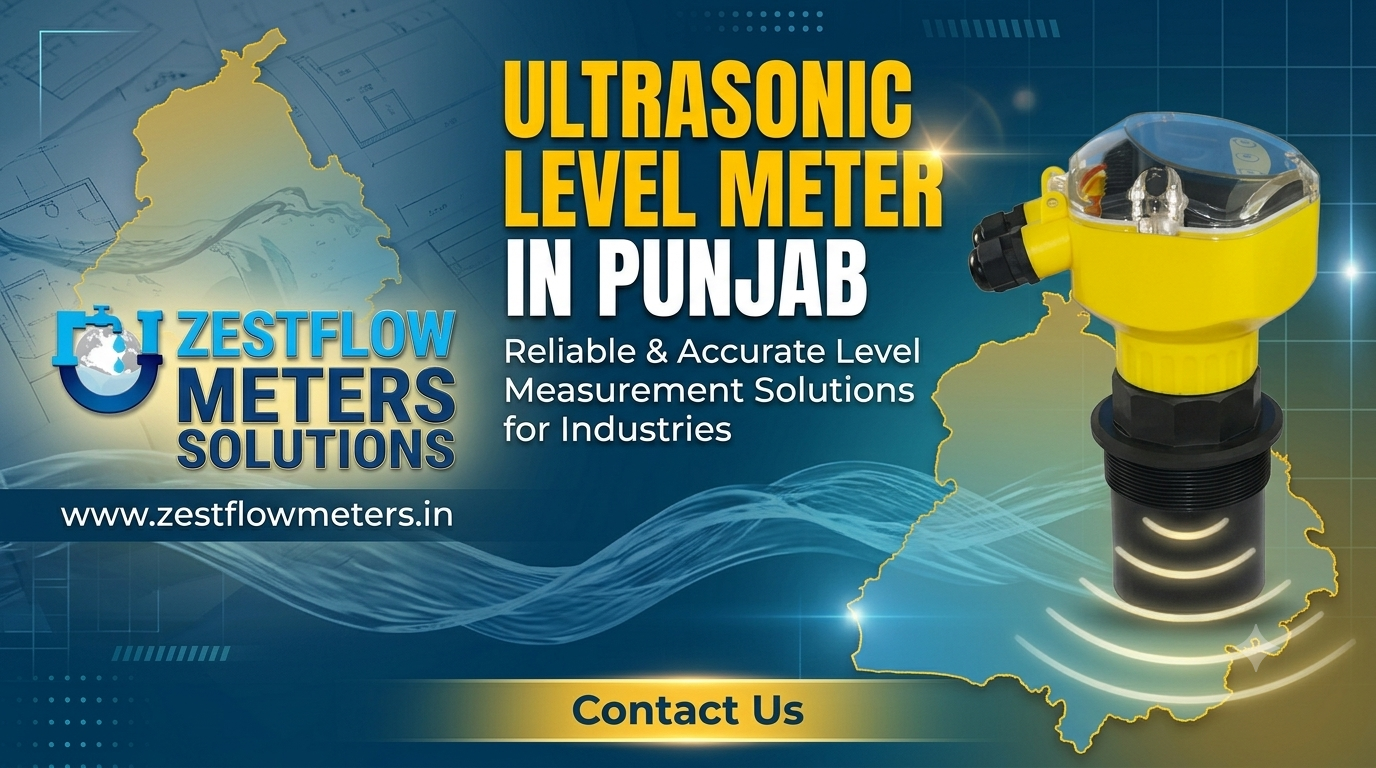
Ultrasonic Level Meter in Punjab: Accurate and Reliable Level Measurement Solutions
Accurate level measurement is essential for industries that handle water, chemicals, wastewater, fuels, and other liquids. Maintaining the correct liquid level helps businesses improve operational efficiency, prevent overflow, reduce material wastage, and maintain workplace safety. Modern industries are increasingly adopting automated measurement technologies to monitor tanks, reservoirs, and storage systems. One such advanced solution is an ultrasonic level meter.
If you are searching for an Ultrasonic Level Meter in Punjab, Zestflow Meters Solutions offers industrial measurement solutions designed to support accurate and efficient level monitoring requirements. Ultrasonic level measurement technology is widely used because it provides non-contact measurement, convenient installation, and reliable monitoring for various industrial applications.
Whether you operate a manufacturing facility, water treatment plant, chemical processing unit, or industrial storage system, choosing the right level measurement instrument can make a significant difference in your daily operations.
This blog explains how ultrasonic level meters work, their benefits, important features, industrial applications, and factors to consider when selecting a suitable instrument.
What Is an Ultrasonic Level Meter?
An ultrasonic level meter is an electronic instrument used to measure the level of liquids or certain bulk solids inside tanks, containers, reservoirs, and other storage structures. It works using ultrasonic sound waves to determine the distance between the sensor and the material surface.
Unlike conventional measurement instruments that require direct contact with the liquid, an ultrasonic level meter generally operates without touching the measured material. This makes it a useful option for applications involving corrosive liquids, wastewater, and other challenging industrial materials.
The instrument sends ultrasonic pulses towards the material surface. These sound waves reflect from the surface and return to the sensor. The device calculates the distance using the time taken by the sound waves to travel back.
Based on the measured distance and the configured tank dimensions, the instrument can calculate the liquid level and display the readings.
How Does an Ultrasonic Level Meter Work?
Understanding the working principle helps industries select the right instrument for their measurement requirements.
The operation of an ultrasonic level meter involves the following steps:
1. Ultrasonic Signal Transmission: The sensor generates high-frequency ultrasonic sound waves and directs them towards the surface of the liquid or material.
2. Signal Reflection: The sound waves travel through the air and reflect when they reach the material surface.
3. Echo Reception: The sensor receives the reflected ultrasonic signals.
4. Distance Calculation: The electronic unit calculates the distance by measuring the time between signal transmission and echo reception.
5. Level Measurement: The instrument uses the measured distance and tank dimensions to determine the material level.
6. Display and Output: The measured information is displayed locally or transmitted to compatible monitoring and control systems, depending on the instrument’s specifications.
This measurement method allows operators to monitor liquid levels without installing sensors directly inside the stored material.
Benefits of Using an Ultrasonic Level Meter
Ultrasonic level meters offer several advantages for industrial and commercial applications. Their non-contact measurement principle makes them suitable for different liquid storage and monitoring requirements.
1. Non-Contact Measurement
One of the biggest advantages is that the sensor does not need to come into direct contact with the liquid. This reduces exposure to corrosive, contaminated, or chemically aggressive materials and helps minimize sensor maintenance.
2. Accurate Level Monitoring
Ultrasonic technology provides continuous level measurement when the instrument is correctly selected, installed, and configured. It helps operators monitor tank levels and maintain better control over industrial processes.
3. Low Maintenance Requirements
Since the measuring sensor generally remains outside the stored liquid, there are fewer problems associated with direct contact, such as corrosion, contamination, and mechanical wear.
However, regular inspection and cleaning of the sensor face may still be necessary in dusty or humid environments.
4. Easy Installation
Ultrasonic level meters are commonly installed at the top of tanks or storage containers. Their installation does not generally require complicated mechanical arrangements inside the tank.
5. Continuous Monitoring
Many modern ultrasonic level meters support continuous measurement and electronic signal transmission. Depending on the model, readings can be connected to PLCs, SCADA systems, controllers, and industrial automation equipment.
6. Improved Operational Safety
Continuous level monitoring helps operators identify high or low liquid levels. When connected to suitable alarm and control systems, these instruments can support overflow prevention and improve operational safety.
7. Cost-Effective Measurement
Ultrasonic level meters can reduce maintenance requirements and simplify level monitoring. Their non-contact operating principle can also make them a practical option for applications where conventional contact-based instruments may experience excessive wear.
Applications of Ultrasonic Level Meters in Punjab
Punjab has a diverse industrial and agricultural environment. Industries, infrastructure projects, and water management facilities require dependable instruments for monitoring liquid levels.
An Ultrasonic Level Meter in Punjab can be considered for several applications, depending on the process conditions and measurement requirements.
1. Water Treatment Plants
Water treatment facilities require continuous monitoring of water levels in storage tanks, treatment chambers, and reservoirs.
Ultrasonic level meters help operators monitor water levels without placing measuring components directly inside the water. This supports better water management and process control.
2. Wastewater Treatment Plants
Wastewater treatment plants handle sewage, industrial wastewater, and other contaminated liquids. Non-contact level measurement can be useful in tanks and collection chambers where direct-contact sensors may require frequent maintenance.
The instrument’s suitability depends on foam, vapour, turbulence, and other surface conditions.
3. Chemical Processing Industries
Chemical industries use storage tanks for different types of liquids. An ultrasonic level meter can help monitor compatible chemical storage applications without direct contact with the liquid.
Before installation, users should check chemical vapour conditions, temperature, sensor compatibility, and the manufacturer’s operating specifications.
4. Agriculture and Irrigation
Agriculture is an important part of Punjab’s economy. Water storage tanks, irrigation reservoirs, and agricultural water distribution systems require proper monitoring.
Ultrasonic level measurement can help farmers and irrigation operators track available water levels and manage storage more efficiently.
5. Manufacturing Facilities
Manufacturing industries use tanks for water, process liquids, raw materials, and other production requirements.
Ultrasonic level meters can provide continuous readings that support production planning, inventory monitoring, and automated process control.
6. Pharmaceutical Industry
Pharmaceutical manufacturing requires controlled production environments and reliable monitoring systems.
Non-contact level measurement can be useful for suitable utility tanks and storage applications. However, hygienic design and process validation requirements should be evaluated before choosing an instrument for pharmaceutical production.
7. Food and Beverage Industry
Food and beverage manufacturers use storage tanks for water, ingredients, and process liquids.
An ultrasonic level meter can support liquid-level monitoring without placing the sensor inside the product. The installation must still meet the facility’s hygiene and process requirements.
8. Industrial Storage Tanks
Industries that store water, oils, compatible chemicals, and other liquids can use ultrasonic level meters to monitor tank levels.
Continuous measurement helps operators plan refilling activities and avoid unexpected shortages or overfilling.
Why Choose Zestflow Meters Solutions for Ultrasonic Level Measurement?
Selecting the right instrumentation partner is important for maintaining measurement accuracy and operational reliability.
Zestflow Meters Solutions provides industrial instrumentation and process measurement solutions for different industrial requirements. Its product portfolio includes level transmitters, flow meters, temperature sensors, pressure gauges, controllers, and data acquisition systems.
Businesses searching for an Ultrasonic Level Meter in Punjab can explore Zestflow’s level measurement solutions and discuss their specific application requirements.
Some important reasons to consider Zestflow Meters Solutions include:
Industrial Instrumentation Solutions: A range of instruments for process measurement and control.
Application-Based Selection: Support in identifying suitable measurement solutions according to operational requirements.
Quality Focus: Attention to product quality and measurement performance.
Multiple Industry Applications: Solutions for water management, wastewater treatment, manufacturing, and industrial processing.
Technical Assistance: Guidance regarding product selection, installation requirements, and instrumentation applications.
The company is based in Agra, Uttar Pradesh, and serves industrial instrumentation requirements. Customers in Punjab can contact the company to discuss product specifications, availability, and delivery arrangements.
Important Features to Check Before Buying an Ultrasonic Level Meter
Not every ultrasonic level meter is suitable for every application. Selecting an instrument based only on its price or measuring range can result in incorrect readings.
Consider the following technical factors before purchasing.
1. Measurement Range
Check the maximum and minimum measuring distance required for your tank or storage structure. Select an instrument with a suitable measurement range for the actual application.
2. Accuracy and Resolution
Accuracy determines how closely the instrument measures the actual level. Resolution indicates the smallest measurement change that can be displayed or detected.
Choose specifications according to your process requirements rather than assuming all ultrasonic meters offer identical performance.
3. Temperature Conditions
Temperature can affect ultrasonic sound propagation. Check the instrument’s operating temperature range and whether temperature compensation is available.
4. Sensor Protection Rating
Industrial environments may expose instruments to dust, moisture, and water splashes. Check the IP protection rating and select an enclosure suitable for the installation location.
5. Output and Communication
Depending on the application, useful output options may include:
4–20 mA analog output
RS485 communication
Modbus communication
Relay outputs
Digital display
PLC and SCADA connectivity
Always confirm compatibility with the existing control system.
6. Tank Design and Installation
Tank height, nozzle dimensions, mounting position, and internal obstructions can influence measurement performance.
The sensor should have a clear measurement path towards the liquid surface. Avoid placing it near filling streams, tank walls, internal pipes, or structures that may create unwanted echoes.
7. Surface Conditions
Foam, heavy vapour, turbulence, and irregular surfaces can interfere with ultrasonic signals.
For applications involving these conditions, consult an instrumentation specialist to determine whether ultrasonic measurement is appropriate or whether radar or another technology would be more suitable.
Industries in Punjab That Can Benefit from Ultrasonic Level Measurement
Punjab has several industrial sectors where automated level monitoring can support operational efficiency.
Some important sectors include:
Textile and garment manufacturing
Food processing and dairy plants
Pharmaceutical manufacturing
Chemical processing
Water and wastewater treatment
Agricultural infrastructure
Paper and packaging manufacturing
Industrial manufacturing facilities
Warehousing and liquid storage facilities
Industrial locations such as Ludhiana, Jalandhar, Amritsar, Mohali, Patiala, Bathinda, and Chandigarh have diverse commercial and industrial requirements. Businesses in these areas can evaluate ultrasonic level measurement according to their specific applications.
How to Select the Right Ultrasonic Level Meter for Your Business
Before purchasing an ultrasonic level meter, prepare the basic technical details of your application.
First, identify the material you want to measure, whether it is clean water, wastewater, an industrial liquid, or another compatible material.
Next, calculate the tank height and the required measurement range. Consider the minimum and maximum operating levels so that the selected instrument can cover the complete measuring area.
You should also identify the temperature, humidity, vapour, and environmental conditions around the installation point.
If the instrument will connect to an automated system, check the required communication protocol and output signals.
Finally, consult the manufacturer or technical supplier with these details. Proper product selection and installation can improve measurement reliability and help prevent unnecessary operating issues.
Importance of Automated Level Monitoring in Modern Industries
Industrial automation is becoming increasingly important for businesses that want to improve productivity and control operating costs.
Manual tank-level checking requires regular human involvement and may not provide continuous information. Automated level measurement helps operators receive readings without repeatedly checking tanks physically.
When integrated with suitable monitoring systems, an ultrasonic level meter can support:
Continuous liquid-level monitoring.
Better inventory management.
Automated pump operation.
High-level and low-level alerts.
Reduced manual inspection.
Improved process visibility.
Better water resource management.
These benefits make ultrasonic level measurement a useful part of modern industrial automation systems.
Get an Ultrasonic Level Meter in Punjab from Zestflow Meters Solutions
Finding the right measurement instrument requires more than selecting a product based on its name. Businesses should evaluate the application, measuring range, accuracy, installation requirements, output signals, and environmental conditions.
Zestflow Meters Solutions offers industrial instrumentation solutions for businesses looking to improve their process measurement and monitoring systems.
If you need an Ultrasonic Level Meter in Punjab for water tanks, industrial storage, wastewater facilities, or manufacturing operations, contact Zestflow Meters Solutions to discuss your requirements.
Visit the official website: https://zestflowmeters.in/
Share your tank dimensions, liquid type, required measuring range, and output requirements to help identify a suitable level measurement solution.
Frequently Asked Questions (FAQs)
1. What is an ultrasonic level meter?
An ultrasonic level meter is an electronic instrument that measures the level of liquids or suitable bulk materials using ultrasonic sound waves. It generally works without direct contact with the measured material.
2. Where can I find an Ultrasonic Level Meter in Punjab?
Businesses in Punjab can contact Zestflow Meters Solutions to discuss ultrasonic level measurement requirements, product specifications, availability, and delivery arrangements.
3. How does an ultrasonic level meter measure liquid levels?
It sends ultrasonic pulses towards the liquid surface and receives the reflected signals. The instrument calculates the distance using the signal travel time and determines the liquid level based on the tank dimensions.
4. Can ultrasonic level meters measure wastewater?
Yes, ultrasonic level meters can be used in suitable wastewater applications. However, foam, vapour, turbulence, and surface conditions should be considered before selecting the instrument.
5. Are ultrasonic level meters suitable for industrial tanks?
Yes. They are commonly considered for industrial water tanks, storage vessels, wastewater chambers, and other suitable applications. The measurement range and operating conditions must match the instrument specifications.
6. What are the main advantages of ultrasonic level meters?
Their main advantages include non-contact measurement, continuous monitoring, relatively simple installation, reduced exposure to corrosive liquids, and integration with suitable automation systems.
7. Can an ultrasonic level meter connect to a PLC or SCADA system?
Yes, models with compatible output and communication options can connect to PLC and SCADA systems. Common options include 4–20 mA and RS485, depending on the product configuration.
8. What factors affect ultrasonic level measurement accuracy?
Factors include temperature changes, foam, vapour, turbulence, tank obstructions, sensor positioning, and the reflective properties of the material surface.
9. Does an ultrasonic level meter require regular maintenance?
It generally requires less maintenance than many contact-based instruments. However, periodic inspection, sensor-face cleaning, and performance checks are recommended.
10. Why choose Zestflow Meters Solutions?
Zestflow Meters Solutions provides industrial process measurement and instrumentation solutions, including level transmitters and other instruments. Customers can contact the company for application guidance and product-related information.
Conclusion
Accurate liquid-level monitoring is important for maintaining efficiency, safety, and productivity across modern industries. Ultrasonic level meters provide a practical non-contact measurement solution for suitable applications involving water, wastewater, industrial liquids, and storage tanks.
Their ability to provide continuous readings, support automation, and reduce direct contact with stored materials makes them a valuable option for many industrial facilities.
For businesses searching for an Ultrasonic Level Meter in Punjab, Zestflow Meters Solutions offers industrial instrumentation solutions and technical assistance to help identify suitable measurement products.
Whether your requirement involves a water treatment plant, manufacturing facility, agricultural water storage system, or industrial tank, choosing the right level measurement instrument can help improve process monitoring and resource management.
Connect with Zestflow Meters Solutions to discuss your ultrasonic level measurement requirements and explore suitable industrial instrumentation options.