Water Resources Monitoring Instruments: Smart Solutions for Efficient Water & Irrigation Management
Introduction
Water is one of the most valuable natural resources, and effective monitoring is essential for sustainable water management. From groundwater and rivers to canals, reservoirs, and agricultural irrigation systems, accurate data helps organizations understand water availability, usage, quality, and movement.
Modern Water Resources Monitoring Instruments are designed to collect accurate information about parameters such as water level, flow rate, pressure, temperature, and water quality. These instruments support better planning, efficient resource utilization, early detection of abnormal conditions, and long-term water conservation.
Similarly, Irrigation Water Monitoring Instruments are increasingly important for agriculture and irrigation projects. Measuring the amount of water flowing through canals, pipelines, and irrigation networks allows users to improve distribution, reduce unnecessary water consumption, and make irrigation operations more efficient.
Zestflow Meters Solutions provides measurement and instrumentation solutions for applications requiring reliable monitoring of flow, level, and other process parameters. Its product portfolio includes flow meters, level transmitters, water meters, ultrasonic instruments, IoT-based flow meters, and data acquisition solutions.
What Are Water Resources Monitoring Instruments?
Water Resources Monitoring Instruments are specialized devices used to measure, record, and monitor different characteristics of water resources. Depending on the application, these instruments can monitor groundwater levels, surface-water levels, flow rates, pressure, and selected water-quality parameters.
Water-resource monitoring can be performed manually at periodic intervals or automatically through digital sensors, data loggers, telemetry systems, and IoT-based technologies.
For example, India’s groundwater monitoring infrastructure increasingly uses Digital Water Level Recorders with telemetry. According to the Ministry of Jal Shakti, around 22,000 DWLRs with telemetry had been installed under various government programs to transmit groundwater-level data to centralized servers in real time as of April 2026.
This demonstrates the growing importance of digital monitoring in water-resource management.
Why Water Resource Monitoring Is Important
Water monitoring provides reliable data that can support better decisions. Without accurate measurements, water management may depend on estimates or occasional observations.
Some major benefits include:
1. Accurate Water-Level Measurement
Water-level instruments help monitor changes in groundwater, reservoirs, tanks, rivers, and other water bodies. Continuous measurements can reveal seasonal variations, declining levels, or unusual changes.
2. Flow Measurement
Flow meters measure the quantity of water moving through pipelines, channels, and distribution systems. Accurate flow measurement can help organizations understand consumption and improve water allocation.
3. Better Groundwater Management
Groundwater is an important source for agriculture, industry, and domestic applications. Continuous monitoring helps identify changes in groundwater levels and supports more informed resource planning.
4. Improved Water Conservation
Accurate measurement makes it easier to identify excessive consumption, leakage, inefficient distribution, and other losses.
5. Data-Based Decision Making
Digital monitoring systems can collect information continuously and make historical data available for analysis. This can support water-resource planning and operational improvements.
Common Types of Water Resources Monitoring Instruments
Different applications require different instruments. Some of the commonly used solutions include:
- Digital Water Level Recorders
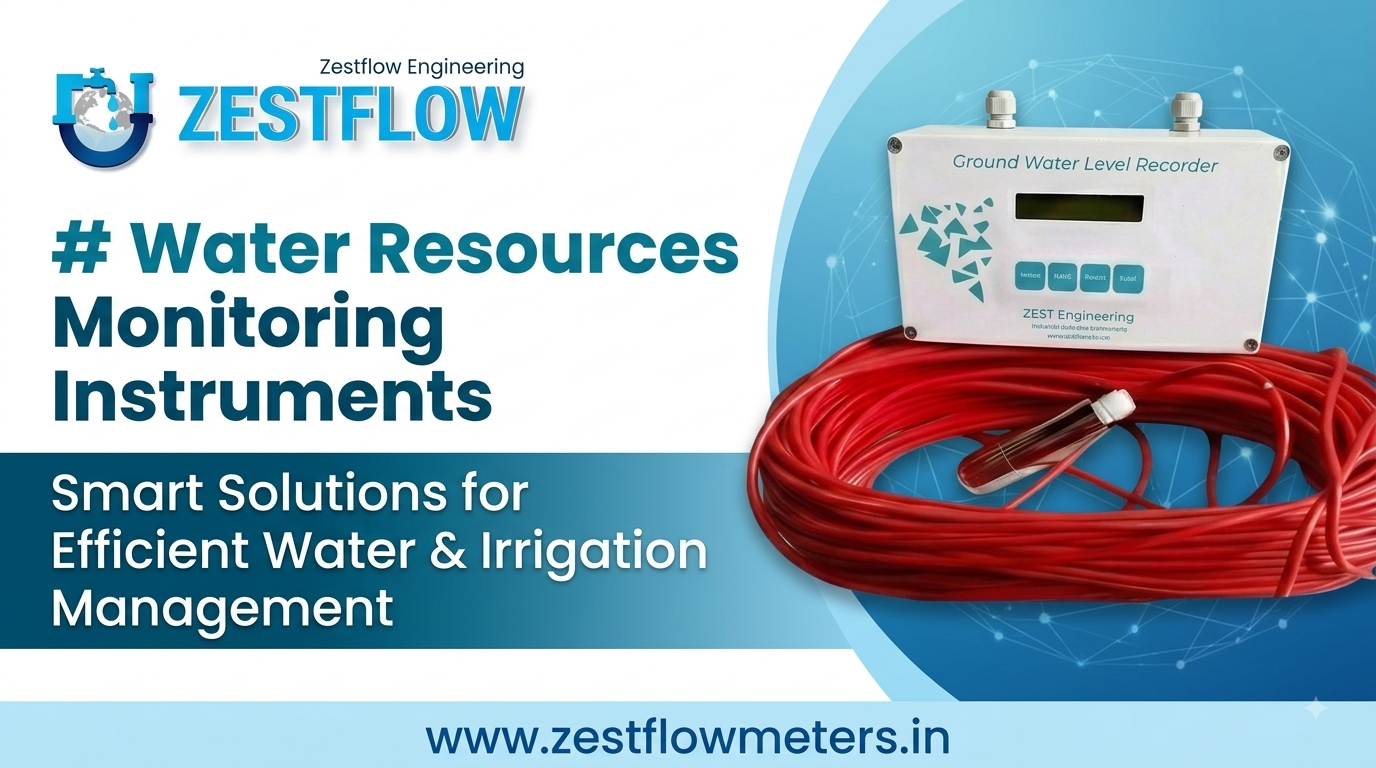
Digital Water Level Recorders measure water levels and can store readings at predefined intervals. Advanced models can be combined with telemetry systems for remote data transmission.
These instruments are useful for groundwater wells, borewells, reservoirs, canals, and other water-monitoring locations.
- Piezometers
Piezometers are used to measure groundwater pressure or hydraulic head. They are commonly associated with groundwater studies, construction projects, dams, embankments, and geotechnical monitoring.
- Electromagnetic Flow Meters
Electromagnetic flow meters are designed to measure the flow of conductive liquids. They can be useful in water-treatment plants, irrigation systems, industrial water lines, and water-distribution applications.
Zestflow’s product portfolio includes electromagnetic flow meters as part of its broader process-measurement solutions.
- Ultrasonic Water Level Meters
Ultrasonic level meters use non-contact measurement technology to determine the level of water. They can be useful where non-contact monitoring is preferred.
- Ultrasonic Flow Meters
Ultrasonic flow meters can measure liquid flow without requiring some of the installation arrangements associated with traditional inline meters. Portable and fixed configurations can be selected depending on project requirements.
- Water Meters
Water meters measure water consumption or flow through a particular pipeline or system. They are widely used in water distribution, irrigation, industrial applications, and utility management.
- IoT-Based Monitoring Systems
IoT-based monitoring systems connect sensors and instruments with digital communication platforms. This enables users to access measurements remotely and monitor changes without visiting every monitoring location.
What Are Irrigation Water Monitoring Instruments?
Irrigation Water Monitoring Instruments are measurement devices used to monitor water flow, water level, pressure, and other relevant parameters in irrigation systems.
Agriculture depends heavily on reliable water availability. However, inefficient distribution or excessive application can result in water wastage. Monitoring instruments help irrigation managers and agricultural users understand how much water is being supplied and where it is going.
Irrigation monitoring can be applied to:
- Irrigation canals
- Agricultural pipelines
- Borewell systems
- Pumping stations
- Reservoir outlets
- Water distribution networks
- Drip irrigation systems
- Sprinkler irrigation systems
- Farm water-storage systems
Accurate flow measurement is particularly important because water-management decisions become more reliable when actual flow data is available. A recent study on low-cost real-time irrigation-channel flow measurement also highlights the potential of digital measurement systems for improving irrigation efficiency.
Benefits of Irrigation Water Monitoring Instruments
- Efficient Water Distribution
Monitoring flow rates helps determine whether the required quantity of water is reaching different areas of an irrigation network.
- Reduced Water Wastage
When actual consumption and flow are measured, abnormal usage and unnecessary losses can be identified more easily.
- Better Pump Management
Flow and pressure information can help operators understand pump performance and identify unusual operating conditions.
- Improved Irrigation Planning
Historical water-flow data can help agricultural organizations plan irrigation schedules based on actual system performance.
- Remote Monitoring
IoT and telemetry-enabled instruments can transmit data remotely, reducing the need for frequent physical inspections.
- Better Resource Management
Reliable measurement supports more efficient allocation of available water resources across agricultural and irrigation projects.
Applications of Water Resources Monitoring Instruments
- Groundwater Monitoring
Groundwater monitoring systems can measure changes in water levels and support groundwater assessment.
- River Monitoring
Water-level and flow measurements can help monitor river conditions and understand changes over time.
- Canal Monitoring
Canal systems require accurate measurement to support efficient water distribution between different locations.
- Reservoir Monitoring
Monitoring reservoir levels and inflows/outflows helps operators understand available storage and water movement.
- Industrial Water Management
Industries can use flow meters, water meters, level instruments, and data acquisition systems to monitor water consumption and process-water movement.
- Water Treatment Plants
Flow and level monitoring are important for controlling different stages of water-treatment operations.
- Agricultural Irrigation
Irrigation systems can use flow and level measurement to improve water distribution and reduce unnecessary consumption.
How to Choose the Right Monitoring Instrument
Selecting the correct Water Resources Monitoring Instruments depends on several factors.
1. Identify the Parameter
First determine whether you need to measure flow, level, pressure, temperature, or water quality.
2. Understand the Installation Environment
Consider whether the instrument will be installed in a borewell, open channel, pipeline, reservoir, tank, or industrial environment.
3. Check the Measurement Range
The instrument should have a suitable measurement range for the expected water level or flow rate.
4. Consider Data-Logging Requirements
For long-term monitoring, data logging can be important because it allows users to store measurements and analyze historical trends.
5. Consider Remote Communication
For geographically distributed monitoring stations, telemetry, cellular communication, IoT, or other remote-data technologies can reduce manual visits.
6. Evaluate Accuracy and Reliability
The instrument should be selected according to the required accuracy, environmental conditions, installation method, and project specifications.
7. Consider Calibration and Maintenance
Regular calibration and appropriate maintenance can help maintain measurement reliability over the operating life of the equipment.
Role of Digital and IoT Technology in Water Monitoring
Traditional water monitoring often requires personnel to visit a location and record measurements manually. Digital technology has changed this approach.
Modern monitoring systems can combine:
- Sensors
- Data loggers
- Telemetry
- IoT connectivity
- Cloud platforms
- Remote dashboards
- Automated alerts
- Historical data analysis
This approach can provide near-real-time visibility into water conditions.
The Government of India has increasingly adopted digital groundwater monitoring technologies, including telemetry-enabled Digital Water Level Recorders.
For large irrigation networks and water-resource projects, remote monitoring can be particularly useful because monitoring locations may be distributed across large geographical areas.
Why Choose Zestflow Meters Solutions?
Zestflow Meters Solutions focuses on measurement and instrumentation solutions for applications involving flow, level, and other process parameters. Its portfolio includes electromagnetic flow meters, AMR water meters, IoT-based flow meters, turbine flow meters, ultrasonic flow meters, ultrasonic level meters, and related instrumentation.
The company also highlights customized solutions based on different flow ranges, sizes, materials, configurations, and application requirements.
For organizations looking for Water Resources Monitoring Instruments or Irrigation Water Monitoring Instruments, choosing equipment according to the application is essential. Zestflow can help users identify suitable measurement technologies for different water-monitoring requirements.
Future of Water Monitoring
The future of water management is moving toward connected and data-driven monitoring. As water demand increases and resources face greater pressure, organizations need better information about where water is available, how much is being used, and how systems are performing.
IoT-based sensors, telemetry-enabled recorders, digital flow meters, cloud-based platforms, and automated data collection can make monitoring faster and more accessible.
The objective is not simply to collect more data. The real value comes from converting accurate measurements into useful decisions that improve efficiency, conservation, planning, and operational performance.
Conclusion
Efficient water management depends on accurate and reliable measurement. Water Resources Monitoring Instruments provide essential information about water levels, flow, pressure, and other parameters, helping organizations make informed decisions about valuable water resources.
At the same time, Irrigation Water Monitoring Instruments can help agricultural and irrigation projects measure water distribution more effectively, reduce unnecessary losses, and improve operational planning.
With the increasing adoption of digital recorders, telemetry, IoT connectivity, and remote monitoring, water-resource management is becoming more data-driven. Organizations can benefit from selecting monitoring solutions that match their specific application, environmental conditions, measurement requirements, and communication needs.
Zestflow Meters Solutions offers a range of flow, level, and instrumentation technologies designed for diverse measurement applications. For projects requiring reliable water-flow and level monitoring, selecting the right instrument is an important step toward more efficient and sustainable water management.
Choose the right measurement technology, monitor continuously, and make every drop count with smarter water management solutions from Zestflow Meters Solutions.