
ZESTFLOW Groundwater Monitoring Solutions: Smart & Reliable Groundwater Monitoring
Introduction
Groundwater is one of the most important natural resources for agriculture, industries, construction projects, infrastructure development, municipalities, and domestic water supply. However, groundwater levels can change because of rainfall, seasonal conditions, pumping, industrial consumption, irrigation, and changes in land use. For this reason, regular and reliable groundwater monitoring is essential for understanding groundwater behavior and supporting responsible water management.
Traditional groundwater measurement methods may require personnel to visit wells or borewells regularly and record water levels manually. Modern monitoring technologies make it possible to collect measurements more consistently and, where telemetry is available, transmit data remotely. Zestflow Meters Solutions offers groundwater monitoring products designed around this need, including digital groundwater level recorders and borewell water-level monitoring systems.
ZESTFLOW Groundwater Monitoring Solutions are designed to help organizations monitor groundwater levels with practical instrumentation, data logging, and remote-monitoring capabilities. These solutions can be useful for projects where accurate historical groundwater data is needed for analysis, planning, reporting, and resource management.
What Are ZESTFLOW Groundwater Monitoring Solutions?
ZESTFLOW Groundwater Monitoring Solutions refer to groundwater measurement and monitoring systems offered by Zestflow Meters Solutions for observing and recording water-level conditions in wells, borewells, and groundwater observation locations.
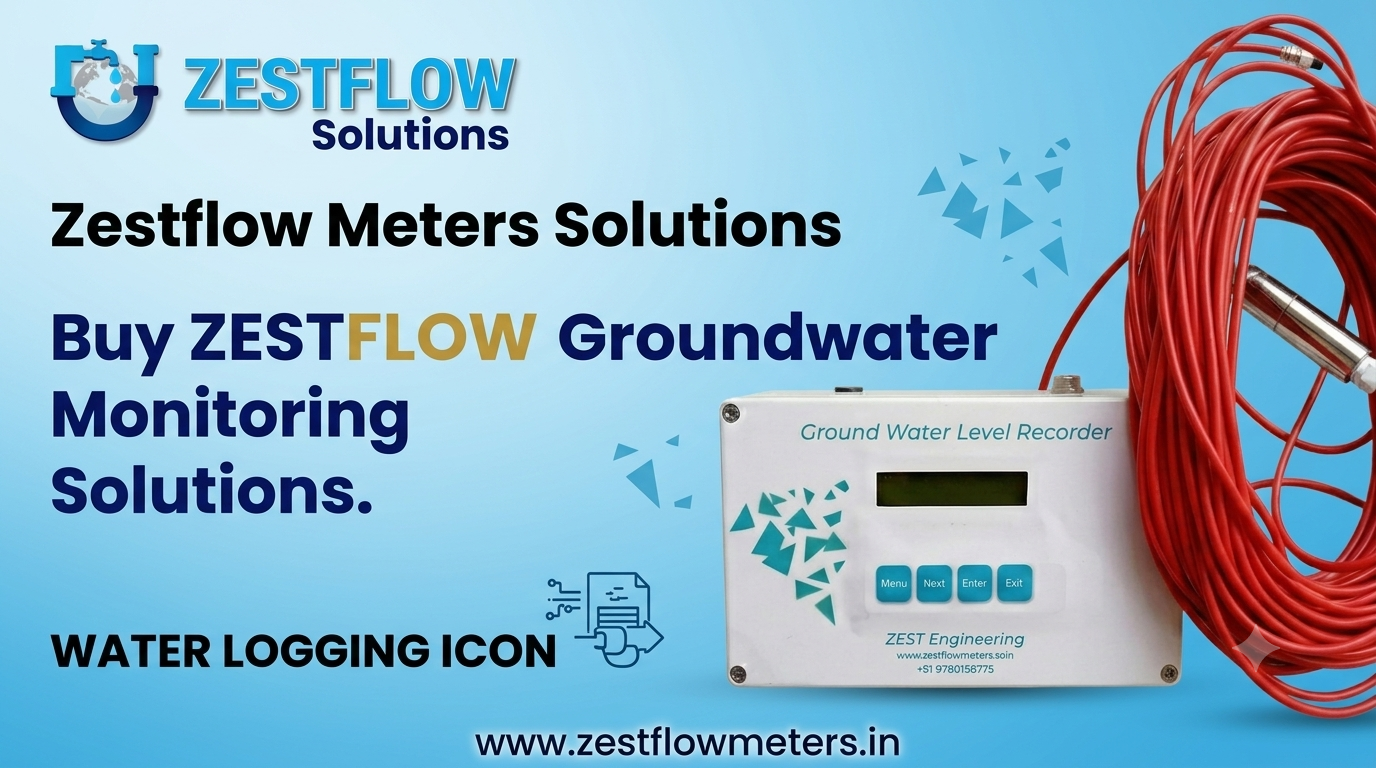
A digital groundwater level recorder can use a submersible pressure transducer to sense changes in water pressure. The measured pressure information can then be converted into water-level information and stored by a data logger. Zestflow’s published information describes its digital groundwater level recorder as a data logger and submersible pressure-transducer combination intended for remote monitoring and recording of water-level or pore-pressure data.
For applications requiring remote access, groundwater monitoring equipment can also be combined with telemetry. Zestflow describes groundwater survey equipment that can include telemetry systems, observation-well monitoring units, and digital water-level indicators, with telemetry options designed for automatic data transmission and remote access.
Why Groundwater Monitoring Is Important
Groundwater monitoring provides valuable information about how water resources change over time. A single water-level reading can provide useful information, but a series of measurements can reveal trends, seasonal changes, responses to pumping, and other variations.
Regular monitoring can help organizations:
- Track groundwater-level changes.
- Understand seasonal groundwater fluctuations.
- Monitor borewell and observation-well conditions.
- Collect historical groundwater data.
- Support groundwater-resource assessment.
- Evaluate the effect of pumping and extraction.
- Improve water-management planning.
- Reduce dependence on manual observations.
- Support remote monitoring requirements.
- Identify unusual changes that may require investigation.
Continuous or frequent groundwater monitoring can be especially useful when the objective is to understand changes over time rather than simply obtain occasional measurements. Modern groundwater monitoring systems commonly combine sensors, data loggers, telemetry, and software or cloud platforms for data access.
How Does a Groundwater Monitoring System Work?
A typical digital groundwater monitoring system consists of several important components.
1. Submersible Water-Level Sensor
The sensor is installed inside a well or borewell at a suitable depth. A pressure-based sensor detects the pressure associated with the water column. Changes in pressure can be used to determine changes in water level.
2. Data Logger
The data logger receives readings from the sensor and records measurements at configured intervals. Instead of relying only on manual readings, the logger can build a historical record of groundwater-level conditions.
3. Telemetry System
Where remote monitoring is required, telemetry can transmit recorded information from the monitoring location to a remote platform. Zestflow’s groundwater survey equipment information highlights automatic data transmission and remote access as features of telemetry-enabled groundwater monitoring.
4. Data Storage and Monitoring Platform
Collected data can be stored for analysis and reporting. Depending on the system configuration, users may be able to access groundwater information through a computer, web interface, mobile application, or other monitoring platform.
5. Power Supply
The monitoring unit requires an appropriate power source. Remote installations may require battery-powered or solar-supported arrangements depending on the project requirements and site conditions.
Key Features of ZESTFLOW Groundwater Monitoring Solutions
The exact configuration should be selected according to the application, installation depth, measurement range, communication requirements, and environmental conditions. However, a modern groundwater monitoring solution can provide several useful capabilities.
- Accurate Water-Level Measurement
Reliable measurement is fundamental to groundwater monitoring. A suitable pressure-based measurement system can continuously monitor changes in water pressure and convert those changes into water-level information. Zestflow’s digital groundwater level recorder uses a submersible pressure-transducer approach for this purpose.
- Data Logging
Data logging allows measurements to be stored over time. Historical data can help users identify patterns that may not be visible from occasional manual readings.
- Remote Monitoring
Telemetry-enabled systems can reduce the need for frequent physical visits to monitoring sites. Zestflow describes telemetry systems capable of automatically transmitting groundwater data and enabling remote access.
- Continuous Monitoring
Continuous or scheduled monitoring provides a more detailed understanding of groundwater behavior. It can be particularly useful for projects where groundwater conditions need to be observed throughout different seasons or operational conditions.
- Data-Based Decision Making
Groundwater data can support decisions related to water extraction, resource planning, environmental assessment, construction monitoring, and infrastructure management.
Applications of Groundwater Monitoring Systems
ZESTFLOW Groundwater Monitoring Solutions can be considered for a variety of applications where water-level information is important.
- Agriculture and Irrigation
Agricultural operations depend heavily on groundwater in many regions. Monitoring borewell water levels can help users understand changes in groundwater availability and make more informed decisions regarding irrigation and water use.
- Industrial Water Management
Factories and industrial facilities may use groundwater for processing, cooling, cleaning, or other operational requirements. Monitoring water levels can provide useful information for managing groundwater extraction and planning.
- Construction Projects
Construction activities can affect or be affected by groundwater conditions. Groundwater monitoring may be used around excavation areas, foundations, tunnels, infrastructure projects, and other sites where changes in groundwater levels or pore pressure need to be observed.
- Groundwater Resource Studies
Hydrologists, consultants, researchers, and environmental professionals may require long-term groundwater-level data for aquifer studies and resource assessment.
- Borewell Monitoring
Borewell water-level monitoring systems can continuously measure water levels inside borewells and provide data that can be used for groundwater-management decisions. Zestflow specifically presents a borewell water-level monitoring system for continuous groundwater-level measurement.
- Environmental Monitoring
Groundwater monitoring can form part of environmental assessment and long-term observation programs. Continuous groundwater monitoring is used in applications such as aquifer characterization, baseline monitoring, and environmental investigations.
ZESTFLOW Groundwater Monitoring Solutions vs. Manual Monitoring
Manual measurement can be useful for basic groundwater observations, especially when monitoring requirements are limited. However, manual monitoring requires personnel to visit the site and take measurements according to a schedule.
A digital groundwater monitoring system can automate the collection and storage of readings. When telemetry is included, data can also be transmitted remotely.
1. Manual Monitoring
- Requires regular site visits.
- Measurements may be taken at relatively long intervals.
- Requires manual record keeping.
- May require more field labor.
- May provide limited visibility between site visits.
2. Digital Monitoring
- Automated measurement.
- Scheduled data recording.
- Digital historical records.
- Reduced dependence on manual observations.
- Remote data transmission can be added.
- Easier analysis of groundwater trends.
The most appropriate method depends on project objectives, budget, site conditions, required measurement frequency, and reporting requirements.
Benefits of Using ZESTFLOW Groundwater Monitoring Solutions
Choosing a suitable groundwater monitoring system can provide both operational and analytical benefits.
- Better Groundwater Visibility
Regular measurements provide a clearer picture of groundwater behavior.
- Reduced Manual Work
Automated data collection can reduce the number of routine site visits required for measurement.
- Historical Data Availability
Stored readings can help users compare groundwater conditions across days, months, seasons, or operational periods.
- Remote Access
Telemetry-based monitoring can make groundwater data available without requiring personnel to travel to every monitoring location.
- Improved Planning
Reliable groundwater data can support better decisions related to water use, extraction, infrastructure, and resource management.
- Early Identification of Changes
Frequent monitoring can make it easier to identify unusual water-level changes that may require further investigation.
How to Select the Right Groundwater Monitoring System
Before purchasing a groundwater monitoring solution, users should evaluate several technical and operational factors.
- Measurement Depth
Determine the maximum depth from which the water level needs to be measured. The sensor range should be appropriate for the installation.
- Required Accuracy
Select equipment based on the measurement accuracy required by the project.
- Monitoring Frequency
Decide whether measurements are required hourly, daily, at specific intervals, or continuously.
- Data Storage
Consider how much historical data needs to be stored and how the data will be retrieved.
- Telemetry Requirements
If the monitoring location is remote, consider whether GSM, cellular, IoT, or another communication method is suitable.
- Power Availability
Check whether grid electricity is available or whether battery or solar power is necessary.
- Environmental Conditions
The sensor and enclosure should be appropriate for the groundwater, well, temperature, humidity, and installation environment.
- Installation and Support
Choose a supplier that can provide appropriate guidance for installation, configuration, commissioning, and maintenance.
Why Choose Zestflow Meters Solutions?
Zestflow Meters Solutions operates in the field of flow measurement, water measurement, water-level monitoring, and analytical instruments. Its website lists products including water level recorders, electromagnetic flow meters, AMR water meters, ultrasonic flow meters, and analytical instruments.
For groundwater applications, Zestflow provides digital groundwater-level recording and borewell monitoring solutions. Its published product information describes the digital groundwater level recorder as a combination of a data logger and submersible pressure transducer for monitoring and recording water-level or pore-pressure data.
This makes Zestflow a relevant supplier to consider when a project requires groundwater-level measurement equipment, digital recording, or telemetry-enabled monitoring.
Maintenance Tips for Groundwater Monitoring Equipment
Proper maintenance helps maintain reliable monitoring performance.
1. Inspect cables and connectors periodically.
2. Keep external enclosures protected from moisture and physical damage.
3. Check sensor installation depth and positioning.
4. Verify the data logger configuration.
5. Review recorded data regularly for unusual readings.
6. Check the communication system where telemetry is installed.
7. Maintain the power supply or battery system.
8. Follow the manufacturer’s calibration and maintenance recommendations.
9. Keep installation and maintenance records.
10. Investigate unexpected changes instead of assuming they are measurement errors.
Future of Smart Groundwater Monitoring
The future of groundwater management is increasingly connected with digital measurement, remote communication, automation, and data analysis. Instead of collecting occasional readings, organizations can use monitoring systems to build detailed datasets and understand how groundwater responds to rainfall, extraction, seasonal variation, and other factors.
Telemetry and cloud-based systems can further simplify access to information from geographically distributed monitoring locations. Modern groundwater monitoring platforms commonly combine data loggers, telemetry, and digital data-management systems for remote monitoring.
As water-management requirements become more data-driven, digital groundwater monitoring can play an increasingly important role in supporting efficient and sustainable resource management.
Conclusion
Groundwater is a valuable resource, and accurate monitoring is an important part of responsible groundwater management. Whether the requirement is for borewell monitoring, construction-site observation, agricultural water management, industrial applications, environmental studies, or long-term groundwater assessment, digital monitoring can provide more consistent and useful information than occasional manual observations.
ZESTFLOW Groundwater Monitoring Solutions provide a practical approach to digital groundwater-level measurement, data logging, and remote monitoring. Zestflow Meters Solutions offers groundwater-related products including digital groundwater level recorders and borewell water-level monitoring systems, with telemetry options available for remote data transmission in suitable configurations.
By selecting the right sensor, logger, communication method, and installation configuration, organizations can create a dependable groundwater monitoring program and use historical data to make better-informed water-management decisions.